
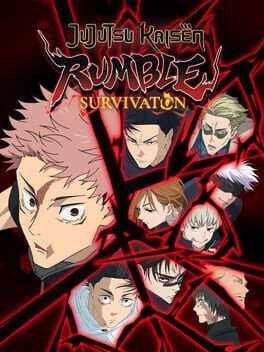

Poncle is turning its breakout horde-survival hit into an 8‑player, anime-fueled battle royale. Here is how Jujutsu Kaisen Rumble: Survivaton adapts the Vampire Survivors formula, why its multiplayer focus matters, and whether it can hook players who do not watch the anime.
Jujutsu Kaisen Rumble: Survivaton Is Vampire Survivors’ Wildest Evolution Yet
Poncle is taking the elegantly simple Vampire Survivors formula and throwing it into a cursed blender with Jujutsu Kaisen, online multiplayer and battle royale rules. The result, Jujutsu Kaisen Rumble: Survivaton, is not just another anime tie-in or a reskin of a popular indie. It looks like the studio’s first big attempt to bend its survivor-style design into a competitive, character-driven format that could matter well beyond the show’s fanbase.
From horde survival to survivors royale
At its core, Rumble: Survivaton still follows the same basic loop that made Vampire Survivors explode. Your attacks trigger automatically, so you are not juggling combos or precise inputs. Skill expression comes from how you move, where you position yourself and which upgrades you draft as the screen fills with enemies.
The twist is that you are no longer alone with the horde. Up to eight players share the same stage, all mowing down cursed spirits for points and power. Instead of a purely personal survival challenge, every decision now has a competitive context. Do you chase dense enemy packs to level faster and risk getting boxed in, or play safer and fall behind in score and power? The familiar hypnotic flow of a survivors run is still there, but layered with constant awareness of rival players who are growing stronger right alongside you.
This shift turns the genre’s usual endurance vibe into something closer to a match-based sport. A run has a clear arc, with an opening scramble for early levels, a midgame where builds come online and the late match where a handful of supercharged sorcerers dominate the map.
Rule Additions and the new battle royale tension
Rumble: Survivaton borrows the broad shape of a battle royale without simply copying shrinking circles and loot drops. Players earn points by defeating cursed spirits and hitting key milestones. The magic number is 100 points, which lets you trigger a Rule Addition, a mechanic that essentially rewrites the match for everyone.
Rule Additions let the leading players meddle with the battlefield in ways that go far beyond a simple power boost. Based on early descriptions, they can disrupt rival plans, tilt the flow of enemies or introduce hazards that favor particular builds. In Vampire Survivors, your power curve is personal and mostly predictable once you know the item pool. Here, the lead player can suddenly change the operating conditions for the entire lobby.
This creates a kind of soft battle royale pressure. You are not getting forced toward a final circle, but you are racing against other sorcerers who are on the verge of rewriting the rules in their favor. The moment someone hits that 100 point threshold should feel like a match-wide alarm, especially if they are already snowballing.
Then there is the finale. Instead of the usual thirty minute survive or die timer, the match climaxes with a one versus one duel between the top two players. That structure is surprisingly elegant for this genre. The bulk of the match still rewards classic survivors strengths like crowd control and build optimization, but victory is settled in a focused showdown that highlights individual characters and skill expression. It is the last-circle showdown idea, translated into a survivors context.
Turning Jujutsu Kaisen’s chaos into mechanics
The Jujutsu Kaisen license is doing more than supplying recognizable faces and theme music. Poncle is drawing from the anime’s distinct power system to explain and justify its expanded mechanics.
More than twenty characters from the series are planned for launch, each with their own cursed techniques, special moves and growth paths. During a match you level up, draft skills and stack upgrades like a traditional survivors run, but because you do it on a fixed character chassis, your decisions feel more like building a bespoke loadout than assembling a random grab bag of items.
Signature abilities from the show are woven into the high points of a match. Over time you build gauges that unlock techniques like Black Flash and Domain Expansion. In the anime, those are cinematic finishers that warp reality. In Rumble: Survivaton they are match-altering power plays that can shred the horde and also catch rival sorcerers in the blast. A well timed Domain Expansion during the final duel could be the equivalent of a fighting game super, but dropped into the survivors framework of moving around dense enemy swarms.
Because the game is centered on multiplayer, these flashy moves serve a dual purpose. They respect the source material with big, faithful animations while also acting as clear visual tells for other players. The spectacle becomes informing, not just distracting, letting even non fans quickly read what is dangerous on screen.
Why multiplayer is the real experiment
Of all the changes Rumble: Survivaton brings, the shift to eight player online play might be the boldest for Poncle. Vampire Survivors is solitary, almost meditative. You sink into a flow state, chase achievements and chase that perfect build. Rumble: Survivaton rebuilds that loop around competitive tension and social friction.
A shared map full of enemies turns basic crowd control choices into dynamic interactions. Wiping a cluster of cursed spirits might not just improve your own position, it might deny a rival the experience they need to reach a crucial power spike. Positioning ceases to be only about survival and becomes a way to gatekeep resources, body block opponents or bait them into risky parts of the map.
The promise of a one versus one finale also encourages informal rivalries during the early and midgame. Spot someone with a strong lead and you might start shadowing them, hoping to siphon their enemy density or force them into tougher patterns. Even without direct PvP attacks, the simple act of sharing a battlefield creates constant micro conflicts.
This is where Poncle’s minimalist input philosophy becomes so important. Because attacks are automated, the barrier to entry for online play remains low. Players who might usually avoid competitive action games can still participate, since success is primarily about route planning, build choices and situational awareness instead of twitch reflexes. That opens the door for a wider audience than a traditional arena fighter or battle royale shooter.
Appealing to players who have never watched Jujutsu Kaisen
Anime branding can be a double edged sword. It guarantees an initial wave of interest from existing fans, but it can also make the game look closed off to everyone else. Rumble: Survivaton has a few structural advantages that should help it break out of that bubble.
First, the core loop is already proven. Vampire Survivors showed that a top down auto attacker with clever build design can hook people who normally bounce off action games. As long as Poncle preserves that satisfying power curve and screen filling chaos, the anime layer becomes flavor rather than a requirement. You do not need to recognize a technique name to enjoy watching it obliterate an entire wave of enemies.
Second, the character led structure may end up acting more like a hero shooter or MOBA than a lore test. Players can simply pick the character whose moveset or silhouette seems appealing and learn their kit through play. If the roster is well balanced and visually readable, the fact that these are preexisting anime icons will feel like a bonus instead of homework.
Third, the match format is instantly understandable even for genre outsiders. Eight players enter, everyone farms power among swarms of enemies, a few surge ahead on the scoreboard and the top two settle things in a duel. It mixes elements of battle royale, survival and fighting games into something that can be explained in a sentence without needing to mention a single story beat from the manga.
Finally, Poncle’s track record with post launch support could matter more than the license. Vampire Survivors evolved dramatically after release through discounts, ports and free or cheap DLC that kept the game in the conversation. If Rumble: Survivaton receives a similar cadence of updates, balancing passes and new characters, it can cultivate a dedicated players first community that exists alongside the anime fandom.
A crucial test for the survivors genre
Jujutsu Kaisen Rumble: Survivaton is more than a clever crossover. It is one of the first big attempts to see if the survivors template can support long term, competitive multiplayer. If Poncle can pull off stable online play, readable chaos and satisfying build diversity in matches with eight players and a constant stream of enemies, it will prove that this genre can do more than single player score chasing.
Licensed games have burned players before, and there are plenty of ways this could go wrong. Balance will be delicate, connective tissue between the early farming phase and the final duel needs to feel fair and matchmaking will have to handle a wide range of skill levels. But the concept is strong, and it smartly leans into what both sides of the collaboration do best. Jujutsu Kaisen provides high impact powers and striking characters, while Poncle supplies a design framework that turns escalating chaos into a satisfying curve.
If all the pieces land, Rumble: Survivaton could end up being the entry point for people who never touched Vampire Survivors and never watched Jujutsu Kaisen, but just want a quick, replayable online game where eight sorcerers sprint through a cursed city, build absurdly broken kits and scrap for a final duel under the glow of a Domain Expansion.