
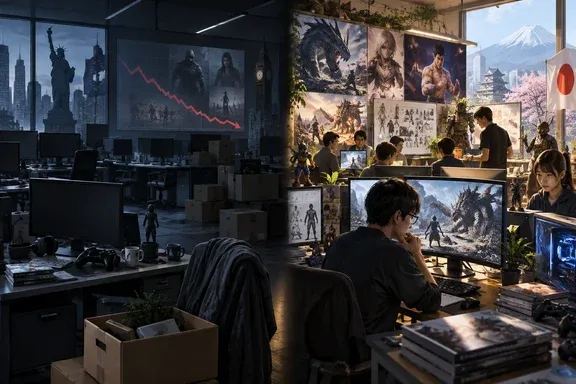

Amir Satvat’s 97 percent retention claim points to a different operating model in Japan, built around leaner teams, lower executive pay, and less exposure to live-service overexpansion.
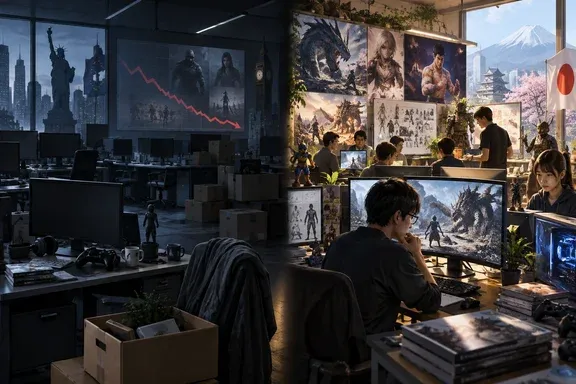
Image: windowsforum.com
The 97 percent figure cuts through the layoff narrative
Amir Satvat, who has run the ASGC Games Industry Layoffs Tracker since 2022, told Edge magazine that Nintendo, Capcom, and Konami have staff retention of “97 percent plus,” according to Eurogamer, Kotaku, GamesRadar, and Notebookcheck reports on the interview. That number lands hard because the wider video game industry layoffs story has been defined by mass cuts across North America and Europe, not by stability.
Eurogamer reports that Satvat’s tracker counted 57,628 jobs lost across the industry from 2022 through 2026. The same reporting says 96 percent of jobs lost in 2026 were in North America and Europe. Notebookcheck, citing the tracker, says North America accounted for 66 percent of this year’s layoff events and 79 percent of affected workers, with North America and Europe together making up 96 percent of recorded layoffs in 2026.
The tension is clear: the industry can be in a severe employment downturn while major Japanese game studios appear comparatively stable. Satvat’s explanation is not that Japan has solved every structural problem. Eurogamer quotes him saying Japan is “a completely different ballgame,” while also stressing that the region is not “a utopia.” The useful question is narrower and more strategic: which operating choices reduced exposure to the worst parts of the crash?
Lean teams changed the risk profile before the downturn hit
Satvat’s central claim is that Japanese publishers such as Nintendo, Capcom, and Konami entered the downturn with a different cost base. Eurogamer quotes him saying Japanese teams “tend to be much smaller and leaner” and did not embrace “mega-blockbusters with 500-person teams” to the same degree. That is an interpretation from an industry tracker, not a company statement from Nintendo, Capcom, or Konami, but it matches the pattern he identifies in the layoff data.
In strategy terms, staff retention is partly decided long before revenue softens. A studio that scales a project around hundreds of permanent workers, live operations infrastructure, and years of post-launch content commitments has fewer clean options if demand misses forecasts. If that company then has to reassure investors, reset spending, or cancel a project, headcount becomes the balance lever.
The Japanese model Satvat describes is closer to controlled scope management. Smaller teams can still make expensive games, and Japan’s largest publishers are not small businesses. But a leaner baseline reduces the penalty for a single miss. It also limits the temptation to staff up around every market signal. In a boom, that can make a company look conservative. In a contraction, the same discipline can look like foresight.
This is where the Japan game development retention story becomes more than a cultural comparison. The reported 97 percent retention figure is a sign of lower organizational volatility. It does not prove every Japanese publisher is healthy, but it suggests their project economics have left less excess headcount to unwind.
Executive pay is part of the staffing equation
Satvat also points to executive compensation as one reason Japanese studios have avoided the sharpest layoff pattern. Eurogamer quotes him saying Japanese executives “still make great money,” typically “two or three million dollars,” rather than “30 million.” Notebookcheck contrasts Nintendo president Shuntaro Furukawa’s reported total compensation of about $2 million with EA CEO Andrew Wilson’s reported $38,649,984 for the last fiscal year, which Notebookcheck says was about 305 times EA’s median employee pay.
Eurogamer separately notes that EA’s Andrew Wilson was awarded $38.6 million last year and that Take-Two’s Strauss Zelnick earned $42.1 million in 2022. Both EA and Take-Two have had layoffs in the period covered by the reporting. That does not establish a simple one-to-one trade, where lower executive pay automatically saves a certain number of jobs. Public compensation packages, severance decisions, project cancellations, and studio staffing budgets come from different parts of corporate governance.
Still, pay architecture sends a signal about priorities. When executive rewards expand while layoffs proceed, the workforce sees a company willing to protect leadership upside before employment stability. Satvat’s comparison suggests Japanese publishers may have less pressure from the top of the compensation stack. That does not make those companies benevolent by default, but it gives them a lower fixed prestige cost and a different internal narrative when markets tighten.
For readers tracking Japanese game studios layoffs, the pay gap is important because it reframes the debate away from talent quality or audience taste. It points to capital allocation. Companies choose whether to spend the boom years on executive packages, permanent headcount growth, or controlled production capacity. Those choices shape the cuts that follow.
Avoiding the live-service rush may have prevented a scope trap
The sharpest strategic contrast in Satvat’s comments is live service. Eurogamer quotes him saying Japanese teams did not get “swept up in the live-service trend.” Notebookcheck similarly reports that he credits Japanese publishers’ resilience partly to avoiding the idea that a successful game needs a 500-person team. This is not a claim that Japanese companies never make online or service-driven games. It is a claim about relative exposure to a costly industry fashion.
Live service can be powerful when it works, but the model changes the studio economy. It encourages long pre-launch development, ongoing content obligations, backend infrastructure, marketing endurance, community support, and a staff plan built around persistence rather than release-and-recover cycles. When every publisher chases that same prize, the market cannot give all of them Fortnite-scale retention. The result is a crowded field where many teams are built for a revenue curve only a few games achieve.
The layoff stories cited by Eurogamer show how broad the pressure has become, with cuts reported at Xbox, Bungie, EA, PUBG Productions, Take-Two, Warner Bros., and Epic. Eurogamer reports that Microsoft’s Xbox changes included 3,200 layoffs and four studio departures. Kotaku separately references 1,600 Xbox job losses in July with another 1,600 planned within a year of those. Those figures reflect different reporting frames around the same broader Microsoft upheaval, so they should not be blended into a single clean total without more detail.
Satvat’s live-service point is best read as a warning about trend-chasing. A studio can survive one failed product. It is much harder to survive a company-wide staffing model built around a market thesis that breaks at the same time as interest rates, subscriptions, and player attention all tighten.
Japan is insulated, not exempt from pressure
The strongest caution in the source material is Satvat’s own. Eurogamer reports that he explicitly said Japan is not “a utopia.” He also described a typical process in which, when Japanese companies need to remove staff from the budget sheet, they may focus on contractors based outside Japan in order “to protect core staff in Japan.” That distinction matters because high retention among core domestic staff can coexist with weaker protections for external or overseas workers.
In other words, the 97 percent figure should not be read as proof that nobody connected to Japanese game production is being cut. It is a claim about staff retention at companies Satvat names, and it sits inside a wider employment ecosystem that includes contractors, outsourcing partners, localization teams, QA support, and regional publishing operations. If the pain is shifted outward, the headline number still tells a real story, but not the whole labor story.
There are also data wrinkles in the public reporting. Eurogamer and Notebookcheck cite 57,628 jobs lost between 2022 and 2026. Kotaku reports that Satvat estimates 14,500 total video game workers will lose their jobs in 2026, while also saying 18,000 to 25,000 people get new jobs in games every year. GamingProMax cites 10,318 confirmed 2026 layoffs at mid-September and a full-year projection around 13,800 after forecasts moderated. Those 2026 projections differ by timing and framing, but they point in the same direction: layoffs remain severe, while global hiring outside the worst-hit regions complicates any single-crash narrative.
That complication is useful. The downturn is not evenly distributed. Satvat told Edge, according to Eurogamer, that for developers in North America or western Europe working in traditional triple-A studios, the situation is “as bad as the ’83 crash.” He also said California accounted for over half of global layoffs during one 12-to-18-month period. Japan’s apparent stability looks less like immunity and more like a different position on the map.
The strategic lesson is discipline before the boom ends
For studios, the practical takeaway is uncomfortable because it cannot be patched in after the crash starts. Retention is the result of earlier decisions about team size, project scope, executive pay, and which market trends deserve full commitment. Satvat’s argument suggests Japanese publishers avoided the worst live service layoffs because they did not build as much of their workforce around the riskiest version of that model.
For developers choosing where to work, the 97 percent retention claim is a useful signal but not a guarantee. A Japanese publisher with strong core-staff retention may still rely on contractors or overseas teams that face different risk. Job seekers should look for project scope, recent hiring speed, live-service exposure, and whether a company is expanding faster than its release slate can justify.
For players, the effect is indirect but real. Stable teams tend to preserve institutional knowledge, production continuity, and sequel planning. That does not ensure better games, and it does not mean every Western studio is mismanaged. It does mean that the business layer behind a release can shape whether a studio survives long enough to support, improve, or follow up on its work.
The clearest reading of the sources is that Japanese game studios layoffs have remained comparatively limited because the biggest publishers named by Satvat entered the downturn with less bloat to cut. Smaller teams, restrained executive compensation, and caution around live service did not make Japan untouchable. They gave companies such as Nintendo, Capcom, and Konami more room to absorb turbulence without turning layoffs into the default correction tool.