
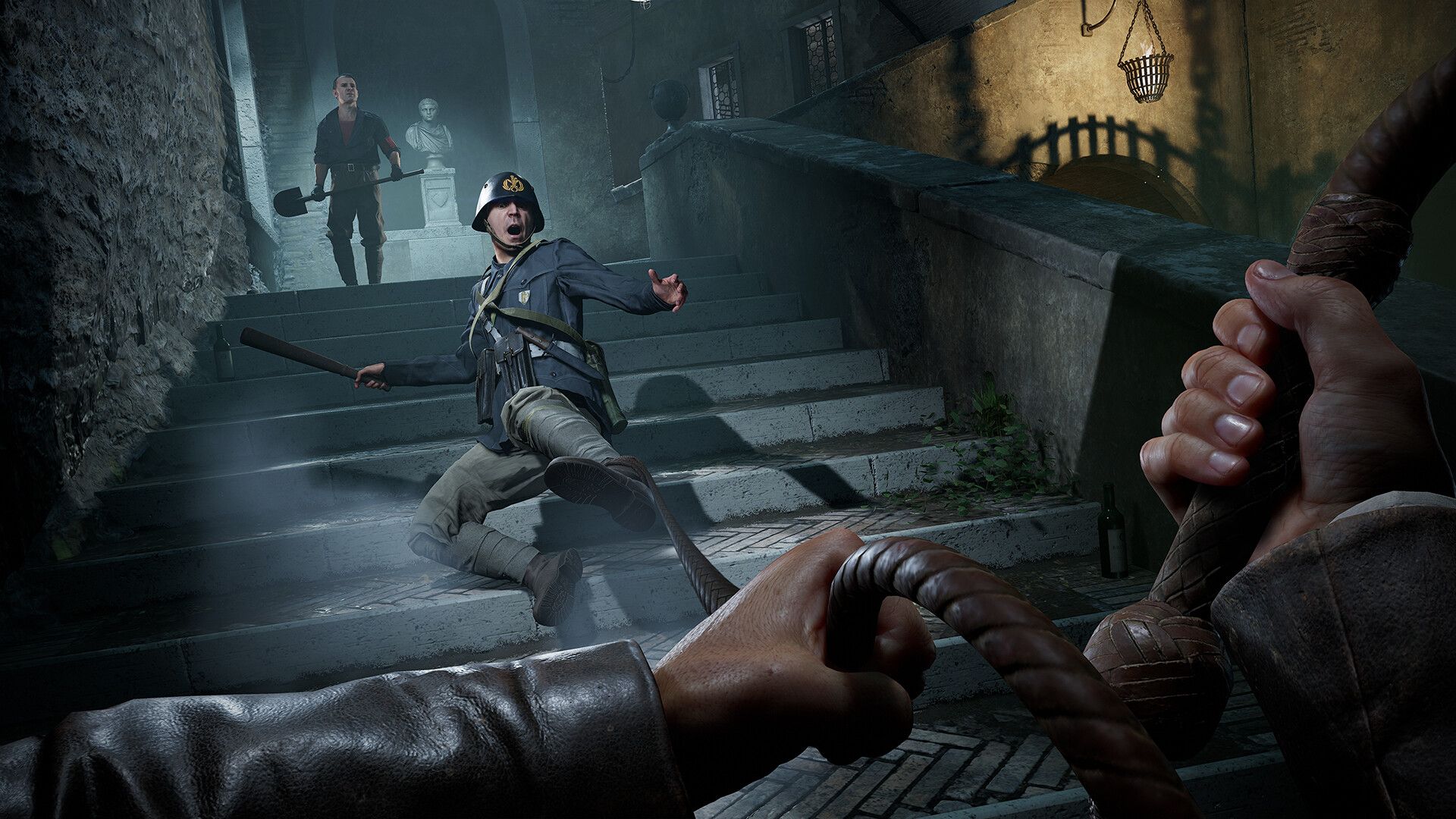
MachineGames design director Jens Andersson says reducing gunplay in Indiana Jones and the Great Circle was "very tough," revealing how the Wolfenstein studio rebuilt its combat rhythm around improvised melee, slow reloads, and Indy’s adventure identity.
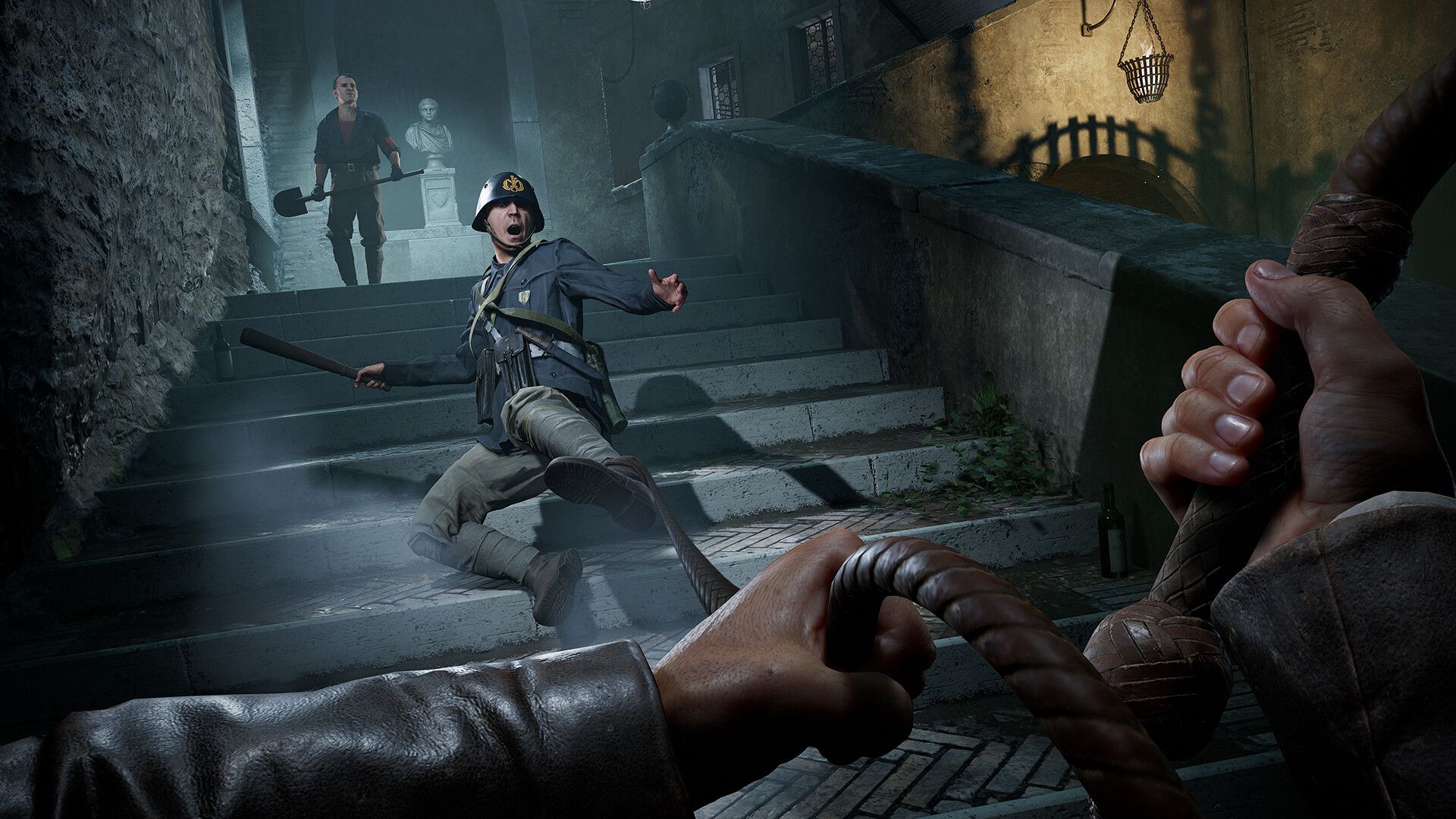
Image: gamesradar.com
MachineGames’ hardest fight was against its own instincts
MachineGames design director Jens Andersson says the studio was “so afraid” of how players would respond to Indiana Jones and the Great Circle because the team had to make a MachineGames title where shooting was pushed to the edge of the experience rather than placed at its center.
Speaking on the FRVR Podcast, as reported by VGC, Andersson described the shift from Wolfenstein to Indiana Jones as “very tough.” His explanation cuts straight to the central tension of Indiana Jones and the Great Circle game design: MachineGames had built its recent reputation on fast, violent, first-person gun combat, then took on a hero whose fantasy depends on brawls, disguises, whips, improvisation, and lucky escapes.
“Especially since MachineGames’ pedigree of Wolfenstein, coming into making Indiana Jones with a team primed to make more gore with heavy weapons, running and gunning… and then ‘oh, we’re going to make a family friendly adventure’. That was very tough,” Andersson told FRVR, according to VGC’s report.
That quote is revealing because it frames the problem as both mechanical and cultural. This was not simply a studio deciding to add fewer rifles to a level. It was a team trained by Wolfenstein: The New Order, Wolfenstein 2: The New Colossus, The Old Blood, and Youngblood trying to preserve the tactile quality people expect from MachineGames while making sure Indiana Jones did not move through rooms like B.J. Blazkowicz.
Nintendo Life noted one tension in Andersson’s wording: “family-friendly” is a complicated label for a game it says carries a PEGI 16+ rating. Still, the design point is clear from the interview. MachineGames was trying to move from gore-forward shooter intensity toward a pulp adventure tone where the gun exists, but the camera, hands, and environment keep nudging the player toward a different rhythm.
The studio could not solve the problem by making guns bad
The simplest solution would have been the least acceptable one: make firearms clumsy, weak, or unpleasant. Andersson says MachineGames rejected that path.
FRVR quotes him saying that maintaining satisfying gunplay was “non-negotiable” because of the studio’s internal culture and audience expectations. Andersson said MachineGames includes people who “love everything about guns,” including some who professionally compete in shooting, and he pointed to the studio’s connection with fans of Quake and other shooters. Nintendo Life also highlighted that statement, emphasizing that poor gunplay would not have been acceptable for a studio with MachineGames’ reputation.
That is the central design bind in the MachineGames Indiana Jones gunplay discussion. If guns feel bad, the studio betrays its own craft and the players who trust it to build sharp first-person combat. If guns feel too good, Indiana Jones and the Great Circle risks becoming a familiar shooter wearing a fedora.
FRVR’s account says the team still needed guns to behave with basic lethality. Andersson put it plainly: “a headshot still needs to kill, more or less.” That detail matters because it separates this from a balance pass where designers simply lower damage numbers. MachineGames was not trying to persuade players that guns were useless. It was trying to make the rest of the toolset so tempting, available, and character-appropriate that players would choose it even when a firearm might be efficient.
For an action-adventure game, that choice is everything. The fantasy of Indiana Jones is rarely clean dominance. It is momentum interrupted by panic, a plan ruined by a louder plan, a punch thrown because the better option vanished three seconds ago. Andersson’s comments suggest MachineGames had to build systems that create that feeling moment to moment without turning combat into a lecture.
A GTA-style wanted system shows how worried the team was
One of the most striking reported details from the FRVR interview is that MachineGames considered a Grand Theft Auto-style star level system. According to VGC and FRVR, the idea was that shooting someone could cause reinforcements to arrive, raising the cost of relying on firearms.
Andersson described the fear behind that experiment: players might take down a guard, see a dropped gun, pick it up, and clear the whole area with firearms. PC Gamer’s coverage also focused on that discarded idea, framing it as a response to MachineGames’ concern that players would simply kill all the Nazis “with just guns.”
The important caveat is that FRVR presents this as one of several designs the team explored, and Notebookcheck specifically notes there is no indication in the source account that the system was ever prototyped. No such GTA-style system shipped in the finished game, according to Notebookcheck’s report.
Even as an unused concept, it explains the scale of the problem. A wanted system would have made gunfire a public escalation event. It would have turned a pistol shot into a level-wide consequence, using external pressure to steer behavior. That is a heavy-handed tool, and the fact that MachineGames moved away from it points to a different design priority: the studio ultimately wanted players to prefer Indy’s methods because they were fun, quick, and expressive, not because the game slapped them with a visible punishment meter every time they pulled the trigger.
That distinction is crucial to the adventure feel. A star system would have made the game police the player from above. The final approach, as Andersson describes it, works closer to the ground: reload timing, nearby objects, enemy pressure, and the satisfaction of cracking improvised weapons over heads.
Slow reloads changed the pace of every fight
The shipped solution begins with friction. According to VGC and FRVR, MachineGames made reloading slow enough that, in many close-range situations, grabbing something nearby or turning the gun itself into a blunt weapon is faster than cycling another round.
FRVR frames the contrast through a familiar shooter lesson: players often learn that switching weapons is faster than reloading. In Indiana Jones and the Great Circle, the “secondary” option can become the butt of the gun, a broom, or another object within reach. That changes the scene from a shooting gallery into a scramble.
This is where MachineGames’ action craft still shows, only redirected. Wolfenstein combat is built on forward pressure, threat recognition, and quick decisions under fire. In Indiana Jones, the pressure remains, but the best answer is often less militarized. You are not scanning for the cleanest line of fire as much as you are reading the room for opportunity. The pace is physical and messy. The distance between Indy and a guard matters because a gun is lethal, but a table leg might be faster.
VGC reports that Andersson acknowledged the studio “penalised shooting so much” and that some players were frustrated by it. He also said many more players loved the result. That is a fair window into the tradeoff. Anyone arriving from MachineGames’ Wolfenstein games expecting uninterrupted firearms dominance was always going to feel resistance. But resistance is the point. The systems are built to make the player feel the drag of choosing the wrong genre of action for this character.
The practical guidance for players is straightforward from the reported design: Indiana Jones and the Great Circle is not asking you to ignore guns completely. It is asking you to treat them as situational tools, often loud and often slower to sustain than the object sitting at your feet. If you approach every encounter as a shooter, the game’s reload and escalation pressures are designed to push back.
Breakable weapons gave Indy his own combat language
Andersson told FRVR that the breakable weapons system arrived “very late” in development, but became the piece that made the melee-first approach click. VGC reports that once the team saw how effective the system was, it began adding stranger objects, including a fly swatter and a violin. FRVR lists other makeshift weapons such as cast-iron pans, wrenches, mandolins, and brooms.
The key is turnover. A permanent melee weapon risks becoming a new optimal loadout. A breakable object creates a beat of comedy, violence, and loss. It gives the player a burst of power, then forces another read of the room. That is far closer to the cinematic grammar of Indiana Jones than an ammo counter alone. Indy wins because he adapts, because a room is full of accidental solutions, because the fight is choreographed around desperation as much as skill.
FRVR quotes Andersson saying the breakable weapons were “a bit controversial,” but that they fit the nature of the game. He also said melee became “interesting, fun, and easy,” while clarifying that he did not mean easy in challenge terms. He meant easy to get into: sneak up, hit someone from behind, spot a new object, try it, watch it splinter, move on.
That late-development success says a lot about the design shift. MachineGames did not abandon impact. It relocated impact from muzzle flash to contact. A violin breaking over a soldier’s head is slapstick, but it is also a combat decision, a pacing tool, and a character statement. The moment only works if the weapon is close enough, the enemy pressure is sharp enough, and the feedback is strong enough to compete with a firearm.
For readers looking at the Indiana Jones and the Great Circle interview through a design lens, this is the most important takeaway. The studio did not merely reduce gunplay. It had to replace the satisfaction loop that guns usually provide in a first-person MachineGames title.
From Wolfenstein spectacle to adventure choreography
MachineGames’ Wolfenstein games are useful context because they show why this pivot was so risky. VGC identifies the studio’s run before Indiana Jones as Wolfenstein: The New Order, Wolfenstein 2: The New Colossus, and the spin-offs The Old Blood and Youngblood. FRVR characterizes those modern Wolfenstein games as known for rapid-fire, gratuitously violent gun combat, including the over-the-top imagery of dual-wield shotguns in Wolfenstein 2.
Indiana Jones and the Great Circle asks for a different contract with the player. The set-piece rhythm is still about danger and release, but the release cannot always be a trigger pull. It has to be a whip yank, a disguise holding for one more second, a shove, a chair, a wrench, or the sudden decision to stop reloading because the enemy is already too close.
That is a meaningful studio evolution. The same first-person perspective that once put players behind heavy weapons now has to sell eye contact, reach, collision, and the comedy of a bad situation getting worse. Andersson’s comments make clear that the team understood how easy it would be for its own strengths to overpower the license.
Notebookcheck cites an earlier August 2024 PC Gamer interview in which Andersson said an Indiana Jones game “could never be a shooter, should never be a shooter,” because Indy is not a character who shoots his way out of trouble. The newer FRVR comments explain the production reality behind that principle. Knowing what Indiana Jones should be is one problem. Building a first-person game that keeps highly skilled shooter players from optimizing the adventure out of the adventure is another.
That is the sharper consequence of the MachineGames adventure game pivot. The studio had to design against player habit, against genre muscle memory, and against part of its own legacy, while still making every hit feel authored by people who understand action.
The remaining question is player appetite for friction
The reports around Andersson’s interview leave one tension unresolved, and it is the one players will continue to feel most directly: how much friction is the right amount when a game wants to preserve character fantasy?
VGC quotes Andersson acknowledging frustration from some players over how strongly shooting was penalized. At the same time, he argues that many more players loved the approach, and that the greatest success was getting people to play “as Indiana Jones would,” choosing improvised melee even when guns could be more effective.
That is a design victory only if the player accepts the premise. For fans arriving because of Wolfenstein, the slower reloads and gun disincentives can feel like a hand on the shoulder. For players looking for an Indiana Jones adventure, those same limits can create the right kind of panic and comedy. The system’s value depends on whether you want combat efficiency or scene construction.
The confirmed release context from Notebookcheck is that Indiana Jones and the Great Circle first released on Xbox Series X/S and PC on December 9, 2024. Nintendo Life’s page context also reflects a Nintendo Switch 2 listing for the game, but the source material here does not provide release timing, pricing, or performance details for that version. Nothing in the supplied reporting changes practical buying guidance on those fronts.
What the interview does clarify is intent. Indiana Jones and the Great Circle was built by a shooter studio that knew guns had to work, feared that working guns would consume the entire game, and found its answer in a combat rhythm where a reload can be the wrong choice and a fly swatter can be the right one. That is the shape of MachineGames’ shift from Wolfenstein to Indy: not a loss of action, but a rerouting of action through character, pacing, and the objects within arm’s reach.