
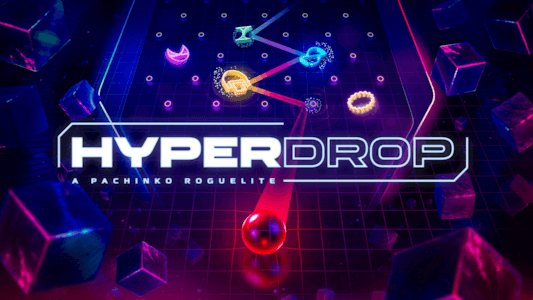

Hyperdrop has a free Steam demo now, giving PC players an early look at Devolver Digital and Dark Dark Goose’s neon pachinko roguelite built around peg upgrades, physics combos, and score-chasing runs.
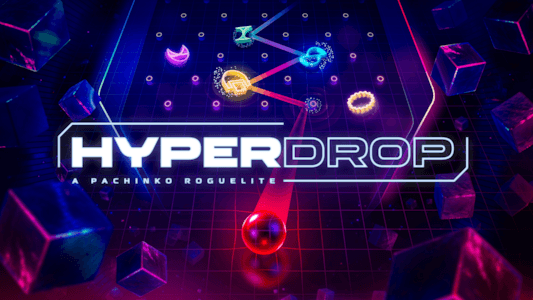
Image: gamespress.com
Hyperdrop’s demo is live, but the full game is still partly in the dark
The strongest news around Hyperdrop is simple and useful: Devolver Digital and debut studio Dark Dark Goose have put a free Hyperdrop demo on Steam now, giving PC players a chance to test the neon pachinko roguelite before its full release details are locked down.
That hands-on availability is the hook, because the rest of the launch picture is still thin. MonsterVine reports that Devolver Digital and Dark Dark Goose announced Hyperdrop for PC and that the demo is available now on Steam. Saving Content, quoting the announcement, likewise says HYPERDROP is “coming soon to PC” and points players to the Steam demo. GamingOnLinux adds a sharper timing note, reporting that there is “no word on the release date other than sometime in 2027.” Those statements are not identical: “coming soon” is publisher-style broad language, while the 2027 note gives readers a more distant expectation. No source material provided here confirms a specific day, price, console version, or early access plan.
For Steam players, that makes the Hyperdrop demo the real product to pay attention to today. It is the only confirmed way to play right now, and it arrives attached to a clean pitch: take pachinko’s plinko-like drop-and-bounce unpredictability, splice it with roguelite upgrades, then wrap it in Devolver’s loud arcade sensibility.
The playable pitch: build a board, drop a ball, chase the number
Hyperdrop starts from a board rather than a character build. According to MonsterVine, the game begins with an empty pegboard and asks players to turn it into a chain-reaction scoring machine. Saving Content’s press-release text describes the same central loop: build point-scoring boards, trigger combos, and keep a run alive for one more drop.
The core interaction is deliberately readable. You choose a drop spot, release a ball, and let the board’s physics do the first layer of work. The roguelite layer comes from what you add to that board between and during rounds: peg placement, peg upgrades, ball upgrades, and run-shaping decisions that can stretch a single drop into a mess of returns, explosions, splits, and rebounds.
GamingOnLinux frames the progression as score-gated rounds, saying each round asks players to hit a target score before continuing to build out their “hand,” which in Hyperdrop’s case is the board of powered pegs. The same report says players can buy upgrades at a shop after rounds or convert earned tokens into more perks. That is the important distinction from a pure pachinko toy. You are still watching a ball ricochet through a board, but the board is becoming your build, and the score requirement is the pressure that decides whether the build survives.
Pegs are the run’s engine, balls are the wildcard
The most promising part of the Devolver Digital Hyperdrop pitch is how many of the scoring tools are physical. GamingOnLinux, MonsterVine, and Saving Content all describe peg upgrades that can split a ball into multiple balls, send balls back to the top of the board, pull them into gravity wells, or trigger explosions that ripple through the layout. Those are confirmed features from the announcement coverage and press-release text, not inferred wishlist material.
That matters because pachinko-style games live or die by the player’s belief that the bounce is wild but legible. A peg that returns a ball to the top is a second chance. A splitter is a multiplier. A gravity well changes pathing. Explosive pegs suggest board-wide chain reactions. The craft challenge for Dark Dark Goose will be making those effects readable at speed, especially once the neon effects and electronic soundtrack climb with the score.
The ball itself is also upgradeable. Saving Content says players can double a ball’s size, give it volatile energy, make it sticky, or increase its bounce. MonsterVine adds that Hyperdrop includes special balls with different physics behavior. GamingOnLinux reports unusual shapes and different materials among the ball options. Taken together, those details point to a roguelite where the same board could behave very differently depending on the object you drop through it. That is a smart fit for a Steam roguelite demo, because the first question players will ask is whether a run feels meaningfully different the second, third, and fifth time.
Where the roguelite structure shows up
Hyperdrop’s loop is not being sold as endless score attack alone. Saving Content’s announcement text says players progress through increasingly difficult stages with unique modifiers and boss battles that force build changes. MonsterVine also reports harder stages, modifiers, boss battles, and alternate board layouts after a completed run.
Those details sketch a familiar roguelite promise: short-term improvisation, long-term pattern learning, and escalating constraints. The twist is that the build space is spatial. Instead of stacking cards into a deck or items onto a character, you are arranging and upgrading a board that must perform under physics pressure. GamingOnLinux’s comparison to Balatro is useful here, but only as a feel reference. That outlet specifically points to Balatro-like score-chasing progression, where the target score keeps rising and your growing toolkit has to keep pace.
The sources do not confirm how much of that structure is included in the free demo. They confirm the Hyperdrop demo is available now on Steam and describe the game’s systems broadly. Readers should treat bosses, alternate board layouts, and late-run modifiers as announced features for Hyperdrop unless the Steam demo itself shows them. If you are downloading specifically to test the full difficulty arc, go in expecting an early slice rather than a guaranteed full run showcase.
Why Devolver’s neon arcade framing fits the Steam audience
Devolver’s name carries a particular signal on Steam: compact ideas with strong hooks, sharp presentation, and enough mechanical bite to survive beyond the trailer. Hyperdrop’s hook is easy to understand in a store grid or festival queue. Drop ball, trigger chaos, beat score, buy upgrades, repeat. That immediacy is useful in a crowded roguelite market where players often decide within minutes whether a game has the right texture.
The neon arcade framing helps because Hyperdrop’s systems are visual by nature. GamingOnLinux describes old-school retro arcade energy, neon colors, explosive peg activations, and a strong soundtrack. Saving Content says the game has neon-soaked visuals and a pulsing electronic soundtrack that evolves dynamically as the score increases. Those are aesthetic claims from the announcement coverage, but they also point to a practical design question: can the game make escalating math feel tactile?
That is where the pachinko roguelite label earns attention. Steam already has a deep audience for score optimization, physics toys, roguelite drafting, and quick “one more run” decision loops. Hyperdrop sits at the intersection of those appetites. Its demo gives players a low-friction way to check whether the ball physics feel satisfying, whether upgrade choices create real intention, and whether the screen remains readable once the board starts popping off.
What remains unannounced before launch
For now, the confirmed availability story is narrow. Hyperdrop is announced for PC, and the demo is live on Steam. Devolver Digital is publishing, and Dark Dark Goose is the debut studio behind it, according to MonsterVine and Saving Content. The Steam page URL is public, but the provided Steam scrape does not include pricing, system requirements, controller details, Steam Deck status, languages, achievements, or a final release date.
The timing language is the main unresolved point. Saving Content’s press-release text and MonsterVine both use “coming soon to PC,” while GamingOnLinux reports that there is no date beyond sometime in 2027. Until Devolver or the Steam listing surfaces a specific launch window in the available public materials, players should treat 2027 as the broad expectation cited by GamingOnLinux rather than a dated release plan.
Console players also have no confirmed path in the provided sources. Every sourced availability note points to PC and Steam. That could change later, especially with Devolver projects often finding wider audiences after PC attention, but there is no supported platform claim here beyond PC.
Should you play the Hyperdrop demo now?
If the phrase “pachinko roguelite” makes your brain start arranging multipliers before the download finishes, the Hyperdrop Steam demo is worth a look precisely because the central feel cannot be judged from feature text alone. This kind of game depends on tiny satisfactions: the bounce of a ball, the timing of a chain reaction, the clarity of upgrade descriptions, and the sting of missing a score threshold by a handful of points.
The reported feature set gives the demo a clear checklist. Look for whether peg upgrades feel strategic rather than decorative. Watch whether ball modifiers change your plan or simply add spectacle. Pay attention to how the game communicates cause and effect when gravity wells, explosions, splits, and returns start overlapping. A great pachinko roguelite needs luck to feel dramatic without making choices feel ornamental.
For everyone else, the demo is the safe play. There is no confirmed price in the provided sources, no final date, and no console announcement. Hyperdrop’s first public move is generous and smart: let Steam players test the drop, the buildcraft, and the neon noise now, then decide whether Devolver and Dark Dark Goose have a score-chaser worth wishlisting for the full PC release.