
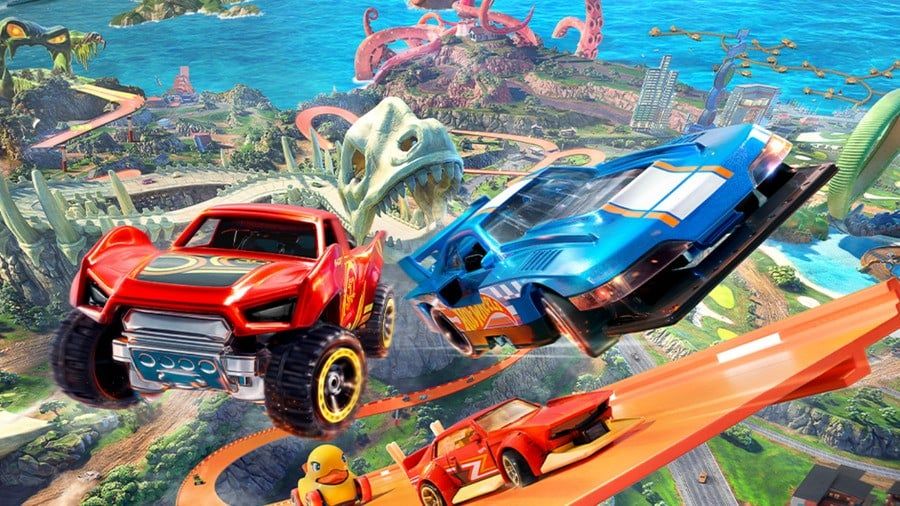
Milestone and Mattel have detailed Hot Wheels Infinite Rush gameplay, including four open-world islands, vehicle classes, Rush Squad switching, customization, and launch timing.
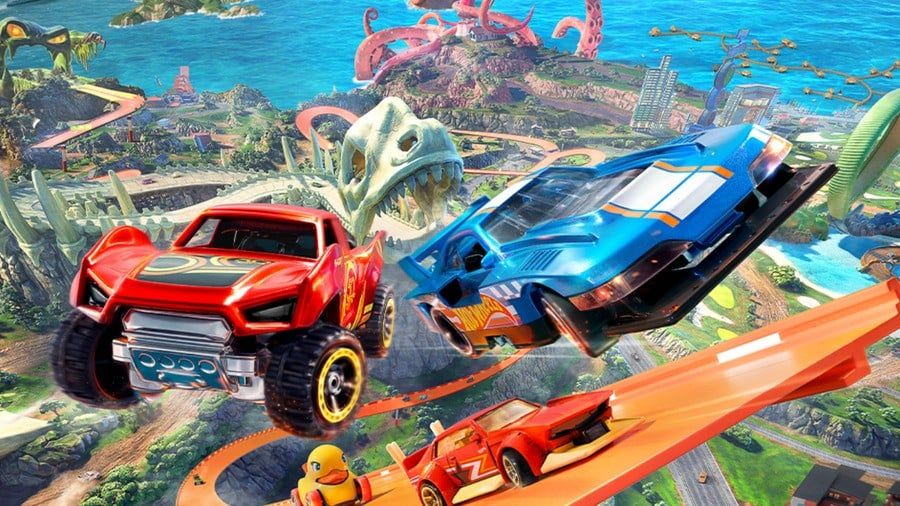
Image: pushsquare.com
Milestone’s new trailer puts the open world at the center
Milestone and Mattel have released a new Hot Wheels Infinite Rush trailer focused on campaign structure, vehicle classes, customization, and the game’s four-island open world. The strongest new detail is how those systems are meant to connect: players will explore four themed toy-scale islands, unlock new areas and challenges, race rival crews, and build a four-car Rush Squad that can be swapped instantly while free-roaming.
That is the clearest statement yet of how Hot Wheels Infinite Rush gameplay is moving away from the tighter track-first identity associated with Hot Wheels Unleashed. Push Square frames Infinite Rush as building on the Unleashed series, with its main point of difference being an open-world structure. Milestone’s official site goes further, describing four action-packed islands filled with challenges, stunts, collectibles, races, free-roam activities, and events that can be found while driving.
The tension for arcade racing fans is obvious. Hot Wheels has always thrived on short, readable track design, boost timing, and exaggerated scale. An open-world island setup gives Milestone room for discovery, stunts, and vehicle variety, but it also asks the handling model to work outside authored track lanes. In racing terms, Infinite Rush has to feel good in the messy sections between events, not only when the route is clean, the apex is obvious, and the boost pads are placed exactly where the designer wants them.
Four islands, sky-jumps, and a campaign built around rival crews
According to Milestone and Mattel’s press release, Hot Wheels Infinite Rush is divided across four themed islands packed with races and free-roaming activities. Players can “sky-jump” between islands as new areas and challenges unlock, which Push Square also highlights as a ramp-based way to move between maps. Milestone’s official site names the broader themes rather than formal island names: a city that never sleeps, green parks and resorts, neon-lit water canals, and a scorching desert.
That spread suggests a conventional open-world racing grammar, with each biome doing a different job. A dense city can support tight navigation and traffic-style rhythm, parks and resorts can open into wider stunt playgrounds, canals can lean into visibility and speed lines, and desert terrain usually gives designers room for large jumps and less constrained routing. Milestone has not published a handling breakdown for each surface in the provided materials, so it would be premature to claim terrain-specific physics. What is confirmed is environmental variety across four separate maps and free-roaming activities distributed through them.
Campaign progression is also clearer now. The new trailer details rival racing crews across the islands, with players taking them on in head-to-head races to become the ultimate Rush Master, according to Nintendo Everything’s report on the trailer and the Games Press release. Milestone’s official site adds a more specific boss structure: each island is ruled by a Rush Master, completing events unlocks that challenge, and beating the Rush Master lets the player claim their car and title. Once all four are defeated, the player is crowned the one true Rush Master.
That structure is straightforward, but it gives the open world a useful hierarchy. Free-roam racing games can blur into map cleanup if the campaign lacks a target. Here, the confirmed loop is event completion into boss unlocks into car rewards. The unanswered question is pacing: Milestone has not detailed how many events are required per island, how much freedom players have in event order, or whether progression gates are tied to car class, collection level, or campaign milestones.
Vehicle classes are built around boost behavior, not only stats
The four Hot Wheels Infinite Rush vehicle classes are Drifters, Speeders, Titans, and Versatiles. Milestone and Mattel describe Drifters as corner-focused cars that recharge boost through drifting. Speeders are built to dominate long straights with increasing speed and boost regeneration. Titans are powerful vehicles with unique boost management mechanics. Versatiles are balanced all-rounders suitable for any challenge.
The important part is that the class descriptions are framed around boost generation and use, rather than a simple top speed, acceleration, handling, and braking split. That is a good fit for Hot Wheels because boost is the primary tempo control in an arcade racer. A Drifter class that rewards controlled oversteer can turn corners into fuel, which tends to favor technical routes and players who like to rotate the car early. A Speeder class that regenerates boost and gains speed on long straights will likely reward clean exits and minimal steering correction. Titans sound less immediately readable because “unique boost management mechanics” is broad, but the wording implies heavier or more powerful cars may have a different boost economy. Versatiles are the fallback for mixed routes where switching to a specialist is unnecessary or risky.
Milestone’s official site also says players can discover and collect more than 150 vehicles through events, activities, and challenges. It lists the same four vehicle types and says each offers a different way to race. That collection size gives the class system room to matter, provided the individual cars are not functionally interchangeable within each category.
The confirmed class design leaves a few performance-minded questions open. Milestone has not stated whether classes have separate upgrade paths, whether vehicle weight affects collisions and landings, whether boost regeneration differs by event type, or whether class balance changes in multiplayer. For now, the reliable takeaway is that Hot Wheels Infinite Rush vehicle classes are being positioned as handling and boost archetypes, not cosmetic labels.
Rush Squad switching could solve open-world routing, if events use it well
The Rush Squad system is the most interesting design addition in the new gameplay details. Milestone and Mattel say players assemble a four-vehicle team with one Hot Wheels car from each class and can instantly switch between them while exploring the world. That means the player is not locked into a single car identity during free roam. In theory, a player can leave a technical section in a Drifter, switch to a Speeder for a long run-up, move to a Titan where boost management or power matters, then return to a Versatile when the route becomes mixed.
For an open-world arcade racer, that is a practical answer to a common problem. In a closed circuit, the designer knows exactly what car the player chose and can shape the challenge around it. In an open world, players may arrive at a jump, drift zone, or timed route in a car that feels wrong for the job. Instant class switching gives Milestone a way to design varied activities without forcing constant garage visits.
There is also a risk. If the world is tuned around frequent switching, the system may become mandatory busywork. If it is too forgiving, class identity may soften and the four categories become loadout flavor rather than meaningful handling choices. The healthiest version would treat Rush Squad as route strategy: pick the right tool when the environment changes, but keep enough control continuity that the game does not feel like four separate handling models fighting for attention.
Milestone has not confirmed whether Rush Squad switching is available during formal races, only that players can instantly switch while exploring the world. That distinction matters. Free-roam switching supports traversal and activity discovery. Race switching would be a much larger competitive design statement, especially for online play. Until Milestone says otherwise, the confirmed use case is exploration.
Customization extends to look, wheels, boost effects, and sound cues
Vehicle customization is also broader than a basic paint selector. According to Milestone and Mattel, players can use Sticker and Livery editors, customize wheels, change boost visual effects, and personalize boost and dash sound effects. Nintendo Everything reports the same list from the latest trailer details.
For a Hot Wheels game, this is useful because cars often function as collectibles as much as performance tools. A 150-plus vehicle garage can become visual noise if players cannot make favorite cars feel personal. Sticker and livery editors address identity, while wheels and boost effects affect the car’s read on screen. Sound customization is a smaller detail, but in a boost-heavy arcade racer it can matter more than it seems. Dash and boost cues help players time inputs without staring at meters, especially when the screen is busy with jumps, stunts, and traffic-like environmental clutter.
The sources do not mention performance tuning, mechanical upgrades, or user-generated sharing for liveries in the provided material. That absence is worth noting. Customization is confirmed as cosmetic and audiovisual based on the current trailer details. If Milestone later confirms tuning, ranked restrictions, or livery sharing, that would change how competitive and community-focused the garage becomes.
Modes, platforms, crossplay, and the September date question
Milestone’s official site lists Hot Wheels Infinite Rush for September 10, 2026, and the Games Press release says the game launches on PlayStation 5, Xbox Series X|S, Nintendo Switch 2, ROG Xbox Ally, ROG Xbox Ally X, and PC via Steam, Microsoft Store, and Epic Games Store on that date. The same release says Early Access begins September 7. Push Square also reports a September 10 launch for PS5.
There is one date wrinkle in the coverage. Nintendo Everything’s article says Hot Wheels Infinite Rush comes to Nintendo Switch 2 on September 7, 2026. The publisher-distributed Games Press release and Milestone’s official site identify September 10 as the launch date, with September 7 described as Early Access. Based on the provided sources, the safest reading is that September 10 is the general launch date and September 7 is tied to Early Access, but Nintendo Everything’s wording creates a platform-specific ambiguity for Switch 2 readers.
Milestone’s official site also states “full crossplay” with Nintendo Switch 2 excluded. That means players should not assume Switch 2 can join the same cross-platform pool as PlayStation, Xbox, and PC unless Milestone updates that policy. The site lists online, offline, and split-screen play, and includes a note that Nintendo Switch 2 will have six competitors per race. The provided material does not include resolution, frame rate, PC requirements, or Switch 2 performance targets.
Milestone lists several race formats on the official site, including Quick Race, Elimination, Waypoints, and Smashing Wheels. Quick Race is described as getting on track and going, Elimination as last vehicle standing, Waypoints as a checkpoint chase, and Smashing Wheels as a target-hitting mode. Those modes fit the open-world structure because they can be placed as discrete events without needing every activity to be a standard lap race.
For players deciding whether to buy at launch, the practical guidance is to separate confirmed structure from unknown execution. The confirmed package has four open-world islands, campaign boss progression, more than 150 vehicles, four boost-oriented vehicle classes, Rush Squad free-roam switching, cosmetic and audio customization, online and offline play, split-screen, and broad platform support. The open questions are handling consistency across free roam and events, Switch 2 technical performance, how Early Access is attached to editions, and whether the class system stays meaningful once players reach the later garage. Arcade racing fans looking for a Hot Wheels open world racing game now have a much clearer blueprint, but the feel of the cars will still decide whether the islands have lasting grip.