
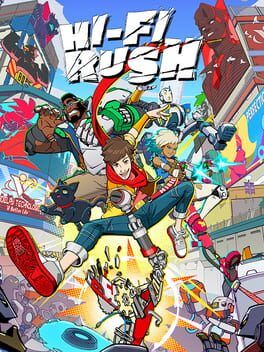

With Hi-Fi Rush newly re‑rated for Nintendo Switch under Krafton, the former Xbox exclusive’s wild journey takes another turn. Here’s how we got here, and why a Switch or Switch 2 version could quietly reshape rhythm‑action design on Nintendo hardware and signal a new era for ex‑Xbox franchises on Nintendo systems.
Hi-Fi Rush keeps finding ways to defy expectations. First it shadow‑dropped as an Xbox console exclusive on Game Pass. Then its creator, Tango Gameworks, was caught in a wave of studio closures just as the game was building long‑tail word of mouth. Months later, PUBG publisher Krafton swooped in to save both the studio and the IP. Now, in 2026, Hi‑Fi Rush has quietly reappeared on PEGI’s database with a new Switch rating, this time with Krafton listed as the publisher.
For a game built around hitting to the beat, its business history has had a surprisingly erratic rhythm. A Switch release would finally bring the loop full circle, and it carries bigger implications than a straightforward port suggests.
From Shadow‑Drop To Studio Shutdown
When Hi‑Fi Rush arrived in January 2023, it felt like the antithesis of how big budget games usually launch. No drip‑feed teaser campaign, no endless CG trailers. Tango Gameworks simply walked onto Microsoft’s Developer_Direct stage, showed a slice of a vivid rhythm action brawler, then dropped it on Xbox Series X|S and PC that same day.
Critically, it landed. Reviewers praised its focus, its confidence and the way every punch, dodge and environmental flourish locked into the soundtrack. Players who might never have touched a character action game found themselves juggling combos in time with The Black Keys.
Commercially, the story was murkier. The game was a hit with critics and a cult favorite with players, but it lived in the gray space of Game Pass metrics, Steam sales and digital discounts. By early 2024, Microsoft had pushed a broader multiplatform strategy and Hi‑Fi Rush jumped to PS5, but it still read as an Xbox‑born success.
Which is why the news in May 2024 stunned people: Microsoft folded Tango Gameworks as part of a round of studio closures, even as Hi‑Fi Rush continued to pick up awards and word‑of‑mouth sales. The immediate reaction across social media, Steam reviews and forums was a mix of disbelief and anger. Players weren’t just losing a studio, they were watching one of Xbox’s few genuinely new first‑party IPs get orphaned.
Krafton Steps In And The IP Leaves Xbox
Behind the scenes, something unusual was already in motion. In August 2024, Krafton announced a strategic deal with Microsoft and ZeniMax: the PUBG publisher would acquire Tango Gameworks, the Hi‑Fi Rush IP and key staff, effectively reversing the closure and giving the studio a new corporate home.
There were two big wrinkles to that announcement.
First, the deal was IP‑specific. Reporting and follow‑up commentary made clear that Tango’s horror lineage, like The Evil Within, stayed under Bethesda’s umbrella, while Hi‑Fi Rush was explicitly called out as Krafton’s new flagship. Second, Krafton repeatedly emphasized that it wanted to “further develop” the Hi‑Fi Rush IP. This was not a quiet library purchase, it was a statement of intent.
Throughout 2025 that intent became more visible. Ownership tags on digital storefronts began to flip from Bethesda to Krafton. The official site and social feeds shifted branding. A long‑rumored sequel quietly entered production with a leaner core team. And just as importantly, old licensing debris started to clear, including the removal of Denuvo from the PC version.
By late 2025, Hi‑Fi Rush was no longer an “Xbox game that escaped closure.” It was Krafton’s cross‑platform rhythm action franchise, one that happened to have been born in the Microsoft ecosystem.
PEGI’s Second Switch Rating, Now With Krafton On The Label
That context is what makes the new PEGI listing so interesting.
Hi‑Fi Rush has actually been here before. Back in April 2024, when Tango was still under Microsoft and Bethesda, PEGI briefly listed a Switch version. At the time it looked like a natural extension of Microsoft’s tentative third‑party publishing push. Then the rating vanished, Tango’s future fell into limbo and the idea of a Nintendo port drifted into “what if” territory.
Fast‑forward to January 2026 and the PEGI database once again shows Hi‑Fi Rush for Switch, but the details have changed. The new entry is dated with a 2026 pre‑release window and lists Krafton as the responsible company. That might sound like a small metadata tweak, but legally it confirms something important: the certification process has been restarted under the game’s new owner.
Ratings do not guarantee a release, and PEGI itself is not an announcement. But certifications cost time and money. Publishers do not typically submit or refresh them two years after an abandoned listing without a clear plan. In other words, if Krafton is pushing Hi‑Fi Rush back through the pipeline for Switch, it is very likely because a Nintendo version is finally on the schedule.
Curiously, the PEGI page mentions only “Switch,” not any successor hardware. Given the timing and the smell of a generational transition in the air, that omission raises an immediate design question: what does a hi‑fidelity rhythm brawler look like on aging mobile hardware in 2026, and how could it scale up if a Switch 2 port follows?
Rhythm Action Under Constraints: Designing For Switch In 2026
Hi‑Fi Rush’s fundamentals are perfectly suited to Nintendo’s audience. It is cleanly readable, built around timing and pattern recognition, and comfortable with stylish exaggeration instead of photoreal spectacle. In many ways it looks like a natural companion to games like No More Heroes, Bayonetta and even The Legend of Zelda: Cadence of Hyrule.
Where things get tricky is not the concept, but the execution under strict hardware constraints.
At its heart, Hi‑Fi Rush needs three things more than raw polygon count: unshakeable timing, visual clarity and responsive input. On modern consoles that is solved with a stable 60 fps target and razor sharp audio latency. Switch complicates that.
Both docked and handheld modes face CPU and memory bottlenecks that can make busy combat arenas and complex post‑processing a juggling act. Rhythm games are uniquely sensitive to frame drops and timing inconsistencies. Missed beats in a shooter can be annoying. In a game where score, rank and even narrative flow hinge on keeping tempo, a stutter can undermine the entire experience.
To make the port sing, Krafton and Tango would almost certainly have to make some targeted decisions.
Visual density could be reduced to protect frame pacing. Background NPC counts, shader complexity and physics‑driven debris might all be dialed back. Cinematic flourishes like depth of field and heavy motion blur are obvious candidates to trim. Hi‑Fi Rush’s bold, cel‑shaded art style makes that process much easier than it would be in a gritty, realistic game. Strong outlines and saturated colors read well even at lower resolutions.
Audio timing would need obsessive care. That means aggressively minimizing input latency, especially in handheld mode, where wireless controller lag and smaller speakers can make rhythm feedback fuzzier. The original versions already include accessibility tools like visual beat indicators. On Switch, those cues become even more important to offset any variance introduced by the hardware.
Finally, there is the question of resolution versus framerate. A locked 60 fps with dynamic resolution scaling would preserve gameplay feel, even if it means frequent drops below 1080p docked or sub‑720p in handheld. For a rhythm action title, players are far more likely to forgive softness in the image than wobble in the beat.
Handled correctly, the Switch version could end up highlighting what made Hi‑Fi Rush special in the first place: economical, expressive animation and clear musical structure, rather than technical muscle.
What A Switch 2 Version Could Unlock
The PEGI listing may only say “Switch,” but a successor system is the silent third party in this conversation. By the time a port ships, Nintendo’s next console will either be announced or actively on the market. For Krafton, launching Hi‑Fi Rush into that window presents an opportunity to reframe it as a cross‑generation flagship.
On more capable hardware, Tango would be free to lean into the record‑sleeve utopia the original art direction hinted at. Higher resolution textures are the obvious upgrade, but the more interesting gains lie in animation density, particle work and camera expressiveness.
Imagine crowd scenes in Vandelay’s corporate plazas that feel genuinely busy, with dozens of employees bobbing in time to the soundtrack instead of a handful of looping NPCs. Think of boss encounters where the environment deconstructs and reconstructs on every beat without threatening performance. Or haptics and audio tricks that use more advanced controllers and spatial sound to reinforce timing, letting players feel the downbeat as much as see it.
From a design standpoint, a Switch 2 version could also experiment with latency‑sensitive features that are tough to trust on current hardware. Optional online co‑op or asynchronous score battles become more realistic when you can rely on stronger CPU, better netcode pipelines and more precise timing APIs.
The key question is how Krafton would package that. A straightforward dual release with cross‑save would be the simplest path, letting players start on the original Switch and upgrade seamlessly later. But a staggered approach, with a baseline Switch version followed by a “definitive” Switch 2 edition, might be more likely given certification timelines and the desire to keep early development targets modest.
Either way, Hi‑Fi Rush has the potential to play a similar role on Nintendo’s next box as titles like Bayonetta 2 did on Wii U: an outsider action game that quietly proves the hardware can do more than mascot platformers and party compilations.
A New Signal For Former Xbox‑Partnered Franchises
Beyond the technical intrigue, a Krafton‑published Hi‑Fi Rush on Switch would send a clear strategic message. This is no longer an Xbox first‑party experiment. It is a third‑party, cross‑platform IP willing to go wherever its audience is.
For Nintendo players, that matters because it reshapes expectations around what “ex‑Xbox” games can do on their platform. Previously, the route for Microsoft‑associated titles to reach Switch often went through Microsoft itself, as with Ori or Cuphead’s late arrival via a publishing deal. Those were special cases driven largely by goodwill and specific partnerships.
Hi‑Fi Rush breaks that pattern. Its creator was once an Xbox studio, but the franchise now belongs to a publisher with its own multiplatform instincts. Krafton is not invested in console wars, it is invested in maximizing reach. If bringing a former Xbox exclusive to Switch is profitable, it will not be the last.
That logic could ripple outward. Other IP that began under the Xbox umbrella but could feasibly transfer ownership in the future may see Nintendo platforms as a more viable destination. Likewise, studios that once perceived alignment with a single platform holder as a long‑term safety net might look at Tango’s journey and reassess. The safety net can vanish. Diversification, and the ability to take your creations elsewhere, becomes more attractive.
For Nintendo, these shifts dovetail with a gradual opening of its own ecosystem. The company has steadily welcomed more ambitious third‑party games, from Monster Hunter Rise to large‑scale JRPGs and cloud‑based ports of visually demanding titles. A stylish, formerly Xbox‑branded rhythm action game sliding into the catalog in 2026 would reinforce the narrative that Nintendo platforms are no longer a secondary stop, but part of the main circuit for third‑party success.
Rhythm, Rescues And Second Chances
When people talk about Hi‑Fi Rush, they usually do it with a kind of surprise in their voice. Surprise that Tango Gameworks, known for horror, pivoted so convincingly to Saturday morning action. Surprise that Microsoft greenlit something so bright and self‑contained. Surprise that a shadow‑dropped AA‑scale game could cut through the noise of an industry obsessed with live‑service sprawl.
The game’s latest twist, a renewed PEGI rating for Switch under Krafton, fits that pattern. It is still not a formal announcement. PEGI is not a Direct. But it is a strong hint that one of the last generation’s most delightful curveballs is about to enter Nintendo’s library, backed this time by a publisher that has built an entire business on multiplatform reach.
If and when Hi‑Fi Rush lands on Switch and potentially on its successor, it will not just be another port. It will be a small but meaningful proof of concept: that inventive rhythm action can thrive on Nintendo hardware, that the scars of studio closure do not have to be permanent and that the boundaries around “platform exclusive” histories are more fluid than ever.
Sometimes, the beat drops again in a new key. Hi‑Fi Rush looks ready to prove that on a new stage.