
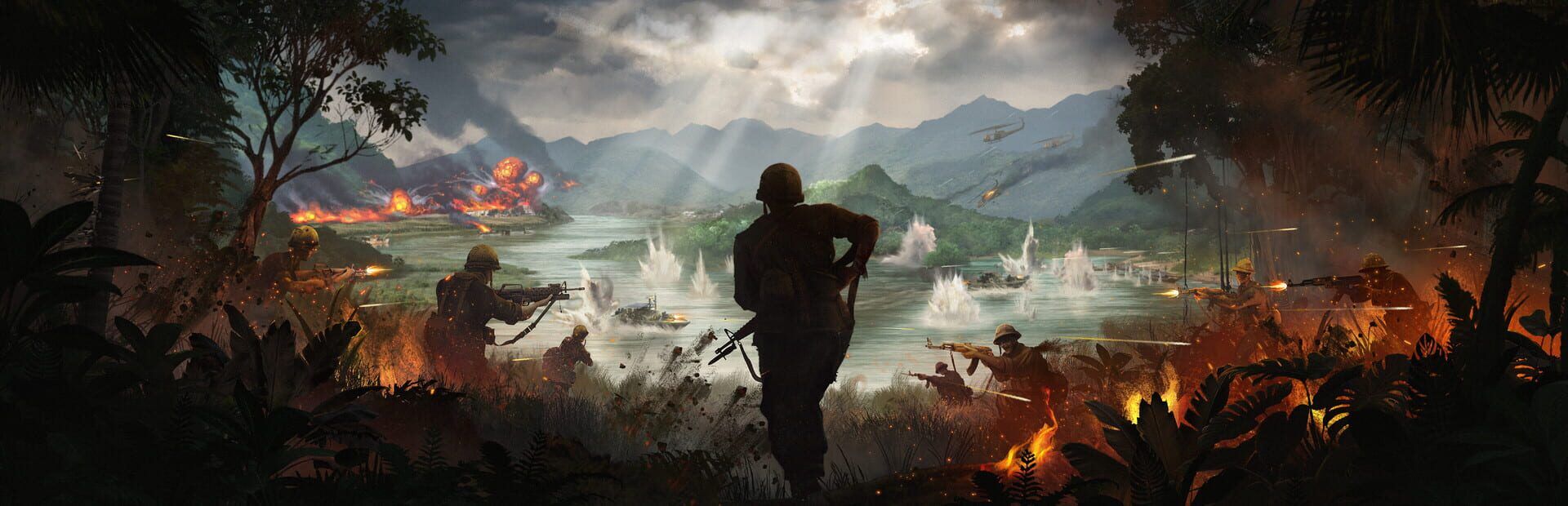

A deep preview of Hell Let Loose: Vietnam, covering its Vietnam War setting, performance targets on PS5 and Xbox Series X|S, PC tech features like DLSS and Lumen, and how it evolves the large-scale warfare formula of the original Hell Let Loose.
Hell Let Loose: Vietnam is not just a reskin of Black Matter’s grim World War II shooter. With developer Expression Games taking point and Team17 still publishing, this spin on the series is shaping up to be a technical step forward and a different flavor of large-scale warfare built around the chaos and asymmetry of the Vietnam War.
Between the studio’s performance targets on console, the PC feature set, and what we have seen in hands-on previews and the open beta, Hell Let Loose: Vietnam looks like a more dynamic, more lethal battlefield that still lives and dies on tight squad coordination.
A new war, same unforgiving scale
Hell Let Loose: Vietnam drops the frontlines of Normandy and Kursk for the dense jungles, river deltas and scorched villages of 1960s Vietnam. It keeps the 50v50 structure and officer-led command hierarchy of the original, but the environment design and faction tools are clearly built around asymmetry.
US forces lean into superior mobility and firepower. Expect Huey helicopters slashing across the sky, air cav insertions that can push a frontline forward in seconds, and heavier supporting weapons when combined arms clicks. North Vietnamese Army and Viet Cong forces lean the other way, toward stealth and attrition, with tunnel networks, guerilla flanking routes and makeshift fighting positions that turn any patch of jungle into a potential ambush.
Across six large-scale maps based on real locations, Expression Games is building levels around vertical foliage, visibility tricks and dense micro-cover rather than the comparatively open, hedgerow-heavy fields of Hell Let Loose. There are still hard capture points and strongholds, but routes between them are less obvious. Infantry will be fighting through plantations, rice paddies, riverbanks and villages where line of sight is often measured in a few dozen meters and sound is the primary early warning system.
The result, even in early footage and beta playtests, is a battlefield that feels more claustrophobic and unpredictable. You still have 100 human players, logistics chains, outposts and garrisons, but the Vietnam setting pushes players to listen, probe and coordinate more carefully instead of simply trading long-range rifle fire over open ground.
How Vietnam rethinks the Hell Let Loose formula
At a systems level, Hell Let Loose: Vietnam keeps the big pillars of the series intact. There are still multiple roles per squad, commanders that call in off-map support, and a resource economy driven by territory control and logistics. Where Expression Games is trying to move things forward is in tempo and team expression.
The original game’s battles often settled into relatively static frontlines once players had placed garrisons and found effective firing lanes. Vietnam’s toolset is designed to keep those lines in flux. Helicopters and river craft can open new angles or redeploy full squads quickly, while tunnels and hidden spawn points let the NVA or VC materialize behind what looked like a safe sector.
This interplay makes reconnaissance and communication even more critical. Squads that move without coordinating with their commander risk being isolated or encircled by enemies who know the terrain better. Conversely, a coordinated platoon can collapse on a contested objective from ground, air and underground routes at once.
Weapon handling is also tuned around the era. Full-power bolt-action rifles give way to faster-firing assault rifles, carbines and machine guns, which naturally raise the lethality ceiling. Suppression and sound design become vital; long bursts from an M60 can lock lanes down while the thump of distant mortars or artillery forces squads to relocate often. The underlying philosophy is similar to the original Hell Let Loose, but players are encouraged to push and reposition instead of sitting entrenched behind a single field.
Performance targets on PS5 and Xbox Series X|S
Expression Games has been straightforward about their console ambitions. Hell Let Loose: Vietnam is targeting 60 frames per second on all current-gen systems, including PS5, Xbox Series X and the less powerful Xbox Series S. Internal rendering resolutions have not been detailed yet, but the priority, according to the team, is a consistently responsive feel across platforms even during heavy action.
That is a significant goal for a game that routinely throws 100 players, artillery, vehicles, dense foliage and long draw distances into the same scene. The original Hell Let Loose could stumble on consoles during intense artillery barrages or smoke-heavy pushes. For Vietnam the team is leaning on a more modern tech stack and aggressive optimization passes to keep frame rates stable while still pushing visual fidelity.
Future-proofing on PlayStation is also in play. While the base PS5 aims for 60 FPS from day one, Expression Games has confirmed that PlayStation Spectral Super Resolution support for PS5 Pro will arrive in a free post-launch update. PSSR is Sony’s machine-learning upscaling and reconstruction tech, intended to allow higher apparent resolutions at console-friendly costs. For a sim-like shooter where clarity and visibility are crucial, that extra sharpness on a midrange TV or 4K display could be a real competitive advantage.
The important takeaway for console players is that Vietnam is being built first and foremost as a 60 FPS experience, with optional bells and whistles slotted around that target rather than sacrificing responsiveness for spectacle.
PC features: DLSS, TSR and Lumen
On PC, Expression Games is embracing a broader set of modern rendering tricks. The studio has confirmed support for ultrawide and super ultrawide monitors, up to 32:9 aspect ratios, which suits the game’s expansive maps and situational awareness focus. There is also support for both Nvidia and AMD upscaling solutions.
Nvidia GPU owners can tap into DLSS 4.5 along with Frame Generation. That means compatible cards can render at a lower internal resolution, reconstruct a sharper image through DLSS, and also use Frame Generation to insert AI-predicted frames between real ones. For a demanding large-scale shooter this combination is a clear path to high frame rates without brutal compromises on foliage density or effects quality.
On the AMD side, the game will support AMD TSR. Temporal Super Resolution functions similarly in spirit to DLSS, using previous frames and motion vectors to upscale and anti-alias the final image. While it is vendor-agnostic and works on a broader set of GPUs, having both DLSS and TSR in the menu ensures players across hardware ecosystems can find a sweet spot between performance and image quality.
Perhaps the most striking technical addition is support for Hardware Lumen. Lumen is Unreal Engine’s dynamic global illumination system, and on compatible hardware it can leverage ray tracing to simulate more realistic bounce lighting and reflections. In a Vietnam setting full of dappled jungle shadows, flickering firelight and sudden muzzle flashes, better lighting should significantly affect how readable and atmospheric the battlefield feels.
The team has indicated that higher-end features are being optimized aggressively rather than simply toggled on and left unrestrained. PC players with top-spec rigs will be able to push visual settings hard, but mid-range systems should still see meaningful benefits from DLSS or TSR without being forced into low presets.
Asymmetry, atmosphere and what it means in the match
The shift to Vietnam is not just cosmetic; it presses on how players read and react to the battlefield. Dense foliage makes flanking routes easier to conceal, but it also means defenders can hide AT teams or MG nests much closer to the objective. The NVA and VC tunnel networks give defenders surprising resilience, as they can regroup underground and surface behind US lines if commanders fail to secure key access points.
On the US side, helicopter insertions dramatically change early-game pacing. Experienced squads can gamble on deep drops behind enemy lines, trading the safety of a standard frontline spawn for the chance to knock out logistics or disrupt tunnel construction before it gets established. Losing a full chopper’s worth of players, however, is a serious setback that can leave a sector under-defended.
Expression Games appears intent on ensuring that this asymmetry remains fun and fair rather than devolving into one-sided stomp matches. Server tools, map design and role limits are being tuned so that, for example, air support must be earned and coordinated, not simply spammed on cooldown. Likewise, tunnel networks require planning and resource investment; they are powerful, but not free.
The high lethality of Cold War-era weapons makes information and discipline the real advantages. Squads that move silently, check their sectors and exploit the thick vegetation will succeed far more often than groups that sprint down roads and shout over each other on voice chat.
Evolving large-scale warfare for the next wave of milsims
Hell Let Loose built its audience by offering 50v50 battles with just enough logistical complexity and communication requirements to feel like a milsim without totally abandoning accessibility. Hell Let Loose: Vietnam is shaping up as a sharper, more dynamic take on that template.
By centering mobility, verticality and concealment, the new setting naturally creates more opportunities for dramatic swings in momentum. A well-timed helicopter push, a tunnel-assisted backcap, a riverborne flanking force or a sudden artillery strike on a jungle treeline can all flip the script on what looked like a stable frontline. Those swings should be visually and mechanically more convincing thanks to better lighting, denser foliage and higher frame rates.
At the same time, Expression Games is clearly aware that the core appeal of Hell Let Loose lies in its structure. The platoon command chain, role specialisation, and necessity of using in-game comms remain untouched. What changes is the canvas on which those systems play out and the tools each faction wields to express their strategy.
If Expression can deliver on its 60 FPS console targets and make good on the promise of its PC tech stack, Hell Let Loose: Vietnam could end up being one of the most technically impressive large-scale shooters on the market when it launches. More importantly for returning players, it has the potential to turn every match into a shifting, three-dimensional brawl through one of the most complex battlefields the series has tackled so far.