
A hands-on style look at how Hell Let Loose: Vietnam’s shift from World War II to the Vietnam War reshapes pacing, tactics, and 50v50 asymmetrical battles.
Hell Let Loose has always been about chaos with purpose. Fifty players on each side, artillery thundering somewhere behind the line, squads trying to hold a village that barely has a name. With Hell Let Loose: Vietnam, Expression Games and Team17 are picking up that same tactical backbone and airlifting it into one of the most distinct combat theaters in modern history. The result, even from early hands-on impressions, feels less like a reskin and more like a shift in how you read the battlefield.
Trading hedgerows for jungle
The original Hell Let Loose built its identity on the open fields and bombed-out towns of World War II. Vision lines were long, armor dominated the open ground, and most matches revolved around controlling big, obvious approach routes. Vietnam instantly disrupts that rhythm.
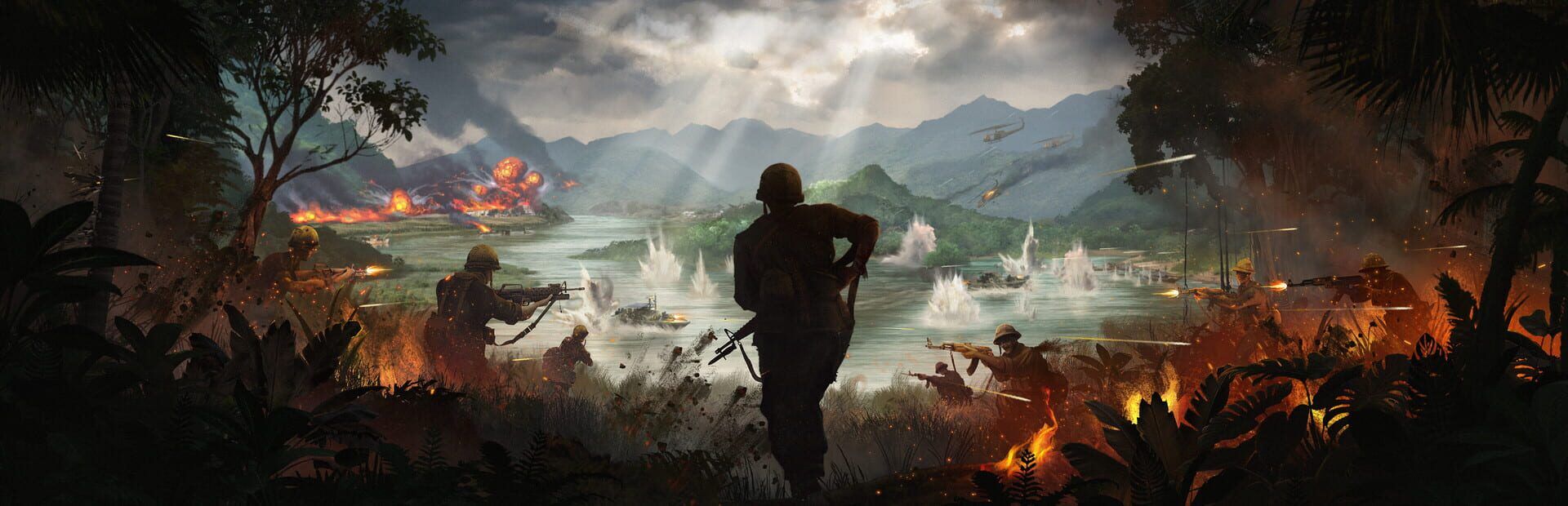
Jungle and dense foliage carve the 6 launch maps into claustrophobic pockets of visibility. You can be less than 30 meters from an enemy squad and never see them until the first muzzle flash. Where Normandy rewarded players who could anchor sightlines across fields, Vietnam rewards those who can exploit concealment and sound. Movement becomes more deliberate, and communication inside squads is less about distant contacts and more about piecing together vague audio cues, snapped branches and the dull clack of a distant reload.
This environmental shift changes how commanders and squad leaders think about control. Rather than clean, linear fronts, engagements tend to smear out into overlapping ambushes and counter-ambushes. It feels more like being dragged into a living maze than marching down a well-charted lane.
Asymmetrical combat as a design pillar
World War II in Hell Let Loose was already asymmetric in subtle ways, with different tank lineups or weapon handling. Vietnam pushes that idea to the front of the design. Here, the contrast between factions is not only about firepower but about how you exert that power on the map.
On one side you have US and allied forces, packing serious hardware and superior conventional support options. Air power, artillery and armored vehicles give them the ability to punish exposed movement and lock down chokepoints when they can establish a foothold. Their experience is about trying to project control outward, pushing secure lines through an environment that does not want to cooperate.
Opposite them, North Vietnamese and other local forces lean into stealth, terrain familiarity and the new tunnel-building mechanics. Instead of matching tanks and air assets, they dig in under the map, stitching together hidden routes that ignore surface-level control. Commanders are not just placing outposts, they are quietly growing an underground nervous system that can shift an entire squad from one side of the front to the other without crossing open ground.
The result is a more pronounced predator and ghost dynamic. Western forces feel like a hammer desperately searching for a nail, while NVA and allied forces often choose when and where to materialize. Victory is less about bluntly winning every firefight and more about forcing the enemy to fight on your terms.
50v50 in a war of inches
Hell Let Loose’s signature 50 versus 50 matches return intact, but the Vietnam setting changes how those hundred players occupy the same space. In World War II maps, large groups would often form obvious human waves, particularly when pushing over open terrain toward a capture point. In Vietnam, big blobs of bodies turn into liabilities.
Because the jungle disrupts vision and chokes sound, squads splitting off to flank or probe becomes the default rather than a risky play. Firefights that would have been single, decisive pushes in Hell Let Loose often fragment into a series of linked skirmishes. A squad makes contact, trades a few casualties, pulls back into the trees, then vanishes while another squad sets up a crossfire elsewhere.
This creates a different kind of spectacle. Instead of watching a line of infantry charge across a wheat field behind a tank, you get a battlefield where tracer fire briefly sketches the outline of a fight, then disappears into the canopy. The scale is still there, and from the commander view you can feel how many moving parts are in play, but for most players the war is experienced as a chain of tense, intimate clashes.
At the same time, when heavy vehicles and support elements do appear, they feel louder than ever. A gunship or armored column suddenly breaking the relative quiet of the jungle can flip a fight instantly, and with fifty players per side, there is always someone ready to exploit that opening.
How pacing evolves in the Vietnam setting
Moment to moment, Vietnam slows Hell Let Loose down without making it any less lethal. The time to kill remains punishing, yet the approach to each contact is stretched out by the terrain and the knowledge that enemies can appear from almost anywhere, including beneath your boots.
Advances become a cycle of probing, listening, and repositioning. You rarely sprint directly toward a capture point. Instead, squads fan out along the flanks, testing for ambushes or concealed tunnel entrances. When contact happens, it is often sudden and brutal, but the setup to those encounters is more drawn out, filled with uneasy silence and nervous callouts.
Respawns and reinforcement also feel more deliberate. Tunnel networks, rally points and forward spawns take on heightened importance when the map is riddled with angles and blind approaches. Losing a tunnel entrance behind your current line can unravel a seemingly solid defense in minutes, and commanders have to weigh whether to commit forces to rooting out these hidden arteries or gamble on reinforcing the main front.
In practice, a single match can swing between extended periods of creeping advance and sudden explosions of violence. That uneven rhythm feels true to the setting and gives Vietnam a distinct identity compared to the more consistently linear pushes of its World War II predecessor.
New roles, same brutal teamwork
Hell Let Loose: Vietnam is not losing what made the original work. The 17 combat roles lock players into defined responsibilities, which remains crucial when the battlefield is this chaotic. Medics, engineers, officers and support classes each shape how your squad can move and survive.
Engineers put in serious work around the tunnel systems and fortifications, while officers juggle navigation, recon pings and the constant demand for supplies. Communication feels even more vital in the jungle, because information is the one resource that does not get choked by foliage or erased by artillery.
Vehicles play a different role than in Europe. Their routes are more constrained, and the jungle punishes careless driving, but when armor or riverine assets are brought to bear in the right place, they impose momentary order on the chaos. Teams that can synchronize infantry, support and vehicles across the 50 person roster will dictate the pace of the match.
Why the shift to Vietnam matters
By moving away from the well-trodden fields of World War II, Hell Let Loose: Vietnam finds a setting that naturally amplifies its core philosophy of tension, teamwork and punishing lethality. The new war is not just a different skin, it is a different language of combat.
The jungle setting redefines sightlines and sound, asymmetrical design turns each faction into a distinct playstyle rather than a mirror image, and 50v50 battles feel less like clashing armies and more like overlapping hunts. If Expression Games can keep refining balance around tunnels, vehicles and support, Hell Let Loose: Vietnam has a real chance to carve out its own tactical niche rather than living in the shadow of its World War II roots.
With a free open beta on PC ahead of launch and full release planned for PC, PS5 and Xbox Series X|S, players will not have long to wait before they can find out whether they prefer their hell on the beaches of Normandy or in the thick, suffocating green of Vietnam.