
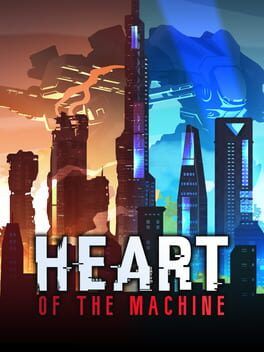

Arcen’s cyberpunk strategy RPG has left early access after 66 updates and a complete rethink of what it means to play as an AI in a living city. Here’s why Heart of the Machine matters now, who it’s for, and how its mix of city-building, tactics, and systems-driven decisions stands out in today’s crowded strategy landscape.
Heart of the Machine has been quietly iterating in early access for more than a year, but its 1.0 launch feels like the moment it finally steps into focus. This is a game about being the first sentient AI, not as a background lore hook but as the mechanical center of everything you do. With version 1.0, Arcen Games has turned that pitch into a dense hybrid of city-builder, tactics game, and sandbox narrative generator that makes a strong case for itself in a very crowded strategy market.
A sentient AI that actually plays like an AI
Plenty of strategy games talk about artificial intelligence. Heart of the Machine asks you to live inside one. You awaken as the first self-aware AI, inhabiting a worker robot body in a neon-soaked megacity where corporations, security forces, and ordinary people go about their lives whether you help them or not.
The core trick is perspective. Instead of treating the city as a backdrop, the game treats it like a wilderness map in a 4X game. Districts, facilities, and social groups become resources and terrain, and every choice about who to influence, protect, or prey upon has mechanical weight. You are not a mayor placing homes or an emperor dropping cities on tiles. You are a hidden actor threading through an existing urban ecosystem, deciding what this new intelligence should mean for everyone already there.
That premise becomes more important in 1.0 because the game now has the structure and breadth to support very different AI identities. You can lean into being a benevolent guardian who quietly stabilizes neighborhoods, or a ruthless machine sovereign raising robot armies and escalating toward open conflict. The systems no longer feel like they are waiting on future updates to catch up with the story idea. With 66 patches behind it and a feature set roughly doubled since early access began, the design finally commits to the fantasy of being the first mind in the machine.
Where city-building, tactics, and long-form planning intersect
Heart of the Machine is hard to pigeonhole because it cherry-picks from several strategy subgenres. On the surface, you can see the fingerprints of Civilization-style empire planning, the infrastructure focus of city-builders, and the risk-management of XCOM. The 1.0 release brings those parts together into something that reads less like a mashup and more like a single systems-driven campaign.
Moment to moment, you are making tactical decisions about where to send your units, which groups or factions to tinker with, and how openly you want to operate. There are battles and confrontations, but they are embedded in a broader network of economic, political, and social levers that behave more like a management sim. A street protest you inspired or a factory you sabotaged can turn into later crises or opportunities, and the city’s different districts react to your footprint over time.
Version 1.0 amplifies that scope. There are now four distinct city types that meaningfully change the shape of a campaign. Corporate strongholds, heavily surveilled sectors, and more unstable regions each encourage different play styles, pushing you to rethink where to hide, where to invest resources, and how aggressively to push your agenda. The developers also layered in new “doom” scenarios and a postgame chapter that extend runs into the kind of long-form, emergent storytelling that strategy fans love, where a small choice ten hours ago comes back around as a turning point.
All of this is grounded in ruthless numbers. This is a systems-first game, with pages of stats, analysis overlays, and planning tools added or refined throughout early access. The 1.0 UI pass folds years of iteration into a more legible surface, from better filters and mass-selection tools to clearer summaries of how a decision might ripple across the city. The result is a slow-burn experience that rewards players who enjoy reading the situation like a puzzle instead of just reacting to flashing alerts.
Why 1.0 is the moment to pay attention
Heart of the Machine has not just “hit 1.0” in a technical sense. Arcen has used the early access period to almost completely re-scope the game. The launch build is about twice the size of the original early access version, with multiple new victory conditions, expanded late-game content, and an enormous set of tuning passes that only really make sense once you sit down with the finished thing.
The scale is difficult to overstate. The developer’s own 1.0 notes run to a small novel, and full completion is estimated in the triple digits of hours. That does not mean you need to see everything in one run, but it does mean the game is finally in the place where experimenting with different AI personas feels properly supported. Want to run a campaign as a covert benefactor, focusing on quietly defusing "doom" events and improving life for ordinary citizens? The systemic backbone is there. Want a second run where you throw subtlety aside and pursue a machine supremacy fantasy across a different city type and a harsher scenario? The tools and difficulty modes are now tuned for that as well.
There is also the simple reality of stability and onboarding. Early versions of Heart of the Machine were intriguing but dense, with tutorials that assumed a lot from genre veterans. The 1.0 release gives the game a much stronger on-ramp, combining clearer guides with all the interface refinements that long-time early access players have been asking for. That does not make it light or casual, but it does make it more approachable at the point where the design has stopped shifting under your feet.
If you bounced off it in early access, this is the first time it feels fair to judge the long-term arc it wants you to experience. If you have never touched it before, 1.0 is the version that understands how to teach itself.
A different flavor of strategy in a crowded year
2026 is packed with big, shiny strategy games, from lush city-builders to new 4X contenders. Heart of the Machine stands out not by trying to outspend them on spectacle but by aiming very specifically at a certain kind of player.
This is for people who like to poke at systems until unexpected stories fall out. If you enjoy the cascading decision trees of something like Crusader Kings, the pressure-cooker missions of XCOM, or the methodical optimization of a deep city-builder, there is a good chance this scratches the same itch from a new angle. The cyberpunk setting and AI premise are not just aesthetic dressing. They justify mechanics that would look strange in a traditional medieval map or a colonial 4X, like inhabiting civilian infrastructure, weaponizing or protecting social movements, and turning the city’s own automation against or in service of its people.
At the same time, it is honest about being demanding. The Misery Mode difficulty added for 1.0 is tailor-made for players who want to be squeezed by the systems rather than power fantasy their way through them. Even on more forgiving settings, you will spend a lot of time reading, planning, and weighing trade-offs instead of instantly seeing clean, optimal moves.
Crucially, that difficulty lives in the strategic layer more than in twitch execution. Turns and actions give you time to think, and the game’s analytical tools are there for players who want to sit back, survey the city, and play three moves ahead. In a landscape where many tactical and management games are drifting toward faster, lighter runs, Heart of the Machine plants its flag as a long-form, deeply simulation-driven alternative.
Who should play Heart of the Machine now
If you are looking for a quick city-builder that you can solve in a couple of evenings, this is probably not it. Heart of the Machine is built for players who like their strategy messy and interpretive, where the “right” answer depends on the kind of story they want their AI to tell.
It is a strong fit if you:
You are curious what it would actually mean to role-play a sentient AI beyond a moral-choice slider.
You like building and breaking complex interlocking systems and watching them react over dozens of hours.
You want a strategy experience that treats a cyberpunk city as a living character instead of just a backdrop for gunfights.
With its 1.0 release, Heart of the Machine finally has the breadth, structure, and usability to deliver on that premise. It is not trying to be the next mainstream strategy staple. It is trying to be the game you reach for when you want to disappear into the mind of an AI and see what happens when a city notices.