
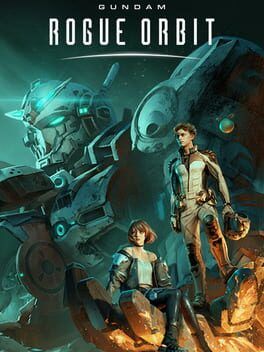

Early Gundam Rogue Orbit preview coverage points to a faster, cleaner entry point for Gundam newcomers, built around melee combat, suit scale, and an original universe.

Image: IGDB
Store links: Gundam Rogue Orbit on Steam
Bandai Namco is selling Rogue Orbit as an entry point, and previews say the combat supports that pitch
The clearest development around Gundam Rogue Orbit is that Bandai Namco is positioning it as a clean on-ramp for players who have looked at decades of Gundam continuity and backed away. The official Bandai Namco Entertainment site describes the game’s cinematic story as “a daring new chapter in the GUNDAM saga,” built as “the perfect entry point for new players” while still aiming at longtime fans.
That marketing line is now backed by a cluster of early hands-on impressions from Gamescom 2026 previews. Kotaku reported that Rogue Orbit takes place in an original universe, removing the need to keep up with the franchise’s long anime and manga history. Console Creatures also reported that the game is set in an all-new universe and said players can “dive in” without prior knowledge. GameSpot’s preview framed the result as a classic action game that can work for someone unfamiliar with Gundam, while still preserving the mobile suit fantasy.
The tension is obvious. Gundam’s identity has long been tied to war, factional conflict, political ideology, and the cost of piloting machines built for human catastrophe. Rogue Orbit appears to be lowering the lore barrier by changing the battlefield and foregrounding readable action. Early coverage suggests that may help a new Gundam game reach players who want a mech action game first, but it also raises the question of how much Gundam can sand down before veteran fans feel the texture has been lost.
An original universe cuts through the lore wall, but it also changes the kind of Gundam story being told
Several previews describe Rogue Orbit as a new universe rather than an adaptation of an existing anime arc. Kotaku reported that players control Re-X, one of the few people able to pilot a mech suit, in a timeline where humanity is close to collapse during a war against an alien threat. Console Creatures similarly described ace pilot RE-X and the Gundam Helix as part of a ragtag group fighting as humanity’s last hope against an unknown enemy.
That premise is practical for Gundam game newcomers. It means players are not being asked to understand Universal Century politics, alternate timelines, old rivalries, or decades of mobile suit nomenclature before the first mission. Kotaku said producer Yuya Tomiyama explained that the alien threat was chosen to make the game “as appealing as possible” to a new audience. In the same interview, Tomiyama acknowledged that the team “did actually walk away from the original Gundam concept,” while arguing that war and drama remain central to the game’s philosophy.
That is where early impressions split in useful ways. Kotaku came away seeing Rogue Orbit as an inviting starting point. Console Creatures was less settled on the story question, arguing that monsters and alien enemies are a strange shake-up for a series usually built around human conflict and political themes. The outlet said removing that inherent part of Gundam risks losing some of the series’ soul in an attempt to broaden appeal.
For readers approaching this as a Gundam Rogue Orbit preview, that distinction matters. The confirmed facts are that Bandai Namco is presenting this as a new chapter, previews describe an original universe, and the antagonist force shifts away from the familiar human-against-human structure. Whether that choice produces a strong Gundam story remains unproven, because multiple previews were based on short demos with limited narrative context.
The pitch works because the first hour seems to speak action-game language clearly
The strongest consensus across early Gundam Rogue Orbit gameplay coverage is that the game feels immediately readable in the hands. Console Creatures described the controls as “snappy, fast, and punchy,” even while saying the demo left the outlet unsure what the overall game wants to be. CNET played about an hour, running through two missions with three premade mobile suits, and said the combat felt polished with months still remaining before the reported launch window.
The hands-on demos were limited, but the structure appears consistent across reports. CNET said the preview included two missions and three premade mobile suits, one stage built as an enemy gauntlet ending in a miniboss and another focused on a full boss encounter. Geek Culture also described a two-mission preview, with one standard path through smaller enemies into a larger boss and another built around a massive dragon-like boss. Console Creatures reported access to two short levels and three different builds.
That structure gives Rogue Orbit a clear action rhythm. You deploy, read enemy patterns, cut through smaller threats, test a weapon’s reach and recovery, then hit a bigger enemy where the spectacle has room to breathe. GameSpot described battles shifting between ranged and melee, sky and land, with weak spots that could be targeted to expose further vulnerability. CNET compared the flow to Dynasty Warriors or Virtual On, with special skills spending an ability gauge and normal attacks feeding it back.
For a newcomer, that kind of clarity is crucial. Gundam can be visually dense. Names, factions, machines, weapons, and timelines can blur together if the game asks too much too quickly. Previewers suggest Rogue Orbit instead starts with verbs that action players already understand: dash, strike, reposition, punish, heal, redeploy.
Melee focus gives the mobile suits personality without burying players in parts menus
Rogue Orbit’s most important design decision may be its emphasis on melee. Gundam games and anime have often balanced beam rifles, sabers, cannons, funnels, missiles, and signature suit gimmicks, but several previews describe Rogue Orbit as a close-range action game first. Geek Culture reported that ranged weaponry largely takes a backseat, and CNET said its demo seemed constrained to melee range apart from support equipment, such as orbiting drones that fired during dashes.
The preview builds help explain how Bandai Namco is trying to keep the fantasy broad without making the opening hours intimidating. Kotaku and Console Creatures both reported three weapon types in the demo: Assault Sword, Whip Sword, and Sword Lance. Kotaku described the Assault Sword as an all-around weapon, the Whip Sword as useful at a distance and against multiple enemies, and the Sword Lance as suited to closing gaps and dealing heavy close-range damage. Console Creatures had a similar read, calling the Assault Sword traditional, the Whip Sword stylish and brutal, and the Sword Lance capable of hard-hitting combos against monsters, other Gundams, and bosses.
That is a smart action-game foundation. The differences are legible before you know the franchise vocabulary. Sword means balanced. Whip means reach and crowd control. Lance means commitment and impact. New players can understand those roles quickly, while returning fans still get the pleasure of seeing mobile suits expressed through weapons, frames, thrusters, Apocalypse Units, and color schemes, all customization categories reported by Console Creatures.
There is a caveat. Preview demos did not show the full customization suite. CNET said Bandai Namco did not include customization functionality because the company wanted the preview focused on gameplay. Console Creatures said the demo had no customization, though the outlet was told that making your Gundam unique is part of the experience. GameSpot described a mission loop built around selecting loadouts, deploying, fighting, learning from failure, and redeploying. The system sounds promising, but the depth, grind, balance, and economy around customization are still unknown.
Scale is the bridge between accessibility and Gundam fantasy
Rogue Orbit’s newcomer strategy only works if the mobile suits still feel like mobile suits. Early previews suggest Bandai Namco is aware of that risk. GameSpot quoted producer Yuya Tomiyama saying the team wanted players to feel the scale of an “18-meter Gundam unit.” The outlet said movement did not feel clunky, but still conveyed the gravity of piloting a huge vessel packed with weaponry.
That balance is hard to tune. Make a mech too heavy and newcomers may bounce off sluggish movement. Make it too weightless and the machine stops feeling like a towering weapon platform. CNET noted that the game avoids the kind of full three-dimensional, high-speed tuning associated with Armored Core 6: Fires of Rubicon, telling players to focus instead on jumping and dashing around like a modern melee action game. The outlet even pointed out the required suspension of disbelief when a mobile suit hops around with normal-feeling gravity on the outside of a space station, but argued that this avoids the awkwardness of floaty movement.
GameSpot’s interview adds another layer. Tomiyama said creating an action game while making it feel like Gundam was the hardest part, because the team wanted realism and player feel without losing the recognizable Gundam identity. Director Yoshiyuki Serizawa also told GameSpot the team created a mobile suit that can be used only within the game, pointing to a design approach tailored to interactivity rather than animation alone.
That is where Rogue Orbit may find its lane. The best set-piece action games make the player feel the size of the moment without slowing the pace into mud. If Bandai Namco can keep the hit-stop, dashes, weak-point targeting, and boss scale working together, Rogue Orbit could offer the fantasy of piloting an enormous machine while still letting new players read the fight second to second.
The old fan question is still open, especially around politics and enemy design
Rogue Orbit’s accessibility comes with a creative tradeoff. Kotaku reported that Tomiyama sees war and drama as the continuing Gundam foundation even with aliens as the enemy. Console Creatures, however, questioned whether swapping traditional human conflicts for monsters and an unknown enemy removes too much of what has historically defined Gundam’s dramatic identity.
That concern is not automatically a strike against the game. A new universe gives Bandai Namco room to build a different kind of tragedy, one driven by survival pressure, military desperation, and the burden placed on rare pilots like Re-X. An alien threat can still support character drama if the story uses it to test alliances, leadership, sacrifice, and the machinery of war. But the previews provided to outlets appear to have shown very little story material. Console Creatures specifically said it did not get even “a sliver” of what the story may say, leaving the outlet confident in the gameplay but concerned about the narrative.
Geek Culture adds useful franchise context here. The outlet noted that Gundam games have been numerous, reporting more than 250 over the years, but that recent console entries have often leaned toward fan service, such as collecting mobile suit parts, rather than gameplay innovation. In that context, Rogue Orbit’s action focus is a meaningful swing. It is also risky, because longtime fans may judge it on elements that preview demos are least equipped to prove: faction writing, character ideology, suit lineage, and whether the new setting feels like a Gundam universe rather than a generic sci-fi war.
So far, the confirmed strengths are tactile. The unresolved issue is thematic. Early hands-on coverage can tell us that the strikes land, the dashes feel responsive, and the boss fights have scale. It cannot yet prove that Rogue Orbit has the political bite or character weight some Gundam fans expect.
Release timing, platforms, and whether newcomers should keep watching
The release picture is mostly clear, though the provided sources are not perfectly aligned. CNET reports that Gundam Rogue Orbit is due out on March 5, 2027. Console Creatures says the game launches in March 2027. GameSpot’s public game page lists PC, PS5, and XBSX as platforms, while the Gundam Wiki, a fan-maintained listing, says PlayStation 5, Xbox Series X, and Steam. GameSpot’s same listing also shows a “First Released” date of Dec. 31, 2097, which conflicts with the preview coverage and appears to function as a placeholder rather than a useful launch date. The official Bandai Namco source text provided for this assignment confirms the positioning as a new cinematic chapter and entry point, but does not include pricing, editions, PC requirements, or performance targets.
For practical purposes, players should treat March 2027 as the reported window, with March 5 specifically attributed to CNET unless Bandai Namco’s own storefronts or official channels confirm it in the material they are checking. No provided source confirms price. No provided source confirms Steam Deck support, console performance modes, cross-save, multiplayer, demo plans, or upgrade paths.
For Gundam newcomers, Rogue Orbit is worth watching because multiple independent previews describe an action game that teaches through feel rather than lore. The original universe, melee-forward combat, and mission-based customization loop all lower the threshold for entry. For longtime fans, the question is sharper: whether Bandai Namco Studios can preserve Gundam’s sense of scale, wartime pressure, and mobile suit identity while steering away from some of the franchise’s familiar political architecture.
The early answer is promising but incomplete. Rogue Orbit seems to understand how a giant robot should hit, how a boss should tower, and how a weapon choice should change the tempo of a fight. The harder test comes later, when Bandai Namco has to show the story surrounding those impacts and the customization systems that are supposed to carry the loop beyond a strong first hour.