
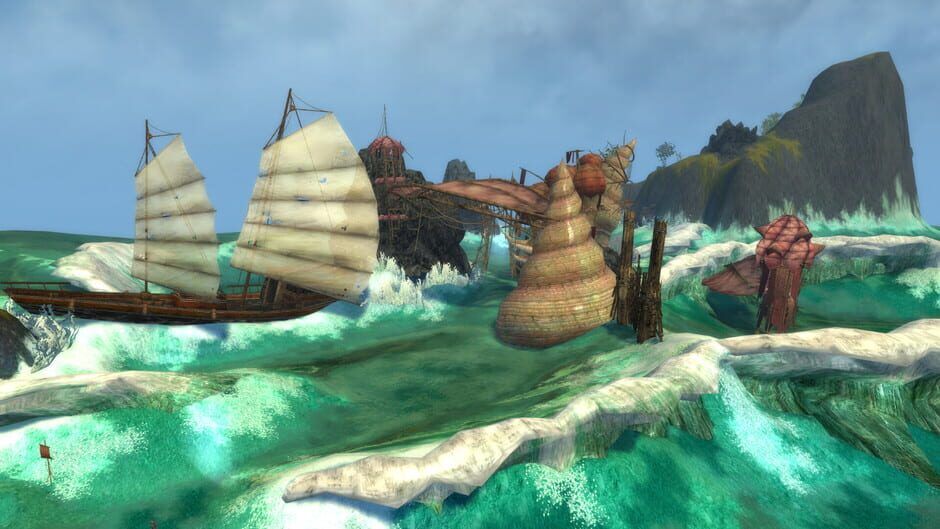

ArenaNet quietly pushed Guild Wars Reforged to mobile in select regions, with a touchscreen-first overhaul and full cross progression. Here is how the classic MMO is being modernized for phones and what it means for PC veterans and mobile-first players.
Guild Wars has always been the “other” big Western MMO, the one that quietly built a fiercely loyal fanbase while World of Warcraft dominated the headlines. With Guild Wars Reforged, ArenaNet already pulled off a rare trick: reviving a 2005 MMO for modern PCs without completely rewriting its identity. Now the studio is testing an even bolder move.
Without a big countdown or flashy showcase, Guild Wars Reforged has slipped into mobile soft launch across a handful of regions, and the way ArenaNet is handling it says a lot about how to revive a classic for phones without losing the PC soul.
A soft launch that arrived earlier than promised
ArenaNet had already announced that Guild Wars Reforged would arrive on iOS and Android in summer 2026 to celebrate the franchise’s 21st anniversary. Instead of waiting, a fully playable soft launch client has landed early in Australia, New Zealand, Canada and the Philippines.
This is not a separate side project or a gacha spin off. The soft launch build is the complete Reforged client running on mobile, with the original Prophecies campaign available out of the gate. Players in those regions can download the app, log in with an ArenaNet account, and immediately see their existing characters and purchases if they already own Guild Wars on PC.
The mobile release is also testing a new business model. Prophecies is playable for free through an ad supported option, while a paid unlock removes ads and opens the door to the familiar buy once expansions. It is a far cry from the energy timers and loot box monetization that dominate mobile RPGs, and it is clearly aimed at lowering the barrier for newcomers without rewriting the game’s economic DNA.
Rebuilding Guild Wars around thumbs and thumbs alone
The original Guild Wars was designed for a mouse, a keyboard, and a full hotbar of skills. Translating that to a phone screen is not a trivial UI pass. ArenaNet’s approach in Reforged is closer to rebuilding the interface from the ground up rather than simply shrinking the PC HUD.
According to the official mobile FAQ and the first wave of soft launch impressions, the entire UI layout has been rethought.
The eight skill slots that defined Guild Wars’ buildcraft have been pulled down to a low horizontal strip that hugs the bottom of the screen, within easy reach of both thumbs. Skills now use large, high contrast icons with clear cooldown rings and responsive touch hitboxes. Targeting is handled with a hybrid of tap to select and a context sensitive smart targeting assist that snaps to nearby foes when you use movement and attack commands.
Movement, which on PC relies on WASD and click to move, has shifted to a virtual joystick and tap to path system. Players can drag a thumb on the left side of the screen for direct control or simply tap in the world to send their character to a location, which echoes how the original client handled click to move. Camera control lives on the right side of the screen, with swipe gestures for panning and pinching for zoom.
Inventory, quest tracking and chat have been broken up into layered, collapsible panels. Instead of the classic floating windows that could clutter a desktop display, the mobile version uses big tabbed panels that slide in and out, pausing non crucial combat interactions and preserving visibility. It feels more like a modern mobile RPG overlay wrapped around the classic Guild Wars logic running underneath.
Preserving the skill bar brain while simplifying the clicks
A key fear among veterans was that Guild Wars’ buildcraft would be gutted in transit to mobile. The game’s identity is built on choosing eight skills out of a huge pool and playing around sharp counters, positioning and timing. ArenaNet’s messaging has been clear that this is not changing, and the soft launch client backs that up.
Skill builds still pull from the same vast library of professions and elites introduced across the original campaigns. Attribute distribution, secondary professions and elite skill captures all remain intact. What has changed is how you manipulate them on a touchscreen.
The deck building and loadout screens have been refitted for tap based browsing. Skills are presented as card like tiles with tooltips that expand on long press, replacing the tiny PC style icons that assumed a mouse hover. Drag and drop works for ordering your eight skills, but there are also quick buttons for auto sorting by attribute or type. It feels closer to a modern deckbuilder UX pinned on top of a mid 2000s MMO ruleset.
Combat inputs have been boiled down to fewer discrete gestures. Single tap activates a skill on your current target. A swipe on certain skills can change behavior, for example turning a ground target spell into a drag and drop AoE template. Long pressing a skill keeps it queued to fire the moment conditions are met, which lowers the need for frantic tapping in high pressure team fights.
The result is a control scheme that does not try to automate combat into an idle experience, but that acknowledges people will be playing on trains, couches and lunch breaks. It keeps the mental load of buildcraft while dropping the physical strain of keyboard like multitasking on glass.
A mobile client that is not a second class citizen
One of ArenaNet’s smartest design choices is refusing to treat mobile as a separate shard of Tyria. The mobile Reforged client connects to the same accounts and the same progression as the PC version, with cross play and cross progression at the core rather than as an afterthought.
If you own campaigns and character slots on PC, those are simply there once you log in on your phone. Gear, titles, Hall of Monuments unlocks and mission progress carry over. The studio has even confirmed that controller support from the PC version is available on mobile, so a Bluetooth pad can turn a tablet into something that feels closer to a portable mini PC setup.
Crucially, ArenaNet is not loosening the screws on gameplay for mobile users. There is no separate balance table or simplified combat for phones. Guild Wars has always been more about tactical pacing than Twitch reflexes, which makes it a better fit for cross platform parity than many action heavy MMOs.
The only truly mobile specific features so far are interface toggles and accessibility options. Text scaling bumps up chat and tooltips for smaller screens. Aim assist and camera smoothing can be tuned for people who find virtual sticks slippery. Notifications can be configured to nudge you about completed Zaishen quests or festival events without turning the app into a push alert machine.
Why Guild Wars might succeed where other mobile MMO revivals struggled
Mobile revivals of classic online games have a mixed track record. Runescape has done well with Old School on phones. Blizzard’s experimental moves with Warcraft on mobile have been more divisive. Many older MMOs that tried mobile ports either launched as heavily monetized side games or as stripped down auto play grinders bearing only surface resemblance to their PC roots.
Guild Wars Reforged has several advantages that give it a stronger shot at reconnecting with its old PC communities while appealing to a mobile first generation.
The first is its original business model. Guild Wars was built around buy to play, no subscription, and instanced content that could scale to small groups or solo play with AI henchmen. That structure fits mobile expectations surprisingly well. Players can jump in for a 20 minute mission or farm run without committing to an endless session or worrying about missing raid lockouts.
The second is that the game is already operating in a “museum plus” mode on PC. Reforged updated the graphics, added controller support, and improved onboarding, but kept the core experience intact. Porting that to mobile becomes an extension of that philosophy rather than a risky reboot.
Third, the cross progression promise is powerful for lapsed veterans. The ability to dust off a 15 year old character, log in on a phone and pick up right where you left off is a uniquely strong nostalgic hook. Instead of asking players to start over on a mobile exclusive shard, ArenaNet is using mobile as a second door into the same house.
Finally, the early soft launch regions are a familiar proving ground for service games. Australia, New Zealand, Canada and the Philippines cover a mix of network environments, device capabilities and MMO friendly audiences. ArenaNet can quietly stress test everything from touch inputs in crowded PvP arenas to ad delivery in free Prophecies playthroughs before throwing the doors open worldwide.
The risk: modern phones, old school pacing
None of this guarantees success. Guild Wars is still a product of mid 2000s MMO design. Its heavily instanced maps, mission based structure and slower, more methodical combat loop are the opposite of the quick fire auto battles that dominate mobile RPG charts.
There is a real question about how well the game’s pacing will land with players who grew up on mobile first titles. Missions can stretch past half an hour, builds often require experimentation, and the social structure leans on guilds and friend lists rather than the drop in, drop out matchmaking of modern co op games.
For returning PC players, the friction may be different. Touchscreen controls will never match the precision or chat speed of a full desktop setup, especially in competitive PvP modes like GvG and Heroes’ Ascent. There is a danger that mobile play is treated as “out of combat” time, good for farming and casual PvE but frowned on for the modes that built Guild Wars’ reputation.
ArenaNet seems aware of this tension. The early focus is squarely on PvE story content, with the Prophecies campaign as the free entry point and other campaigns and dungeons following as paid add ons. That gives the studio room to watch how players engage on phones before fully promoting the most competitive content to mobile users.
Reconnecting a classic MMO with a fragmented audience
Underneath the UI experiments and soft launch monetization tweaks, Guild Wars Reforged on mobile is trying to solve a very specific problem. How do you keep a classic PC MMO alive in a world where your audience is split across desktops, laptops, Steam Decks and phones?
For ArenaNet, the answer is not to chase the top grossing mobile charts, but to make Tyria a place that can follow players across their devices without compromise. That means a legitimately modernized UI, but it also means trusting that there is still an audience in 2026 for a buy once, play forever online RPG.
If the soft launch goes well and ArenaNet resists the urge to bolt on aggressive monetization or auto play shortcuts, Guild Wars Reforged could become a case study in how to bring a classic MMO forward without alienating the people who kept it alive. If it stumbles, it will likely be because the gulf between mid 2000s design and modern mobile habits was more difficult to bridge than clever UI layouts and ad supported campaigns can fix.
Either way, the early mobile soft launch is a clear signal. ArenaNet is not finished with classic Guild Wars. It is trying to turn a 21 year old PC MMO into a true cross platform service, one that treats your phone as just another way to step back into Ascalon rather than a lesser, simplified version of Tyria.