
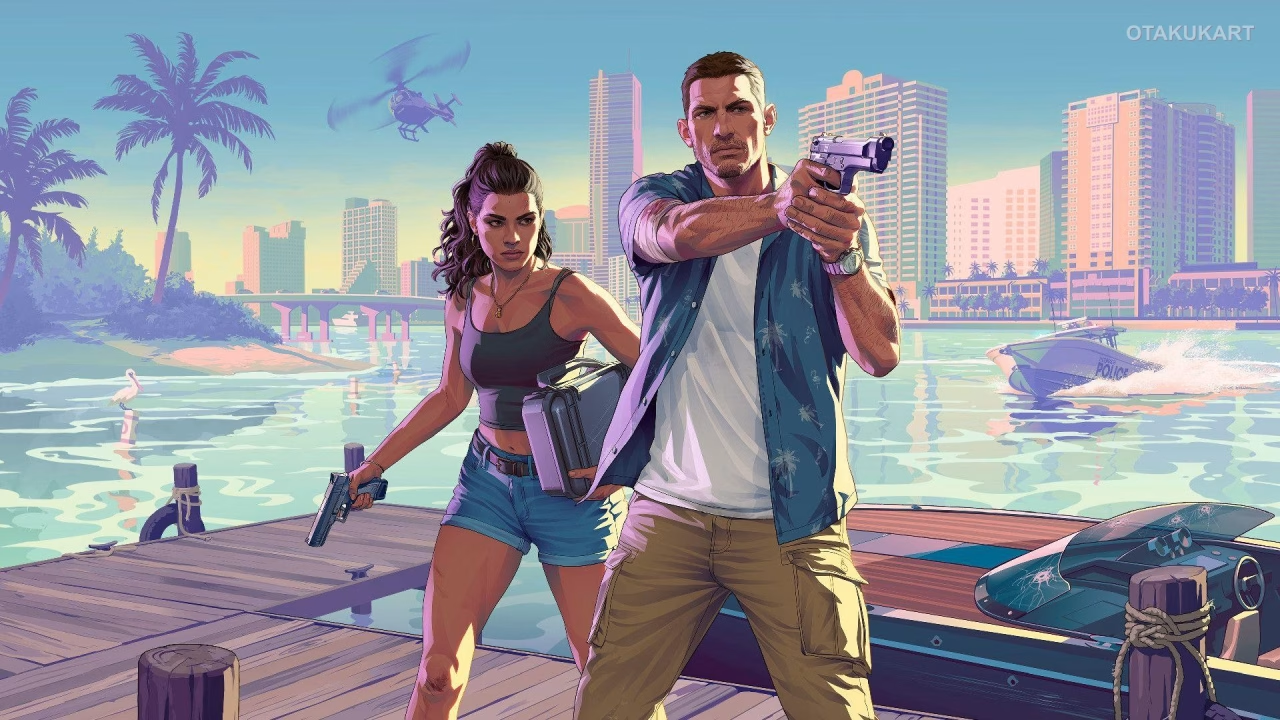
Former Rockstar producer John Ricchio says GTA 6 could be “monstrous,” but Rockstar has not confirmed the map dimensions or install size. Here is how to read the scale talk without mistaking expectation for fact.
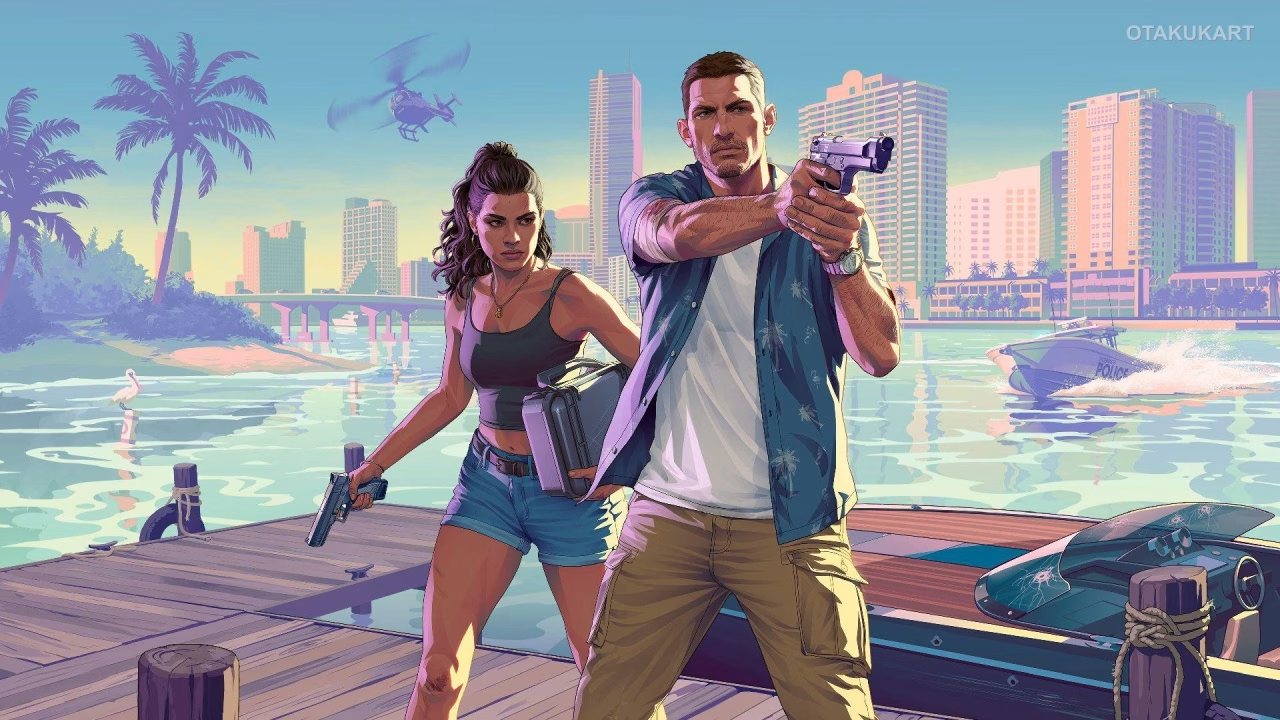
Image: otakukart.com
A former Rockstar producer reignited the GTA 6 size debate
The sharpest new comment about GTA 6 size does not come from a Rockstar spec sheet. It comes from former Rockstar producer John Ricchio, who worked on Grand Theft Auto 5 and Red Dead Redemption, according to GamingBolt and TheGamer. Speaking about Rockstar’s habit of expanding its worlds between entries, Ricchio said, “The fact that every single time they do a GTA, it’s ludicrously bigger than before is like something that I think about. Like, I can only imagine the size of GTA 6. Like it must be monstrous. Or if not monstrous, it’s probably way more detailed.”
That quote is useful because it captures the expectation around Rockstar’s next open world, but it is also easy to overread. Ricchio is a former producer, not a current Rockstar spokesperson giving current technical details. The former Rockstar producer GTA 6 comment is an informed outside perspective based on the studio’s history, not confirmation of a specific Grand Theft Auto 6 map size, file size, number of regions, or amount of playable interior space.
The tension around the quote is exactly where the real story sits. GTA 6 is expected to be enormous because Rockstar has trained players to expect escalation, but “monstrous” can mean several different things. It can mean square mileage. It can mean dense streets, swamps, beaches, traffic, interiors, and side activities. It can mean a huge production budget. It can also mean a punishing GTA 6 install size that forces console owners to clear space before launch. The word is cinematic, but the questions are practical.
Rockstar’s size reputation is built on escalation, not a confirmed number
Ricchio’s point rests on a visible pattern. As GamingBolt summarizes his comments, he described GTA 5 as significantly bigger than GTA 4, and said Rockstar’s worlds were continually growing between GTA and Red Dead Redemption. TheGamer also notes that Ricchio tied that escalation to an expectation around Rockstar releases, where each new open-world entry is assumed to outscale the last one.
That history matters, but it does not answer the key reader question: how big is the Grand Theft Auto 6 map? In the source material provided, Rockstar has not published a measured map size, a comparison chart against GTA 5, or a full technical breakdown of Leonida. GamingBolt says players are still waiting to see more of Leonida and the activities available there. That leaves the conversation suspended between reasonable expectation and missing official detail.
For an action-adventure game, scale is never a neutral number. A larger map can give missions room to breathe, especially in a crime saga built around pursuits, escapes, stakeouts, roadblocks, and sudden turns from quiet driving to chaos. It can also damage pacing if the geography stretches every objective into transit. Rockstar’s best set-pieces work because the city feels staged for momentum: an alley that cuts into a boulevard, a bridge that becomes a trap, a coastline that turns a chase into a change of vehicle. If GTA 6 is larger, the better question is whether that scale creates rhythm, pressure, and surprise, rather than empty distance.
Retailer listings point toward breadth, but they are not Rockstar confirmation
Some of the strongest recent scale signals have come from store listings rather than Rockstar. ScreenRant reported that an Amazon Brazil listing for Grand Theft Auto 6, later altered, described players exploring “Vice City, beaches, swamps, small towns, and various regions of Leonida.” ScreenRant also reported that Brazilian retailer Kabum had listed the map as “the most massive, dense, and insane map ever created by Rockstar Games,” with language about neon-lit Vice City, dangerous swamps, crowded beaches, realistic suburbs, and Leonida stretching from end to end. That Kabum listing was also described as since altered.
Those listings are relevant because they line up with the public expectation of a broad GTA 6 open world: city, wetlands, coastline, suburbs, and multiple regions rather than one urban core. They are also weaker than a Rockstar announcement. ScreenRant’s own report cautions that the details were not confirmed by Rockstar, despite the headline framing the map size as officially confirmed. That distinction matters. A retailer description can be based on publisher-supplied copy, placeholder marketing language, localized wording, or an earlier draft. Once altered, it becomes a signal to track, not a fact to lock in.
The interesting word in the retailer language is “dense.” Ricchio’s own quote leaves room for that interpretation when he says GTA 6 could be monstrous, or if not monstrous, “way more detailed.” Dense design is where Rockstar’s worlds tend to earn their reputation. A beach is only valuable if it changes the way missions unfold. A swamp is only valuable if it creates different routes, sightlines, police response, wildlife pressure, or environmental hazards. A suburb is only valuable if it shapes social texture and pursuit flow differently from downtown Vice City. The map can be wide, but the game lives in the friction between places.
The GTA 6 install size is still unannounced
The most immediate practical version of the size question is storage. On that front, the confirmed answer remains simple: Rockstar has not announced the GTA 6 install size in the provided source material. ScreenRant’s file-size report says the exact file size for Grand Theft Auto 6 has not been revealed, even as fans speculate about how much space the game could require.
That report cites a Reddit prediction of roughly 200GB to 250GB at launch, along with other fan estimates. One commenter compared the possible figure to Red Dead Redemption 2 taking 150GB on PC and guessed around 225GB. Another argued that a required SSD could reduce duplicated data and put the game closer to 140GB to 170GB. Others landed around 180GB to 210GB. These are fan estimates, not published requirements.
The historical comparison is striking but limited. ScreenRant notes that GTA 5 required only 8GB when it first launched on PlayStation 3 and Xbox 360, then grew substantially across later releases, especially on PC. That does not let anyone calculate GTA 6’s final footprint. Modern asset quality pushes sizes upward, while console SSD architecture and compression can push duplication downward. Until Rockstar, PlayStation, Xbox, or an official storefront publishes storage requirements, any exact number should be treated as speculation.
For players planning their consoles, the best guidance is to wait for official preload details before deleting half a library. If GTA 6 lands anywhere near the fan estimates circulating now, it will be one of the major storage events of its launch window. But no current source here supports treating 200GB, 225GB, or any other number as confirmed.
A huge budget can encourage huge expectations
The scale discussion is also being shaped by the business weight around the game. GamingBolt reports that GTA 6’s budget reportedly crossed $2 billion according to UK government records. The same outlet says analyst firm Newzoo noted the magnitude of the pre-order campaign, estimating about $260 million in first-week revenue and projecting, if momentum holds into launch, first-week sales of 37 million at the low end and 51 million near the top end.
Those figures are reported estimates, not design documentation. They do, however, explain why every size claim around GTA 6 travels so quickly. When a game is framed as a commercial event at that scale, players start looking for proportional proof inside the product: a bigger map, more regions, more missions, more activities, more simulation, more technical spectacle. The danger is that marketing gravity can flatten all those questions into one demand: make it bigger.
Bigger is the easy sell. Better is harder. Better requires missions that use the world with precision. It requires traversal that stays expressive after the tenth hour. It requires combat arenas that do not feel randomly dropped into a giant backdrop. It requires a wanted system, traffic flow, and environmental design that can support both quiet character scenes and explosive escapes without breaking the illusion. If GTA 6 is truly monstrous, the design challenge is making the monster move with purpose.
The real test is density, pacing, and how Leonida plays under pressure
From a player’s seat, the most important GTA 6 size question is not whether Leonida is larger than GTA 5’s map in raw acreage. It is whether the world can sustain story pacing and emergent chaos without becoming slack. GTA’s rhythm has always depended on contrast: cruising and catastrophe, planning and improvising, a clean route turning into a desperate scramble. A massive world helps when it gives those transitions space. It hurts when it pads the time between them.
That is where Ricchio’s “or if not monstrous, it’s probably way more detailed” line deserves attention. Detail can outperform distance. A smaller district with layered routes, believable crowds, readable landmarks, and useful interiors can produce stronger action than miles of low-interaction scenery. A dense GTA 6 open world would make every getaway feel authored and unstable at the same time, with shortcuts, traffic patterns, water routes, and regional personality all affecting the player’s choices.
The retailer descriptions reported by ScreenRant, if they reflect the final game in broad strokes, suggest Rockstar is aiming for environmental variety across Leonida: Vice City, beaches, swamps, small towns, suburbs, and multiple regions. Variety alone will not decide the game’s quality. The decisive question is whether each area changes the verbs. Does a swamp chase feel different from a freeway pursuit? Does a crowded beach alter stealth, police response, or movement? Do small towns provide narrative pressure rather than postcard scenery? Those answers are still unannounced.
How to read the next wave of GTA 6 size claims
Right now, the confirmed picture is narrower than the conversation around it. GamingBolt reports that Grand Theft Auto 6 is headed for Xbox Series X/S and PS5 on November 19. Ricchio, a former Rockstar producer credited by outlets with work on GTA 5 and Red Dead Redemption, says he can only imagine GTA 6’s size and expects it to be monstrous or much more detailed. Store listings in Brazil, according to ScreenRant, have referred to Vice City, beaches, swamps, small towns, suburbs, and regions of Leonida, but those listings were altered and were not Rockstar confirmations. Rockstar has not confirmed the install size in the source material.
That leaves players with a sensible checklist. Treat former-developer comments as context, not current production disclosure. Treat altered retailer text as a clue, not a guarantee. Treat fan storage estimates as planning anxiety, not technical requirements. Watch for official storefront updates, preload listings, platform storage requirements, and a gameplay presentation that shows how Rockstar is using Leonida in motion.
The healthiest expectation for GTA 6 size is not blind faith in the biggest possible number. It is the hope that Rockstar’s next world is large where it needs room, dense where it needs texture, and disciplined where story and set-piece pacing demand control. A monstrous map can impress in a trailer. A great open world has to survive the drive after the explosion, when the player is alone with the road, the radio, the next objective, and the question of whether the world still feels alive.