
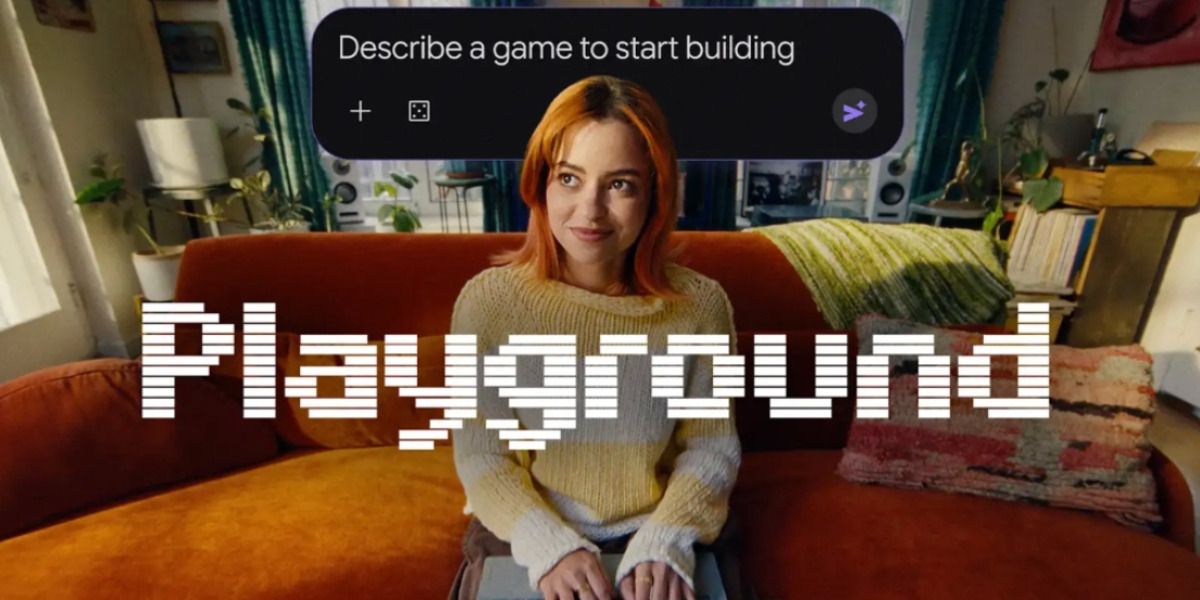

Google has revealed Playground, an experimental browser platform for prompt-made games. The pitch is access, but quality, rights, pricing, and Unity Spark limits define the real test.
Image: pocketgamer.biz
Google’s AI game tool is live, but the real test is still forming
Google has launched Playground, an experimental browser-based game-creation platform that lets users generate simple games from text prompts, with a more advanced Unity-powered version planned for later this year. The concrete news is straightforward: Google is putting prompt-based game creation in front of the public at playground.google, and multiple outlets report that the first rollout is aimed at users aged 18 and older in the United States.
The tension is in the gap between the pitch and the playable reality. Google describes Playground as a way to “create, play, and share custom games” without coding experience, according to its announcement cited by The Verge, GameSpot, TechCrunch, VGC, and Shacknews. Users can type what they want to build, test the result, keep it private, share it through a link, or publish it to a Playground Explore gallery. TechCrunch reports that users can choose a genre such as trivia or racing, start from scratch, specify 2D or 3D, select single-player or multiplayer, and describe mechanics, gameplay, and visual style. The same report says uploaded visuals can be transformed into game assets matched to the game’s art style.
That is the strongest version of Google’s pitch: an AI game development platform that turns intent into something playable in the browser. It is also a pitch arriving in a market that has learned to be cautious about AI tools promising democratization. VGC notes that generative AI remains contentious in games because of plagiarism concerns and the perceived poor quality of results, even as many developers use AI to reduce costs and speed up production. Playground enters with both arguments attached from day one.
The platform pitch is access, iteration, and a new creator funnel
Google’s framing is that game creation has historically been limited to people with technical experience, and that Playground lowers that barrier through a conversational interface. The Verge quotes Google saying users can start from a blank canvas, remix starter prompts, or use guided support, then ask for changes to physics, rules, characters, or environments. That emphasis on iteration is important. Google is not only selling a one-prompt novelty; it is positioning Playground as a loop where players become tinkerers, then creators, then publishers inside Google’s own gallery.
That loop resembles the strategic logic behind Roblox, Fortnite Creative, Minecraft creation culture, and newer AI creator tools, although Playground’s early form appears narrower and more experimental. GameSpot explicitly reads Google’s move as an attempt to take a piece of the Roblox-style user-generated games market, while TechCrunch places it alongside Roblox’s July announcement of a Build feature that lets users create games through natural-language prompts. The Verge also notes Meta’s recent announcement of AI game-building tools for Horizon on phones and the web, with published games able to reach Facebook and Instagram recommendations.
For Google, the value is not only that users can make small games. The strategic value is a pipeline: browser access lowers installation friction, links lower sharing friction, the Explore gallery creates discovery pressure, and token limits connect creation volume to subscription tiers. The Verge reports that Playground is free to use, but Google One subscribers receive higher weekly token limits depending on plan, according to Google spokesperson Nia Carter. TechCrunch likewise reports a weekly token system, with the free tier offering limited tokens and Google One AI subscribers receiving higher usage limits.
There is one access wrinkle worth flagging. The Verge and TechCrunch describe Playground as available in the U.S. for users 18 and older, while GameSpot says the opportunity to make a game is “apparently rolling out” soon and that upgrading a Google One plan lets people get started immediately. Those reports do not fully contradict each other, but they suggest that public availability, creation access, and higher usage limits may not be identical for every user at launch.
Unity Spark is the larger strategic bet, not the launch-day product
The most consequential part of the announcement may be the tool that is not broadly here yet. Google and Unity are tying Playground to Unity Spark, a browser-based AI game creation platform scheduled for beta later this year. VGC reports that Unity Spark will let users generate 3D games with text prompts using assets from Unity’s store. GamesIndustry.biz adds more specifics: Unity Spark runs on the Unity engine, is entirely browser-based with no download required, and will allow users to design and iterate on 3D games through text prompts.
Unity Spark is being announced as part of a strategic partnership with Google, but GamesIndustry.biz reports that it will use a variety of generative AI models and is not exclusively tied to Google’s AI technology. That distinction matters. Google Playground is the consumer-facing platform and publishing surface; Unity Spark is closer to an editor, runtime, and asset economy play. The Verge reports that games made with Unity Spark will be shareable on Playground, and that a closed beta is planned for later this year with a waitlist opening alongside the announcement.
Unity’s pitch also tries to draw a line between tool-assisted creation and instant content sludge. In a blog post cited by VGC and GamesIndustry.biz, Unity CEO Matt Bromberg said Unity Spark is not about “one-shotting” or asking AI to “regurgitate an already invented game.” He framed it instead as a way for people with genre knowledge, visual ideas, or modding experience to build interactive projects worth polishing and sharing. He also emphasized that Spark connects directly to the Unity Asset Store, where creators can build with artist-created assets from Unity’s community.
The Asset Store connection is the key strategic difference from a purely generative toy. In a demo described by GamesIndustry.biz, a prompt for a cape surfaced suggested Asset Store items, while another prompt for a sunrise background produced options. The AI agent could also suggest tools based on user behavior, such as creating a lighting preset toggle, and multiple agents could work at the same time. If that works as described, Unity Spark becomes a browser editor wrapped around assets, agents, and collaboration rather than a standalone image-and-code generator.
The limits are as important as the promise
Unity Spark’s confirmed constraints make the comparison with full game development much clearer. GamesIndustry.biz reports that the Spark editor only runs on desktop browsers, although games made with it can be played on both desktop and mobile browsers. Multiple users can work on the same project by sharing a link. At launch, projects cannot be downloaded or exported to the full desktop Unity engine, and projects made with Unity Spark cannot be sold. Payment will use a credit-based system tied to AI tokens, with some free credits and additional credits available for purchase, although GamesIndustry.biz says the full payment details have not been finalized.
Those limits define the audience. If you want to prototype a small browser game, test an idea with friends, or publish inside Google’s Playground environment, Spark could become useful when it arrives. If you want a commercial pipeline, source-level ownership, engine portability, console deployment, or a path from prototype to a normal Unity project, the announced launch state does not provide that. That is not speculation; it follows from the reported restrictions on export and sales.
This is where Unity’s business incentives become visible. VGC reports that Unity’s share price fell 20 percent last year when Google unveiled its Genie 3 world generation model, and that Bromberg later told the Financial Times the market reaction misunderstood how AI would affect the games industry. His line, as quoted by VGC, was that “AI doesn’t replace software; it uses it.” Unity Spark is the product version of that argument. Rather than letting AI be framed as a threat to engines, Unity is trying to make the engine, runtime, store, and browser workflow the place where AI game creation happens.
For developers and asset creators, the open questions are obvious but still unanswered in the provided announcements. Google and Unity have described access, collaboration, tokens, and publishing surfaces. They have not, in the cited reports, fully detailed moderation rules, IP dispute handling, revenue sharing, long-term project ownership terms, or how asset-store economics will work when AI agents recommend purchasable content inside a creation flow.
Early playable examples show why scrutiny will follow this platform
GameSpot’s hands-on impressions are a useful counterweight to the platform pitch because they focus on the gap between generated presentation and generated play. The outlet describes the initial rollout as underwhelming and points to Volcano Run, whose key image showed a sports car racing on a crumbling road while the actual gameplay appeared to involve a rudimentary rectangular motorcycle-like vehicle in a Tron-like environment. GameSpot also singled out a Unity Spark highlight called Horror Story, where a ghost leading players into a haunted house moved with animation the outlet found unintentionally funny.
The same impressions were not universally negative. GameSpot called Steampunk Match, a match-3 puzzle game about creating combos to stop a boiler from exploding, the most promising experience it tried. The outlet said it felt better than attempts at action-RPG-style games such as Catacombs. That split is important because it suggests the early meta for AI-generated games may favor constrained genres with clear rules, readable feedback, and limited animation demands. Match-3, trivia, simple racing, and lightweight arcade formats are easier to validate than action RPGs, horror pacing, or physics-heavy character games.
From a strategy perspective, that is the first balance problem for Google Playground AI game creation. If the platform’s Explore gallery rewards ratings and play activity, as The Verge reports Google intends, creators will quickly learn which genres the tool handles well and which produce broken expectations. A user-generated ecosystem tends to optimize around the easiest path to attention. If AI-generated cover art looks richer than the game underneath, Google will have to manage a storefront-like trust problem before Playground can become a credible discovery surface.
The broader scrutiny is also about labor and originality. VGC notes plagiarism concerns around generative AI, and Shacknews appended its own policy stating that its staff does not use generative AI in its content and prohibits use of its work for AI training or generation in its style or format. That policy is not about Playground specifically, but it reflects the climate into which Playground is launching. Google says Playground is powered by existing foundation models including Gemini, Nano Banana, and Lyria paired with a custom harness refined through internally built games and evaluations, according to Google spokesperson Nia Carter in The Verge. For many developers, the next questions will be about training data, asset provenance, moderation, and whether AI-made works crowd out human-made ones in discovery spaces.
Who should try Playground now, and who should wait
Based on the reported launch details, Playground is worth trying now if you are in the supported region, meet the 18-plus requirement, and want to experiment with browser games as sketches rather than finished products. TechCrunch reports that games can be played on mobile devices and computers, kept private, shared by link, or published to the Explore gallery. The Verge reports that select genres will support leaderboards and multiplayer, and that the gallery will surface games using ratings and play activity. For a casual creator, that is enough to test whether a prompt can become a playable loop.
If your interest is professional development, Unity Spark is the piece to watch, but the sensible posture is patience. Its beta is scheduled for later this year, according to VGC, The Verge, and GamesIndustry.biz, and its launch-state restrictions are significant. No project export to the full Unity editor and no selling projects at launch are major limits for anyone thinking commercially. The credit system is also not final, so the real cost of sustained iteration remains unclear.
Compared with Unity’s web-based push, Google Playground is the front door and social layer. Unity Spark is the deeper editor layer, with collaboration, the Unity runtime, agents, and the Asset Store. Engadget reports Google’s claim that Spark will unlock professional-level mechanics, high-fidelity 3D capabilities, and the flexibility of the Unity runtime, but those capabilities still have to survive beta testing, pricing decisions, and creator scrutiny.
The forward-looking read is that Google is not returning to gaming in the same way it tried with Stadia. TechCrunch and GameSpot both connect the announcement to Google’s broader history in games, including Stadia’s shutdown, but Playground is a different kind of bet. It does not require Google to win the console, cloud streaming, or premium publishing race. It asks whether AI, browser distribution, and user-generated content can create a new layer of game creation inside Google’s ecosystem. The answer will depend less on announcement-day ambition than on playable quality, rights clarity, fair costs, and whether creators feel they are gaining leverage instead of feeding another platform.