
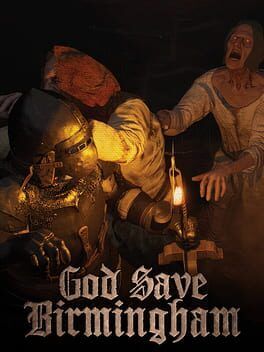

At PAX East, God Save Birmingham turned heads with its physics-driven survival, methodical scavenging, and authentically grim medieval setting. Here is why this brutal undead sim might be one of the most interesting twists on the zombie genre in years, and what we still do not know before it lurches into Early Access.
God Save Birmingham is not another chainsaw-and-molotov power fantasy. On the PAX East floor, Ocean Drive Studio’s medieval zombie survival game stood out precisely because it is small, slow, and frighteningly physical. You are not a spec-ops hero picking perks off a skill tree. You are a miserable peasant in 14th century Birmingham, stuck in a walled market town while thousands of former neighbors shuffle through the streets looking for you.
The demo on show felt less like an open world checklist and more like being dropped into a historical diorama that has gone very wrong. The team has talked about recreating Birmingham at a scale where around 6,000 villagers have joined the undead horde, and you are simply trying to outlast them for as long as possible. That focus on one convincingly realized place immediately separates it from the usual generic forests or post-apocalyptic suburbs that dominate the genre.
What really made the PAX East build memorable was how much of the moment-to-moment survival is driven by physics and improvisation. Nearly everything in the environment has weight and momentum, which turns scavenging runs into clumsy, desperate slapstick that can swing from hilarious to horrifying in seconds. Shoving a barrel into a doorway is not a menu option. You physically drag it into place, feel it fight the cobblestones, then watch it judder when a mass of corpses slams into the other side.
The same mindset applies once the dead get within arm’s reach. You can injure specific limbs to slow or disable enemies, clip a leg to send a zombie toppling, or sever an arm so it can no longer grab you as effectively. It is gruesome, but it also underlines that this is a game about controlling space and momentum rather than racking up headshots. A loose wagon wheel, a stack of timber, or a hanging crate is often more valuable than the sword at your belt if you use it at the right angle.
Combat feels purposefully scrappy. One-on-one, a lone villager zombie is something you can manage, backing up over uneven ground and lining up careful swings. The moment there are three or four, the physics systems turn against you. Bodies jam doorways, trip over each other, and pin you in corners. When one of them grabs hold, you are locked into a panicked struggle while their friends lurch forward. The grapple system the studio is experimenting with in this pre-alpha build might be the single best advert for why groups are to be feared rather than farmed for loot.
If many zombie games are about growing stronger, God Save Birmingham is about feeling fragile. Nowhere is that clearer than in how it treats scavenging and crafting. There is no magical sequence where you punch trees for wood and mash together a stone axe in your inventory. You are a medieval commoner, not a walking crafting bench. If you want an axe, you find an axe. If you want planks, you need tools that can actually cut timber. Until you do, even the simplest upgrades feel out of reach.
This slower cadence gives basic discoveries a weight they often lack. Stumbling into a storeroom with a half-rusted hatchet tucked behind some sacks is not a minor find. It is a moment that reshapes your next few in-game days. Do you risk a longer excursion now that you can break open barrels and dismantle furniture more efficiently, or do you drag your prize back to your current hideout and call it a win?
The same applies to classic survival concerns like food, water, and warmth. Inns, wells, and larders exist where you would expect them in a medieval town, but they are not infinite resources. Water in particular seems tuned to keep you moving, always needing to venture just a little further out of your comfort zone in search of the next drinkable stash. The tension is less about exotic loot and more about whether your next outing will even get you back alive.
Crafting and fortification, at least in this early look, hinge more on clever use of what is already there than on growing a handcrafted base from nothing. Instead of plopping down prefab walls, you are repurposing real spaces that feel like they belong to a functioning town. This slower, more grounded loop makes every expedition a tiny story about what you found, what you dragged home, and what it cost you.
The choice to set all of this in a grimy 14th century market town is God Save Birmingham’s quiet masterstroke. Medieval settings are not new in games, but they are rarely paired with the routines of survival horror. Here, everything about the era adds friction. Architecture is all tight alleys and timber frames. Sanitation is practically nonexistent, which feeds naturally into systems that track cleanliness and scent. Illness and injury carry an edge that is less about magic potions and more about ugly, lethal infection.
This period focus also affects how you read the world. A smithy is not just set dressing. It might be your only hope of finding a hammer tough enough to break through locked shutters. A church is not a generic safe room, but a stone bulwark that could funnel the horde into a choke point if you can figure out how to hold its doors. Because the town is based on a real historical location, it implicitly encourages you to think like someone who lives there rather than a tourist in a sandbox.
It helps that the zombies themselves are not just anonymous flesh piles. They were bakers, guards, vendors. The preview build leans into that sense that you are fighting people the town needed a few days ago. Ocean Drive Studio has even floated the idea of a Guilt system where slaughtering your neighbors might wear on your character’s psyche and subtly distort your perception of reality. Even if that mechanic never ships, the intent speaks to the tone they are chasing. This is not about mowing down thousands of faceless monsters. It is about surviving the death of a community.
Shelter is where all of these ideas collide. There is no snapping down a perfect square of wooden walls on an empty field. With the dead already thick in the streets, carving out somewhere to sleep means invading a real building, clearing it room by room, then physically locking it down. Chairs and tables become barricades. Crates become ramparts. A cart wedged in a side alley might be the only thing stopping a wandering group from spotting your front door.
Because barricades are simulated objects rather than abstract upgrades, they behave in messy, believable ways. Stack things carelessly and zombies will rock them loose as they shove. Place a chest a little too close to a window and you might find it blocking your own escape route as much as theirs. It is a survival game where your mistakes are visible in the layout of your hideout, not just in a stat readout.
That sense of physically wrestling with the environment is what made the PAX East demo stand out amid so many other survival pitches. Where some games chase breadth with sprawling maps and elaborate tech trees, God Save Birmingham is laser focused on the feel of a single desperate night, repeated over and over as you push a little further, stockpile a little more, and try not to make a single fatal misstep.
For all its promise, this was a pre-alpha slice with plenty of unknowns left hanging over it. Performance and AI behavior were still rough, with the kind of pathfinding hiccups and clipping issues you would expect from a game with this many physics objects and shambling bodies. Balancing a town full of simulated props and hundreds of persistent zombies will be a huge technical challenge, especially once players start really stressing the systems with elaborate barricades and improvised traps.
The broader structure of the game is also still a question mark. We know the focus is on open-ended survival, but how a full run is framed remains unclear. Will there be overarching objectives or narrative arcs tied to specific districts and characters, or is Birmingham more of a sandbox where each life is its own emergent story with no fixed end point? The answer will heavily influence how much long-term pull the game has once the basic novelty of the setting wears off.
Progression is another area where the developers have yet to fully lift the curtain. The historical grounding suggests a more restrained approach to character growth, but there are hints of systems tracking infection, cleanliness, warmth, and perhaps even mental state. How these layer together into a satisfying long-term arc without undermining the grounded tone is still unknown. A world this harsh needs some sense of advancement, but tip too far toward gamified perks and you risk losing the fragile vulnerability that makes the early hours sing.
Then there is the question of how the horde will scale over time. The ambition to populate Birmingham with thousands of undead residents is exciting, yet the preview naturally only showed small slices of that crowd in action. How the game will handle different districts waking up, whether the dead migrate in response to noise and routine, and how your presence reshapes the town’s danger profile are all unanswered. The fantasy of surviving in one living, dying city really depends on those big-picture behaviors panning out.
Even with those open questions, it is easy to see why God Save Birmingham turned heads at PAX East. It is not trying to reinvent survival from the ground up so much as strip it back to its meanest essentials, then reframe them through the lens of a specific, believable place. By leaning into physics, scarcity, and the grim reality of medieval life, Ocean Drive Studio might have found one of the few remaining angles that can make zombies feel unsettling again.
As an early look, the demo is more promising proof of concept than finished product, but it is a compelling one. If the team can maintain that oppressive, improvisational feel while solving the technical and structural puzzles that come with it, God Save Birmingham could emerge as one of the most distinctive survival experiences on the horizon. Until we see more of the full town and the systems that govern it, Birmingham’s bleak future remains intriguingly uncertain.