
Genigods: Nezha is a 2028 PS5 and PC action RPG steeped in Chinese creation myth. We break down the reveal trailer, divine weapon combat, and the long road ahead in a crowded character‑action field.
Genigods: Nezha arrived with a five‑minute reveal that feels like a mission statement. This is a hardcore, single‑player action RPG built in Unreal Engine 5, aiming to blend Chinese creation myths with blisteringly fast, high‑impact combat. It is also a game targeting a distant 2028 release window, which makes its first impression carry even more weight.
Below we break down what the trailer actually shows, how it leans on Chinese mythos, what the “divine weapon” and water‑based combat systems promise, and what Genigods: Nezha will need to get right if it wants to sit alongside heavy hitters like Devil May Cry, Stellar Blade, Black Myth: Wukong and modern God of War rather than just be compared to them.
A trailer built like an epic prologue
The trailer opens not with bombast but with creation. We see the Spirit Pearl, a luminous artifact cradled by Nüwa, the Goddess of Life, against a chaotic primordial sky. Rather than immediately dropping into combat, the game spends precious seconds on visual storytelling: clay, water, and celestial light swirling as the Spirit Pearl is sculpted into a human form.
That early focus is important. A lot of character‑action trailers jump straight to particle effects and boss scream‑offs. Here, Genigods Lab uses the reveal to anchor the action to a mythic throughline. You start as a celestial artifact, become the first human, and eventually return as the legendary Nezha. The trailer cuts between these stages as if flipping through chapters of a mythological chronicle.
Once the combat starts, the pacing shifts hard. Shots of serene god‑scapes give way to rapid‑fire exchanges on broken bridges in the clouds, crumbling mountain temples, and along the bodies of colossal deities. The camera hugs in close on Nezha’s martial arts choreography, then abruptly pulls back to show her sprinting up walls or darting across a god’s arm like an ant on a living mountain.
What stands out is the sense of verticality and momentum. Nezha rarely stays grounded for long. Even basic looking strings end with a launch or a chase into the air, and the trailer constantly cuts between ground rushdowns and aerial follow‑ups, suggesting that juggling enemies between planes will be a core part of the game’s rhythm.
Chinese creation myth as scenario, not just dressing
A lot of action games nod at mythology through enemy names and background lore. Genigods: Nezha is positioning Chinese myth as the foundation of its set‑pieces.
The trailer and press materials line up around early genesis stories. Nüwa, credited with crafting humanity and repairing the sky, literally shapes the protagonist out of clay and divine water. The game frames you as the “heart of creation,” a concept the trailer reinforces with shots of Nezha standing at the intersection of shattered celestial rings and a broken heaven.
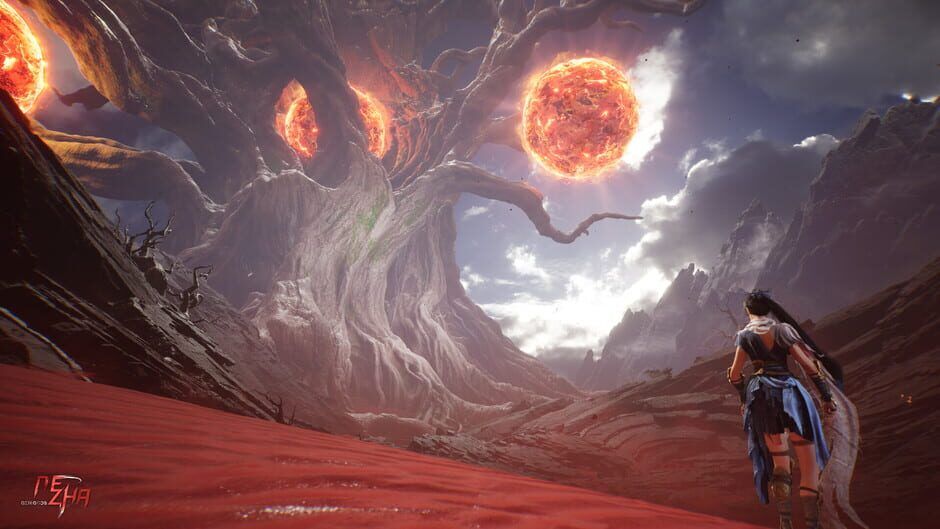
Iconic figures and tales flash through the footage. The giant Kuafu appears, not as a simple boss, but as a partner that you climb and fight alongside as you scale the Sun Tree. That tree itself acts as a massive level structure, a living bridge between mortal and celestial realms. Far above, the Nine Suns float like burning wounds, until Nezha draws a bow and looses an arrow that tears one from the sky.
Crucially, these aren’t framed as optional side stories. The trailer implies that these myths are the spine of the campaign. You are not just roaming a vaguely “mythical” China, you are walking through foundational legends: chasing the suns, mending heavens, rewriting origin stories by force of will and weapon.
If Genigods Lab follows through on that framing, it could differentiate itself from other mythology‑infused games by treating myth as level design and mission structure rather than just lore flavor. The reveal trailer is already hinting at that approach with every big set‑piece being a known story reinterpreted for interactive spectacle.
Divine weapon combat and the water philosophy
On the mechanical side, the trailer doubles down on two big pillars: a “divine weapon” toolset and a combat philosophy drawn from Bruce Lee’s Jeet Kune Do.
Nezha fights with what the studio describes as Divine Water, which behaves almost like a shape‑shifting weapon. The trailer shows blades that liquefy and reform mid‑swing, kicks that explode into dragon‑shaped torrents, and charged strikes where water condenses into a tiny, high‑pressure impact point.
Two techniques are called out in marketing that match what we see on screen. One‑Inch Flash reads like a Jeet Kune Do homage, channeling Divine Water into an armor‑breaking, ultra short‑range burst that dents heavily armored foes. In trailer cuts, it looks like a compact shockwave that instantly staggers chunky enemies before flowing into launchers or aerial strings.
Dragon’s Kick, by contrast, is all about control. Nezha spins low, trailing a crescent of water that sweeps groups off their feet. In footage, it doubles as both a crowd‑control tool and a way to reposition, letting her cancel out of pressure and redirect into flanks or aerial chases.
Underneath the flashy effects, there is a clear philosophy: water adapts, yields, then strikes. Parry flashes, well‑timed dodges, and counter hits dominate the fighting clips. Rather than pure aggression, Genigods: Nezha appears to reward reading patterns, baiting, and firing back with precise, high‑impact responses. That aligns with the “hardcore” positioning, but it is expressed through fast, flowing motion instead of the heavier, shield‑and‑axe cadence of something like God of War.
The divine weapon aspect goes beyond movesets. The trailer and press blurbs mention a system where treasures found in the world can be combined to forge unique skills. Bits of that show up as Nezha deploys short‑lived mythic powers, such as spectral arms that sprout mid‑combo or brief transformations toward her fabled three‑headed, eight‑armed form. If that customization is meaningful rather than just cosmetic, it could give players a lot of agency in how they route combos and respond to different enemy archetypes.
Ground‑to‑air combat that leans into spectacle
The trailer puts real emphasis on seamless transitions between ground and aerial combat. In practice, that shows up in a few recurring patterns.
We see launchers that send enemies aloft, followed by Nezha instantly dashing up to meet them with mid‑air strings. She cancels from aerial slashes into short stalls that let her reposition above foes, then drives them back down in shockwave finishes. In other segments, she uses environmental elements like falling debris or godly limbs as anchor points to reset jumps or extend airtime, keeping the fight suspended longer than a single jump should allow.
The dual stance idea appears when she shifts from a fast, almost spear‑like style into heavier, more sweeping attacks without a hard pause. There are hints of a grounded “stance” emphasizing quick counters and a more aerial or aggressive state built for extended juggles and area coverage. If those stances genuinely alter frame data and properties instead of just animations, it could offer the kind of depth character‑action fans look for.
Importantly, the spectacle is tied to combat clarity rather than obscuring it. Visuals are dense, but the key telegraphs are readable: big wind‑ups for boss swings, distinct color cues on parryable blows, and a clean silhouette on Nezha despite the water effects. That is essential if the team wants to appeal both to spectacle‑hunters and players who care about tight, learnable systems.
The 2028 window: plenty of time, and plenty of risk
Announcing a completely new IP with a 2028 window in 2026 is a bold move. It signals two things. First, Sony and Genigods Lab are comfortable committing to a long road, which suggests they see franchise potential here instead of a one‑off experiment. Second, the studio is inviting years of comparison to whatever the character‑action landscape looks like by the time the game actually arrives.
From a technical angle, the trailer already looks like a strong Unreal Engine 5 showcase. Wide shots of the Sun Tree, dense volumetric lighting as suns burn overhead, and detailed godly anatomy are the sort of elements that can age well if they are grounded in good art direction rather than pure tech flex. The risk is less about visuals aging out and more about mechanical expectations shifting.
By 2028, players will have had multiple post‑Wukong mythological action games, further evolutions of Soulslikes, and whatever comes next from studios like Team Ninja and Platinum. Genigods: Nezha will be judged not only against what we see today, but against years of iteration across the genre. The long runway is an opportunity to refine and respond to emerging trends, but also a pressure cooker where early hype can turn into skepticism if updates feel thin.
What Genigods: Nezha needs to stand out
The trailer makes a strong first impression, but the character‑action arena is brutally competitive. For Genigods: Nezha to do more than ride the wave of comparisons, it will need to convert its surface hooks into deep, memorable systems.
The first key is to fully commit to its mythic identity. Using creation myths as set‑piece backdrops is a great start, but the game will stand out more if the player’s choices truly “write a line into the epic,” as the studio phrases it. That could mean branching encounters in which how you resolve a myth changes later scenarios, or mechanical consequences for decisions you make during legendary events. If the ending of the Nine Suns tale can play out in different ways depending on how you fight it, for example, the game moves from retelling legend to actively rewriting it.
Second, the divine weapon combat will need depth equal to its spectacle. The water philosophy is a smart differentiator, but players will sniff out shallow systems very quickly. To compete with the likes of Devil May Cry or Bayonetta, Genigods: Nezha should offer: expressive combo routing that rewards labbing, enemy types that force you to use the full toolset, and difficulty options or modifiers that encourage mastery without locking casual players out.
The mention of combining treasures to forge skills hints at a build layer. For it to matter, those combinations have to go beyond just damage bumps. Tying certain crowd‑control tools, parry windows, or stance properties to player‑selected relics would give the game a bit of character‑action DNA blended with light character building, making replays feel different rather than just harder.
Third, the game’s approach to accessibility and input could be an important differentiator. TechRadar’s coverage notes that the team is interested in marrying high‑end action with more approachable control options, invoking Street Fighter 6’s modern and classic schemes. If Genigods: Nezha can ship with both deep, manual combo inputs for veterans and streamlined options that let newcomers enjoy the spectacle without clawing the pad, it could broaden its audience without diluting its identity.
Finally, pacing and structure will matter as much as raw combat feel. The trailer hints at a journey that spans realms and reincarnations, but the final game will need to thread story, traversal, and combat into a cohesive arc. Colossal god battles and Sun Tree climbs are memorable only if they are surrounded by quieter beats that develop Nezha’s identity, interrogate her role as both artifact and human, and dig into her relationship with figures like Nüwa and Kuafu.
If Genigods Lab can deliver on those fronts, Genigods: Nezha has a shot at being more than “the Chinese God of War” shortcut some outlets are already leaning on. The reveal trailer shows a team with a clear visual and mechanical thesis. The next few years will decide whether that thesis evolves into one of the PS5’s defining action RPGs or remains a gorgeous, ambitious curiosity from a promising new studio.