
Gears of War: E-Day supports Xbox and PC crossplay, but split-screen, account setup, Horde Siege grouping, and weapon unlocks all affect how squads should organize before playing.
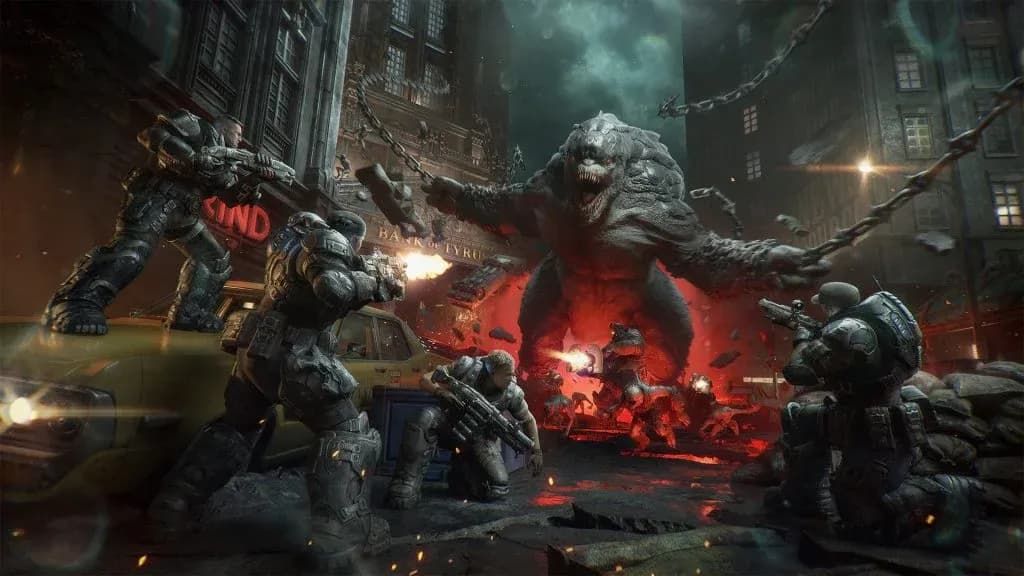
Image: games.gg
Gears of War E-Day crossplay covers Xbox and PC, but grouping is not friction-free
The key confirmed detail for anyone planning a squad is straightforward: Gears of War: E-Day supports crossplay between Xbox and PC. Gamepur reports that E-Day is available on Xbox Series X|S and PC through the Microsoft Store and Steam, and says the Steam page lists Cross-Platform Multiplayer and cross-platform invites among its features. That puts Xbox console players, Microsoft Store PC players, and Steam players in the same practical matchmaking and invite conversation.
The tension is in the setup around that support. According to Gamepur, a Microsoft account is required to play E-Day, and players must accept the Microsoft Services Agreement. Account linking is described as optional, but Gamepur ties it to roaming saves, friend connections, and cross-platform invites. In other words, Gears of War E-Day crossplay may be supported at the platform level, but squads should make sure every player has the account side handled before the first session.
For mixed-platform groups, the safest planning assumption is simple: online co-op is the shared lane. Xbox and PC players can play together, but local split-screen has platform limits, and the available source material does not describe PC local co-op. If your group includes a couch pair on Xbox and remote friends on PC, Games.gg reports that the Xbox split-screen pair can also connect online to fill out a four-person campaign squad.
Campaign co-op is built around Bravo Squad’s four seats
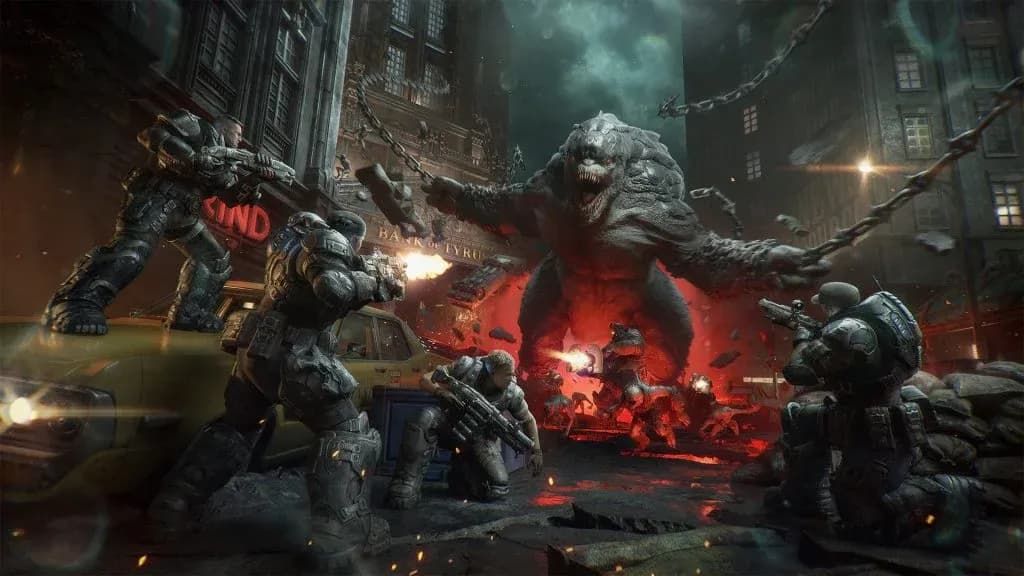
Games.gg reports that the E-Day campaign supports up to four players online, with each player controlling one member of Bravo Squad: Marcus Fenix, Dominic Santiago, Mags Carter, or Lucas Reyes. The same guide says all four characters are available from the first mission, so nobody in a full party has to unlock a co-op slot before joining.
That matters for pacing. This is not a co-op setup where latecomers are waiting for a class gate just to play a specific campaign role. The campaign can be played solo with AI companions filling empty seats, according to Games.gg, and real players take those squad positions when they join. Downed teammates can be revived, and Games.gg also notes that Drones pinning a downed player can be pulled off or shot from range. For a shooter squad, that makes spacing and callouts matter immediately.
There is one useful accessibility detail for mixed-skill groups. Games.gg says each co-op player can choose their own difficulty independently. If one player wants Insane and another wants a calmer first run, the squad does not have to standardize around the least experienced player or the strongest one. That is a smart fit for a game likely to pull together returning Gears players, Game Pass browsers, and PC friends who may be arriving from outside the series.
Split-screen is Xbox-only, while PC players are online-only
The biggest limitation in the Gears E-Day co-op setup is local play. Games.gg says two-player split-screen is available on Xbox Series X|S only, and that the PC version, whether through Steam or the Xbox app, does not support local split-screen. Gamepur also lists split-screen as two players on console only. A separate Gears of War: E-Day wiki page likewise states that split-screen is limited to console hardware.
That creates a clean but important dividing line. If two players are on the same couch with an Xbox Series X|S, they can use split-screen. If the same two players are on PC, the source material says they need online co-op instead. For a group organizing around Gears of War E-Day platforms, this is the detail most likely to cause launch-night confusion.
There are also co-op rules that affect how a session feels once it starts. Games.gg reports that solo play pauses normally, but in co-op only the host can pause. Everyone else opening a menu leaves the action moving. The same guide says the campaign supports up to five separate playthrough saves, which should help players keep a solo run separate from different co-op groups. It also describes a ping system that lets players mark enemies, objects, and locations while aiming, with squadmates able to see those markers through walls. For squads without headsets, that could be the difference between a clean flank and a wipe.
Horde Siege details have one important source conflict
Horde Siege is where the public guide information needs careful reading. Gamepur describes Horde Siege as a co-op wave-survival mode where players drop in as a four-player squad. Games.gg, however, describes E-Day as having a 12-player Horde Siege mode. VGTimes also refers to a 12-player Horde Siege mode. Those statements are not identical, and the provided material does not include an official mode ruleset that resolves the difference.
The least risky way to read it is that players should treat four-player grouping as the clearly repeated squad unit, while recognizing that some guides describe the broader Horde Siege mode as supporting 12 players. Until Microsoft, The Coalition, or an official store listing spells out whether that means three squads, a larger shared activity, or a different matchmaking structure, players should avoid assuming that all 12 friends can form one conventional party.
That distinction matters because E-Day’s co-op identity changes depending on the mode. Campaign is framed around four Bravo Squad characters. Horde Siege appears to be tied to classes and long-term unlocks. A four-person group can plan around roles and progression with confidence based on the cited guides, but a larger community night should wait for official lobby and party-size confirmation before locking plans.
Versus is 4v4, and crossplay puts PC and Xbox aim cultures together
For competitive players, the available sources point to 4v4 Versus. Gamepur describes Versus as competitive multiplayer for up to eight players across supported platforms, while Games.gg and VGTimes both refer to 4v4 Versus. That gives Gears of War E-Day multiplayer a smaller, tighter team structure than large-scale arena formats, which fits the series’ usual emphasis on cover control, close-range shotgun fights, and coordinated pushes.
The crossplay angle is still worth watching. The source material confirms Xbox and PC crossplay, but it does not provide details on input-based matchmaking, crossplay toggles, ranked restrictions, aim-assist behavior, or netcode settings. Those are the questions that determine how fair a mixed-input competitive pool feels over time. A Steam listing flag for cross-platform multiplayer tells players they can connect across ecosystems; it does not, by itself, answer how E-Day separates or blends controller and mouse users in serious matchmaking.
For now, the practical advice is to test crossplay in casual or private sessions before treating it as your ranked default. If your group is split between Xbox and PC, confirm invite flow, voice setup, and comfort with the mixed lobby environment early. The sources support cross-platform play, but they do not yet support claims about competitive safeguards.
Loadouts are split between campaign pickups and Horde Siege class progression
The broader co-op structure makes more sense when you look at how E-Day handles weapons. GamingBolt’s unlock guide says the campaign includes a large arsenal, but much of it is tied to progression. The guide reports that finding weapons during the story unlocks them in Supply Caches, while Horde Siege requires players to reach specific levels with a given class to unlock weapons permanently.
That means a campaign squad and a Horde Siege squad are likely to think about gear differently. In the campaign, GamingBolt lists early weapons such as the Snub sidearm and Gnasher shotgun as Act 1, Chapter 1 pickups, with the Lancer Mk1 and Hammerburst appearing in Act 1, Chapter 2. Later weapons include the Gut-Puncher grenade launcher in Act 1, Chapter 4, the Breechshot in Act 2, Chapter 1, and the Prototype Lancer and Longshot in Act 2, Chapter 2. GamingBolt also lists character signature weapons, including Fenix’s Signature Proto Lancer, Santiago’s Signature Gnasher, Reyes’ Signature Longshot, and Carter’s Signature Gut-Puncher, but says those signature weapons are unavailable in Horde Siege.
Horde Siege class progression is where group planning gets sharper. GamingBolt lists the Snub as a starting weapon for Assault, Breacher, Marksman, and Medic. The Gnasher is a starting weapon for Assault, Breacher, and Medic, while Marksman unlocks it at level 6. The Hammerburst starts with Marksman and Medic, but unlocks at level 4 for Assault and level 6 for Breacher. The Longshot starts with Marksman, while Assault unlocks it at level 17, Breacher at level 25, and Medic at level 30. If your squad is trying to cover close-range breach power, precision fire, and utility without duplicating roles, those unlock timings matter.
The takeaway for a Gears E-Day guide is that crossplay gets everyone into the same ecosystem, but progression still shapes what each player can actually bring. A PC friend joining an Xbox squad can play with the group, but their Horde Siege class level determines their spawn options. Before grinding wave survival, decide who is committing to which class so the team is not waiting until level 30 for a weapon it assumed would be available on demand.
Best setup advice before you invite the squad
For most players, the cleanest setup is a four-person online campaign group across Xbox Series X|S and PC, with everyone signed into the required Microsoft account setup before party time. If two players are on the same Xbox, use split-screen and bring the remaining players online. If anyone is on PC, do not plan around local split-screen, because the cited guides say it is not supported there.
If your group intends to bounce between Xbox and PC, Gamepur reports that E-Day supports Xbox Play Anywhere, with a single purchase covering Xbox consoles and PC at no extra cost, plus shared progression and achievements across both. Gamepur also says the game is optimized for handheld play on Steam Deck, Xbox Ally X, and Xbox Ally devices, which may help players who rotate between desktop and portable sessions. Those are useful platform details, but players should still verify storefront language before buying, especially if they care about Steam versus Microsoft Store ownership.
The remaining unknowns are mainly competitive and large-mode specifics. The sources support Xbox and PC crossplay, campaign co-op up to four online players, console-only two-player split-screen, and 4v4 Versus. They conflict or differ in wording around Horde Siege scale, with Gamepur emphasizing a four-player squad and Games.gg and VGTimes describing a 12-player mode. Until official materials clarify the lobby model, plan Horde Siege around your core four and treat larger arrangements as unconfirmed. That is the least painful way to get into E-Day without your squad discovering the fine print after everyone has already cleared the night.