
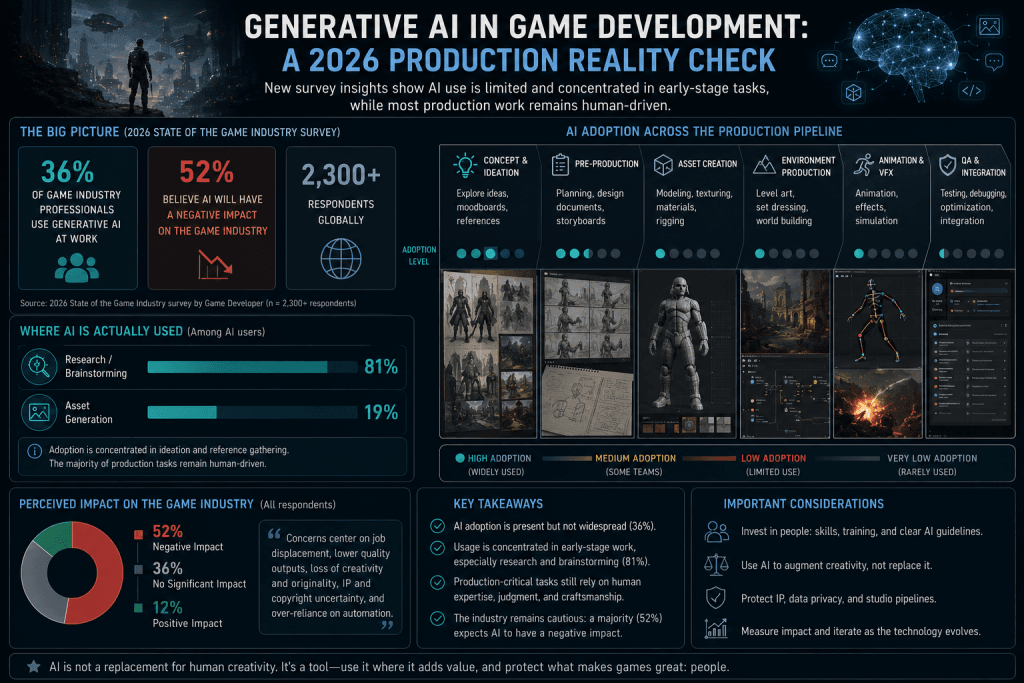

The latest GDC State of the Game Industry report says 40 percent of surveyed game professionals use generative AI at work, even as 55 percent say AI is hurting games.
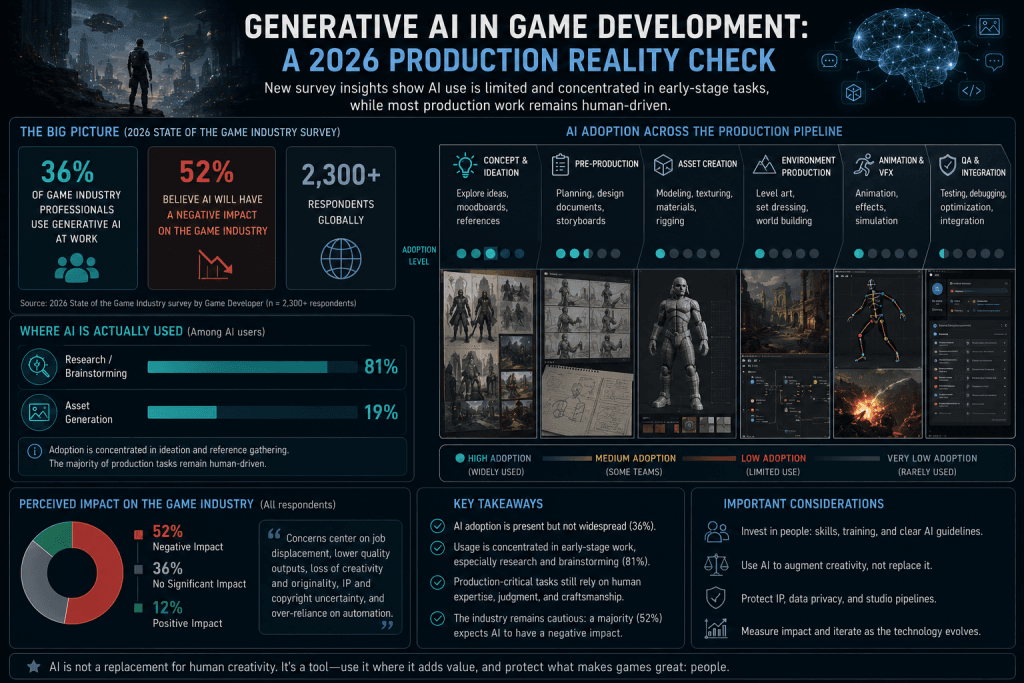
Image: nastyrodent.com
Adoption is rising, but approval is not following it
The latest GDC State of the Game Industry report says 40 percent of surveyed game industry professionals now use generative AI tools as part of their job, up from 36 percent in the previous report. That is the hard number driving the new round of debate around AI in game development, but it lands beside an equally important counterweight: according to GamesIndustry.biz and Eurogamer’s coverage of the report, 55 percent of respondents said AI is having a negative impact on games.
That split is the story. The GDC generative AI survey does not show a clean march toward industry-wide enthusiasm. It shows a toolset becoming harder for studios to ignore while many workers remain unconvinced, hostile, or worried about the pressure attached to its use. GamesIndustry.biz quoted GDC survey project lead Beth Elderkin describing the shift as a move from theory to actuality: people now know the technology, know how often it appears in daily work, and have firmer views on whether they want to use it.
There is also a small but notable source discrepancy around the size of the survey pool. GamingOnLinux, Shattered, and GameNGuide cite more than 2,600 responses, while Eurogamer describes more than 2,300 respondents including developers, producers, marketers, executives, and investors. The shared takeaway across the provided coverage is consistent, however: the 2026 GDC state of the game industry report records a four-point increase in reported workplace generative AI use, while negative sentiment remains higher than adoption.
The most common uses are support tasks, not a single AI-made-game pipeline
The survey details reported by trade outlets point toward generative AI being used most often in support, planning, and production-assistance roles. GamesIndustry.biz reports that 57 percent of developers using the technology employ it for text generation, research, early prototyping, coding, and presentations. The Verge’s coverage of the GDC survey gives a more granular cut, saying respondents who use AI reported research and brainstorming at 73 percent, data analysis and summarization at 62 percent, and code generation and debugging at 56 percent.
Those categories matter because they describe the first places studios tend to test a risky tool: work that is internal, iterative, and easier to review before it reaches players. Research summaries, draft pitch materials, prototype scripts, localization experiments, and debugging assistance can all sit upstream of final content. That does not remove the controversy, but it explains why adoption can rise even while developers reject the idea of handing over final creative authorship.
Other coverage adds that usage is frequent among adopters. GameNGuide and Shattered report that 57 percent of AI users said they use these tools daily. If that figure reflects the GDC report’s adoption pool, it suggests generative AI is becoming a recurring workflow layer for many who have crossed the threshold, rather than an occasional curiosity. The strategic risk for studios is obvious: once a tool becomes daily infrastructure, policy written after the fact has to govern habits that may already be embedded in production.
Mobile, free-to-play, and business teams are leading the curve
The strongest adoption signals are not evenly spread across the industry. The Verge reports that usage was higher among developers working on free-to-play games, at 58 percent, and among mobile-only studio workers, at 70 percent. GamesIndustry.biz also says generative AI is most popular with business operations and services, mobile-only studios, and free-to-play developers.
That distribution tracks with the economics of those sectors. Free-to-play and mobile development often involve fast content iteration, live operations, user acquisition testing, data-heavy decision-making, store-page experiments, customer support workflows, and constant presentation of performance metrics to internal stakeholders. The reported use cases of summarization, research, text generation, presentations, and data analysis fit that environment more naturally than they fit a boutique narrative studio trying to protect a tightly authored voice.
The age and gender splits reported by Eurogamer add another wrinkle. According to its summary of the GDC report, 54 percent of respondents aged 45 or older reported using generative AI tools, an eight-point increase from the previous year. Eurogamer also reports higher usage among men, at 45 percent, than women, at 33 percent. The source material does not explain the cause of those gaps, so they should not be overread. They do, however, underline that “game developers using AI” is not a single demographic or creative identity. Adoption is being shaped by job function, studio model, seniority, and workplace expectations.
Pressure is concentrated in AAA, while indies report more distance
The clearest workplace-pressure number in the provided coverage concerns AAA development. GamesIndustry.biz, Eurogamer, and GamingOnLinux all report that 27 percent of AAA workers said they feel encouraged or pressured to use generative AI. By comparison, GamesIndustry.biz and Eurogamer report that only 9 percent of indie developers said the same.
That contrast is important because it separates access from pressure. A solo developer can decide whether an AI coding assistant is useful and take responsibility for the result. A worker inside a large studio may be responding to management targets, tool mandates, presentation norms, or production expectations. In a big studio, “encouraged” and “pressured” can exist on the same spectrum, especially if workers believe refusal may make them look slow or difficult in an unstable job market.
The survey arrives after a period of heavy layoffs, which affects how any productivity tool is interpreted. GamesIndustry.biz reports that 33 percent of respondents had been laid off in the last 24 months, while GamingOnLinux puts the figure at 34 percent. Both outlets report that 54 percent of laid-off respondents had not found another job. In that climate, a studio telling workers to use generative AI will not be heard as a neutral software recommendation. It will be heard against a backdrop of lost jobs, reduced teams, and anxiety over whether automation is being used to support developers or replace them.
Resistance remains rooted in authorship, labor, and trust
The GDC report’s negative-sentiment figure is higher than its adoption figure, which is the cleanest sign that use does not equal endorsement. Eurogamer reports that 55 percent of respondents said AI is having a negative impact on games, up one point year over year. GamesIndustry.biz similarly notes that negative views have increased slightly, while the larger swings seen in earlier years have calmed down.
The anonymous developer comments cited by Eurogamer show where the resistance is centered. One UK respondent said they did not enter a creative industry to hand creativity to an algorithm. Another respondent from California said they entered the industry to collaborate with creative people, not to have an advanced chatbot riff on ideas from someone who was laid off. Eurogamer also quotes a respondent objecting to people being asked to read what no human wrote or see what no human created.
Those comments are not policy documents, but they identify the emotional and professional fault line studios must address. Developers are not only asking whether a model can generate usable text, code, or images. They are asking who gets credited, whose work trained the tool, whether junior roles will shrink, whether human craft will be devalued, and whether players can trust that a game’s creative identity came from the people selling it. The source material does not settle those questions. It shows that they remain central even as usage rises.
Studios need policy before workflow hardens into precedent
For studios, the strategic lesson is that a blanket “yes” or “no” policy is unlikely to match how generative AI is already being used. The reported use cases span low-risk internal support, such as summarizing research, and higher-risk creative or technical work, such as prototyping, coding, and concept development. The Verge’s reported percentages around brainstorming, analysis, and debugging suggest many developers are already using AI at points where output can influence design direction, engineering quality, or production planning.
A useful studio policy has to distinguish between internal assistance and player-facing content, between optional use and managerial pressure, and between reviewed output and unverified machine output. It also has to define who can approve AI-generated material, whether AI use must be disclosed internally, and which tasks are off limits because of contractual, creative, or reputational risk. The GDC survey does not provide those rules. It does provide evidence that studios waiting for consensus may be waiting too long.
The labor context makes that urgency sharper. GamesIndustry.biz reports that almost half of respondents work for studios that used some form of external development in the past 12 months, and that some non-co-development studios have begun offering co-development services to generate extra income or diversify. The same outlet reports that 50 percent of respondents said they had turned to self-funding, often using contract work and co-development to finance projects. In a market where funding is harder and teams are patching together survival strategies, AI policy is no longer a future-facing ethics exercise. It is part of production management, hiring, outsourcing, and pitch discipline.
The practical read: treat 40 percent as adoption, not consensus
The 40 percent developers generative AI figure is the headline because it is simple, measurable, and up from last year. Readers should be careful with what it does and does not prove. It does prove, according to the GDC state of the game industry report as covered by multiple outlets, that generative AI is now a workplace tool for a substantial minority of surveyed game professionals. It does not prove that most developers support the technology, that most games are being built around it, or that AI-generated assets are becoming standard across every studio type.
The more useful interpretation is that AI in game development has entered the policy phase. The speculative argument over whether generative AI will appear in production has largely been answered by the survey’s adoption data. The harder questions now sit with studio leadership, workers, unions, publishers, platform holders, and players: where is use acceptable, who decides, what gets disclosed, and how does a team protect human authorship while still allowing tools that some developers find useful?
For players, the survey is a signal to pay attention to studio disclosures and developer statements, especially around games that advertise large content pipelines, rapid live-service output, or unusually small teams for their scope. For developers, it is a reminder that personal preference and company expectation may increasingly collide. For studio heads, the worst move is ambiguity. The GDC survey shows rising use and rising concern existing at the same time. Any studio policy that ignores either side is already behind the meta.