

An indie developer says stolen laptops cut his Gamescom short, while CD Projekt Red, Indie Game Joe, and others offered support. Here is what happened and how studios can reduce convention risk.
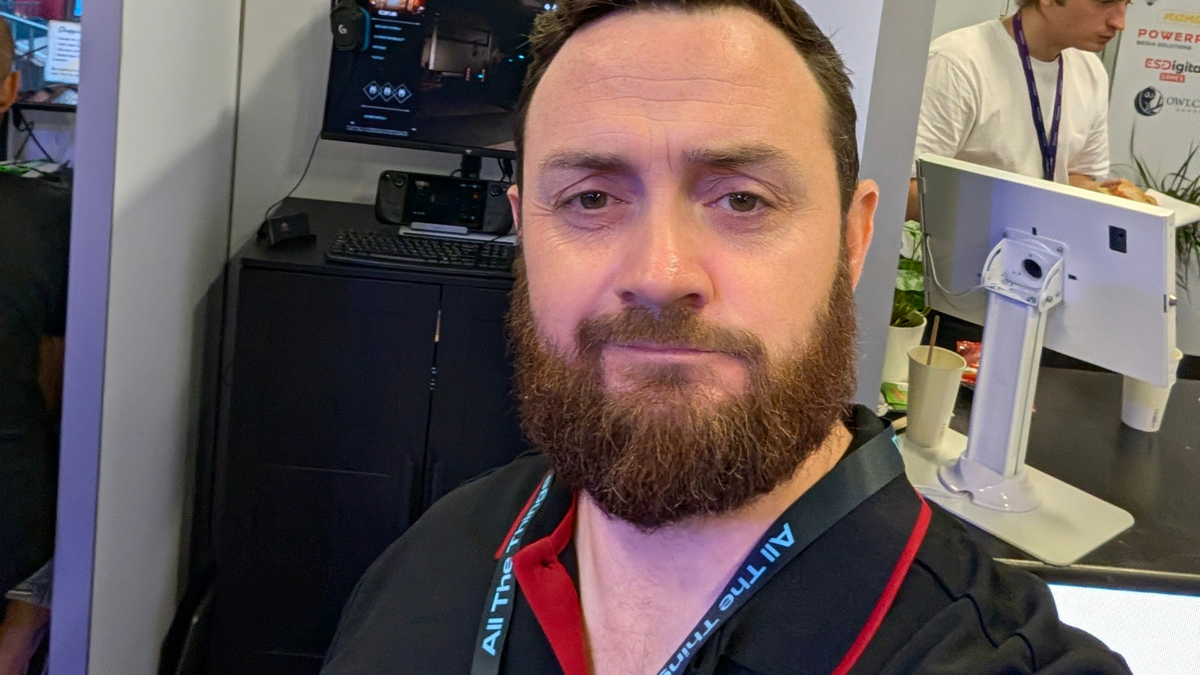
Image: enduins.com
A stolen booth setup turned Gamescom into damage control
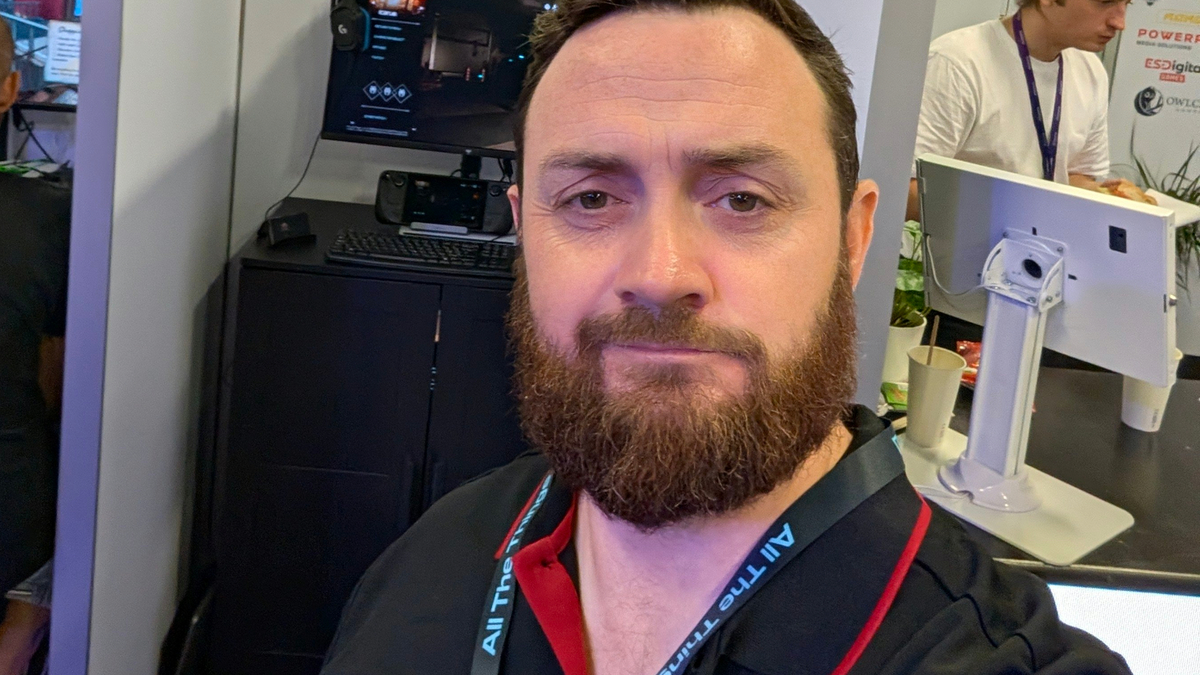
Ryan Laley, the solo indie developer behind the upcoming horror game Mimic, said his Gamescom was effectively cut short after laptops were stolen from his booth overnight. In a video posted to X on August 28, Laley said police reports had been filed and described the loss as “a huge blow financially and mentally.” IGN, GameSpot, Kotaku, TheGamer, and Aftermath all reported on Laley’s account, with several quoting him saying that other developers were hit as well.
The immediate tension is that this was not described as a public-floor grab during show hours. Laley said the theft happened overnight, after his booth in Gamescom’s business area had been left for the night. According to Kotaku and Aftermath, Laley said that area was supposed to have 24/7 security and limited access after hours. TheGamer also reported that he told commenters the booth was in the business area, where he believed overnight access was restricted.
That makes the Gamescom laptop theft especially painful for small teams. A convention trip is already a high-risk budget play for an indie developer: travel, booth costs, equipment, time away from development, and the hope that appointments or wishlists can justify the spend. Aftermath reported that Laley traveled from Essex, England, to Cologne, Germany, and had paid “thousands of pounds” to show Mimic ahead of its planned October release. When the demo hardware disappeared, the loss was not limited to the value of the laptops. It disrupted the entire reason for being there.
What is confirmed, and where the numbers are still unclear
The clearest confirmed facts come from the developers’ own public statements. Laley said his equipment was stolen, said police reports had been filed, and said the incident had been reported to Gamescom center management and security. TheGamer reported that the thieves took the laptops but left the chargers behind. Aftermath reported, based on Laley’s account, that his new Alienware laptop had been stored in a cupboard in the booth before he discovered it was missing.
A second confirmed case came from iam8bit. GameSpot reported that iam8bit posted on X that two laptops had been stolen from its booth overnight despite the presence of Koelnmesse security. Aftermath said an iam8bit representative confirmed the theft and reported that the stolen machines contained builds for iam8bit Presents titles Petal Runner and Escape Academy 2: Back 2 School. GameSpot likewise reported that iam8bit said the laptops contained early demos for those games.
The total scale is less settled in the provided reporting. Laley said “all our laptops” had been stolen and that other developers were affected. IGN and Kotaku described multiple developers being hit. Iam8bit specifically identified two laptops. IXBT Games reported that “at least eight laptops” were stolen, but the other supplied outlets do not independently establish that total in the material provided. The cautious read is that multiple booths and at least Laley plus iam8bit were affected, while the final count remains unconfirmed from the sources available here.
GameSpot said it had reached out to Gamescom for comment and would update if it received a response. The provided material does not include a full Gamescom explanation for how the thefts happened, whether cameras captured anything, or whether any equipment was recovered.
CD Projekt Red’s response turned a theft story into an industry support story
The visible rally around Laley began quickly. The official Cyberpunk 2077 account, representing CD Projekt Red’s Cyberpunk team, replied to Laley’s post with an apology and an offer to help. As quoted by GameSpot, IGN, and TheGamer, the account said it would “check the Arasaka hardware archives” and see if it could send “a few things” his way, adding, “No choom should have to start from zero.”
That line was framed in Cyberpunk 2077’s in-universe voice, but the practical point was straightforward: CD Projekt Red offered support after seeing an indie developer lose the hardware needed to show his game. The support was not described by the sources as immediate replacement gear on the show floor, and CD Projekt Red itself said it would not help “right this second.” Still, it gave the incident enough visibility to become a wider industry conversation rather than a private convention disaster.
Indie Game Joe, identified by IGN as Joe Henson, the Don’t Scream developer and an industry commentator, also stepped in. GameSpot reported that Laley thanked Indie Game Joe for donating the funds to replace his lost hardware. GameSpot also noted that Indie Game Joe encouraged players to wishlist Mimic. TheGamer reported additional support from Playtonic Games, the studio behind Yooka-Laylee, which sent words of support to Laley.
For readers tracking the CD Projekt Red Gamescom support angle, the important distinction is that the company offered help publicly, while the reported full replacement funding came from Indie Game Joe. Laley’s own follow-up, quoted by GameSpot, thanked the broader industry for support and singled out Indie Game Joe for donating the money to replace the hardware.
The business-area question Gamescom still has to answer
The unresolved issue is security expectation versus security outcome. Gamescom is a massive event in Cologne, and Kotaku described it as the world’s largest gaming event, with over 350,000 attendees in a typical year. Its business area is supposed to be a controlled environment for press, publishers, partners, and developers. That distinction matters because developers make different security decisions when they believe a space is access-controlled overnight.
Laley’s comments, as reported by Kotaku and TheGamer, suggest he believed the business area had 24/7 security and limited night access. Iam8bit’s post, quoted by GameSpot, specifically said its two laptops were stolen “despite the presence of Koelnmesse security.” That does not prove negligence from the venue or organizer. It does show why affected developers are likely to want a timeline, camera review, access-log review, and a clearer explanation of what “security” meant in practice overnight.
This is the strategic layer of the story. A convention booth is a temporary deployment site, and developers often treat it like a controlled branch office for a week. The Gamescom indie dev theft shows the danger in that assumption. Even if a hall is not open to the public, a booth still has weak physical boundaries, many people with badges, many vendors moving equipment, and a daily rhythm where staff are exhausted by the end of appointments.
The incident also puts pressure on event organizers to communicate the limits of overnight protection. If exhibitors are expected to remove all laptops nightly, that needs to be explicit before teams build their staffing, booth layout, and hardware plan around leaving machines in place. If devices can remain, the organizer’s security model has to match the value of what studios are leaving behind.
For indie studios, the lost hardware is only one part of the exposure
The obvious cost is financial. Laley called the theft expensive and heartbreaking, and Aftermath reported that he bought a new Alienware laptop for the event. For a solo developer, that can mean losing the machine used to demo the game, capture footage, handle builds, take meetings, and continue work during travel. Laley told IGN, “I can’t do my job,” which captures the operational problem better than the price tag alone.
There is also a marketing cost. IGN noted that Gamescom had opened with Opening Night Live on August 25 and that, at the time of its story, more than two days remained in the show. Losing demo machines mid-event can erase booked appointments, press opportunities, publisher conversations, and creator coverage. Laley later said, in a follow-up quoted by IGN, that he would still be around Gamescom “boothless” in a Mimic shirt, which is a resilient recovery move, but it is not the same as having a functioning demo station.
The iam8bit case adds a second risk: unreleased builds. Aftermath reported that iam8bit said stolen laptops with Escape Academy 2 and Petal Runner demos put in-progress builds “at risk of being leaked.” A leaked demo build may not represent final quality, may contain unfinished content, and may expose internal assumptions about content, stability, or performance. For a publisher, that is reputational risk. For an indie, it can become a production risk if the build contains credentials, debugging tools, unannounced material, or files that were never meant to leave the show environment.
That is where the convention security conversation has to move beyond sympathy. Support from CD Projekt Red, Indie Game Joe, and other developers can help one creator recover. The next step is reducing the blast radius before a theft occurs.
A practical convention security plan for developers
Developers should plan for a convention demo machine as if it might be lost, stolen, damaged, or inspected outside the team’s control. The Gamescom laptop theft does not prove every event floor is unsafe, but it shows that an access-controlled business area is not enough by itself. Laley himself said, according to TheGamer, that next time he may need to take security into his own hands, secure things more heavily, or take equipment back to the hotel each night, even if that is a “massive pain.”
The first decision is whether laptops ever stay overnight. If the build is important, the safer policy is to remove machines daily and accept the inconvenience. If a team must leave hardware at the booth, it should use physical locks, locked transport cases, concealed storage that is harder to remove quickly, and a booth inventory routine at close and open. Aftermath’s report that Laley’s machine had been stored in a cupboard is a reminder that a cupboard is storage, not a security system.
The second decision is what lives on the show laptop. A convention device should carry only the demo build needed for the event, with no source code, no personal files, no saved passwords, no cloud sync sessions that expose project folders, and no credentials that allow access to repositories, analytics, storefront dashboards, press lists, or publisher materials. Full-disk encryption, strong login protection, remote-wipe capability, device tracking, and recorded serial numbers should be treated as part of the booth kit, like HDMI cables and power strips.
The third decision is recovery speed. Teams should have a second copy of the demo ready to deploy, cloud backups separated from the stolen machine, and a written plan for who files the police report, who contacts the event organizer, who notifies partners, and who posts publicly if appointments are disrupted. Iam8bit’s public statement focused on disruption to its appointment schedule and the risk of leaks. That is the right order of operations: secure the facts, protect the build, then salvage the business calendar.
For indie teams, this is harsh but useful strategy. A show build is part of the game’s go-to-market plan, and hardware security is part of that plan too. Gamescom gave Laley a painful example, but the industry response also showed how quickly the development community can mobilize when the facts are clear and the need is immediate.