

How 11 bit studios’ frozen city-builder might adapt its intricate UI, harsh moral choices, and survival rhythms to Nintendo Switch as the studio expands the wider Frostpunk universe.
Frostpunk has always been a game about pressure. The pressure of a dying world closing in, of dwindling coal supplies, of a population that needs both heat and hope to keep moving. Now 11 bit studios wants to pack all of that into a Switch cartridge.
The newly announced Nintendo Switch version of Frostpunk does not have a release date yet, but it is confirmed as a native port of the original 2018 “society survival” city builder. For console players who skipped the PC and previous-gen releases, this is the first time the struggle to keep the last city on Earth alive will be playable in handheld form.
What’s actually coming to Switch
Across the official announcement and platform blogs, 11 bit studios is positioning this as the full Frostpunk experience on Nintendo hardware rather than a cut-down experiment. That means the core campaign that charts New London’s rise from scattered survivors around a generator, plus the suite of post-launch modes that reshaped the game into something more replayable.
Endless Mode is explicitly name-checked, and that brings with it multiple maps and scenario types. Endurance leans into attrition, forcing you to ride out brutal storms over the long term. Builders slows the tempo but asks for careful, efficient city layouts. Serenity dials down the hostility without removing it completely and frames the map more as a sandbox for city tinkering. On PC those variants significantly extended Frostpunk’s life after the credits; on Switch they could become ideal quick-hop sessions while docked or curled up on the sofa.
The announcement copy also talks about the full law and society systems being intact. That includes the original Book of Laws structure, where you sign off on child labor, emergency shifts, and public order policies, then live with the consequences in the form of unrest or loyalty. The tech tree, automatons, higher-tier heating infrastructure and late-game scouting options are also expected to carry over. Nothing in 11 bit’s messaging suggests this is a pared-back “lite” version, which is key for a game built around cascading systemic decisions.
Can Frostpunk’s UI survive the shrink to handheld?
The biggest open question is not content, but interface. Frostpunk was built first for PC with a mouse hovering over concentric rings of buildings. Even the later console versions had to work hard to make an icy sprawl readable from the couch.
Switch adds another constraint. In handheld mode you are looking at a 6.2 or 7-inch screen where individual tents, workplaces and citizen icons will sit much closer together. The original game’s beautiful circular city layout can quickly turn into a tangle of information, from temperature overlays to workplace efficiency indicators.
There are a few likely answers to this. Previous console editions leaned on radial menus and contextual prompts that popped off selected buildings and interface elements. A similar approach on Switch would let players use the sticks to “orbit” around the generator, then dive into building menus or citizen info via face buttons. The smaller screen argues for stronger use of zoom levels and high-contrast overlays, helping you toggle from a cinematic city view to a pure planning layer that emphasizes heat ranges, coal flow and workforce distribution.
Touchscreen input is another possibility. 11 bit has not confirmed it, but Frostpunk’s pacing is slow and deliberate enough that tap-to-select and drag-based camera movement would make sense in handheld play. Panning across the snowfields with a thumb and tapping workplaces to shuffle workers could soften the barrier for players who might be intimidated by dense strategy UIs.
Whatever the specifics, the key will be responsiveness. Frostpunk works because you are constantly scanning for developing problems. A layer of sluggish selection or tiny unreadable icons could undercut the whole hybrid pitch. Done well, though, a refined Switch UI could make this the most approachable console version yet.
Survival loops on a hybrid system
Frostpunk’s main loop rests on short cycles of decision making. You run the generator, watch your coal pile tick down, adjust work shifts, sign laws and then wait to see how your people react. Storms hit on a schedule, expeditions bring back unexpected complications, and the city lurches from one uneasy day to the next.
On a hybrid system like Switch those loops lend themselves well to portable play. A single in-game day can be managed in a few minutes, and the game allows pausing and time control. That makes it perfect for short sessions on a commute or before bed where you tweak resource allocations, queue up new buildings and sign a law before putting the system to sleep.
At the same time Frostpunk thrives on long-form tension. The best runs build a knot in your stomach over several in-game weeks as looming storms and tough policy paths close off your options. The Switch’s docked mode supports that style of play. You can settle in on the TV for a multi-hour session where you zoom out, micro-manage workforces and endure the slow slide toward hope or despair.
That contrast between “one more day” handheld play and sprawling docked marathons is where Frostpunk could slot neatly into the Switch library. It is as much a management sim as it is a mood piece, and the flexibility to drop in and out could make it easier to live with a game that often feels deliberately oppressive.
Does the moral tension still hit away from a desk?
Frostpunk’s defining trait is not the cold, but the way it forces you to rationalize cruelty. Allowing children to work in coal mines, turning to propaganda and harsh policing, or deciding who freezes so that others can live are the pivotal moments that players remember.
Those choices lose their impact if they are reduced to casual taps while half-watching something else. There is a risk that the portability of Switch might undercut the gravity that comes with playing at a desk with headphones on, letting the storm howl around you.
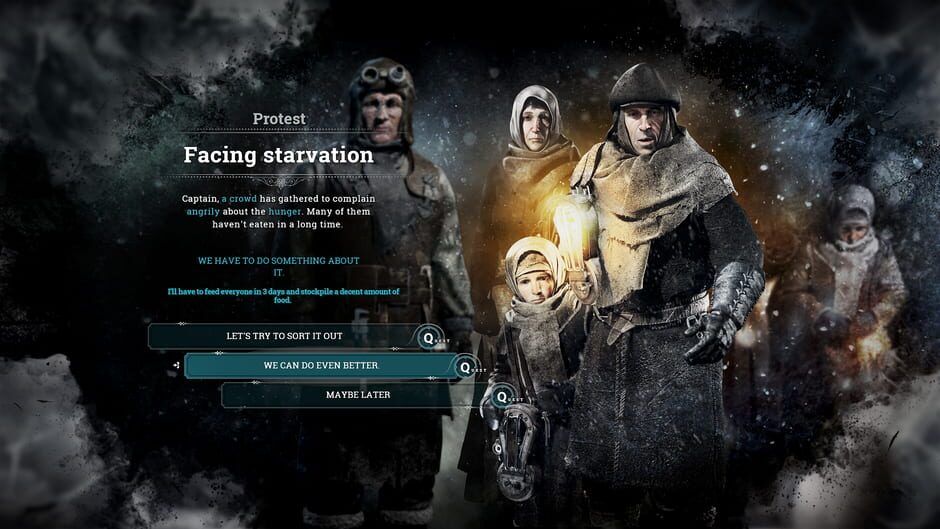
However, the visual and audio design does a lot of the heavy lifting. The sight of people gathering around a corpse in the snow or protesting outside the generator is as punchy on a handheld screen as it is on a monitor. If 11 bit keeps the full suite of animations, citizen barks and UI feedback, the moral weight should carry over.
The Switch’s suspend feature could even heighten the drama. Pausing right before signing a controversial law and coming back to it hours later on a lunch break can stretch out the dread. Frostpunk’s binary choices do not rely on twitch reflexes, they rely on time to think, and hybrid hardware encourages that kind of stop-start reflection.
How this fits into 11 bit’s wider Frostpunk push
The Switch port is not arriving in a vacuum. 11 bit studios has been steadily escalating Frostpunk from a one-off city builder into a broader property.
On the PC front, Frostpunk 2 is on the way as a larger-scale industrial sequel that jumps the timeline forward and looks at what happens when oil and class struggle replace coal and simple survival. Separately, Frostpunk 1886 is positioned as a more focused project returning to the original setting to tell side stories within the frozen city framework.
Bringing the first Frostpunk to Switch fits neatly alongside those efforts. It keeps the original game visible just as newcomers are about to hear more about the sequel and the spin-off. For players who discover the series on Nintendo’s platform, the Switch port becomes the entry point that explains why the generator, the laws and that huge frozen crater matter at all.
It also hints at a longer-term console strategy. 11 bit has usually treated consoles as important but secondary to PC. Delivering a careful, feature-complete Switch edition suggests the studio sees value in a broader audience for its bleak, systems-driven games. If Frostpunk finds an audience on Switch, it strengthens the case for future Frostpunk projects and potentially other 11 bit titles to arrive on Nintendo hardware.
What console players should expect
For now there are still unknowns. 11 bit has yet to share a release window, specific Switch performance targets, or concrete details on controller layouts and touchscreen support. But the messaging is clear that this is the full society survival package, not a scaled-back experiment.
Console players coming from more streamlined city builders should prepare for a heavier experience. Frostpunk will happily let your city die if you misjudge a storm or try to keep everyone comfortable for too long. It wants you to feel that constant squeeze between survival and humanity.
If 11 bit can nail readable UI at handheld scale and responsive controls in both docked and portable modes, the Switch version has the potential to be the most flexible way to play one of the last decade’s most distinctive city builders. Surviving the cold is hard enough. Surviving it on a small screen might be the real test of Frostpunk’s design.