
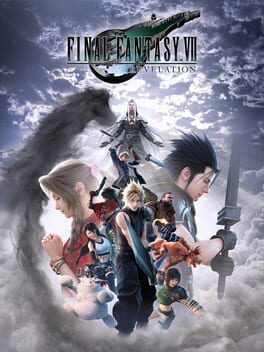

Director Naoki Hamaguchi says Final Fantasy VII Revelation has an even bigger world than Rebirth, raising the real question: can guidance, density, and the Highwind keep scale from becoming fatigue?
Image: IGDB
Store links: Final Fantasy VII Revelation on Steam
Revelation is aiming bigger, and Square Enix knows that creates a problem
Final Fantasy VII Revelation director Naoki Hamaguchi has said the sequel’s world is “even bigger than it was in Rebirth,” according to GoNintendo’s summary of a Eurogamer interview, while also acknowledging that “open world fatigue” is something some players feel. That is the concrete development here, and it immediately frames the challenge for Square Enix’s final entry in the remake trilogy: bigger is easy to promise, but harder to justify after a game as broad, segmented, and activity-heavy as Final Fantasy VII Rebirth.
My Nintendo News, also citing Square Enix’s comments, reports that the studio has been working to ensure players are guided naturally toward interesting places and activities rather than left overwhelmed. Game Rant similarly reports that Hamaguchi described Revelation’s open-world setting as designed to be understandable and easy to navigate, with proper direction for players who want to know where to go.
That distinction matters because the Final Fantasy VII Revelation open world is already being framed around scale, but the player argument around Rebirth was rarely about landmass alone. Rebirth’s regions were large enough to support hunting intel, combat assignments, summon shrines, protorelic chains, Queen’s Blood, chocobo traversal, lifesprings, towers, and region-specific minigames. The fatigue many players describe comes from the rhythm of completion, repetition, and reward pacing, not simply from not knowing where the main objective is.
The Highwind sounds like Revelation’s answer to both travel and orientation
The most specific systems detail in the source material is the Highwind. GoNintendo reports from the Eurogamer interview that the airship allows “total open-world freedom,” letting players leap from the deck and parachute seamlessly into any location on the map. The descent is also described as a way to hide loading screens. Game Rant reports that players will be able to select a location in the world, travel there, parachute down with the party, and fast travel back to the Highwind as needed.
GoNintendo’s summary adds an important layer: Highwind fast travel is described as having two phases. In the first, players jump and open the parachute; in the second, they choose where to land. During the first phase, visual markers on the ground indicate major objectives, minigames, and other activities. Once closer to the ground, those cues disappear.
That is the most interesting design idea in the discussion so far. If implemented cleanly, the Highwind could give Revelation a top-down planning layer that Rebirth did not have in the same way. Instead of moving from tower to map icon to checklist, players may be asked to read the world from altitude, choose a destination, and commit to a landing route. The reported fading of visual cues near the ground is especially notable because it suggests Square Enix is trying to guide without leaving the screen permanently covered in objective language.
The risk is equally clear. If the Highwind becomes a prettier menu for the same density of icons, it will not solve the fatigue Hamaguchi is discussing. If it helps players choose their own route through meaningful clusters of content, it could make a larger world feel more deliberate than Rebirth’s region-by-region completion structure.
Guidance is useful, but density and reward structure are the real test
Hamaguchi’s reported focus on guidance addresses one version of open-world fatigue: the feeling of being dropped into a vast space with no readable intent. Game Rant says he contrasted Revelation’s approach with open-world games that give players little direction, and said Revelation will provide the guidance players need when exploring regions such as Mideel and Wutai. Those locations are named in Game Rant’s report, while the broader source material does not yet provide a full region list or activity breakdown.
For Rebirth players, the sharper question is whether Revelation’s bigger map will be denser in a meaningful way or simply busier. Rebirth was at its best when side content fed the party system, materia experimentation, character relationships, or the world’s local identity. Queen’s Blood worked for many players because it had its own progression, escalating opponents, and a reason to revisit strategy. Combat assignments also had value when they pushed enemy assessment, stagger planning, and party composition.
The weaker open-world moments came when tasks felt structurally similar across regions, even if the scenery changed. A larger Final Fantasy 7 Rebirth sequel can improve on that only if its activities are less interchangeable. For an RPG, density is not a count of icons per square kilometer. It is whether a detour changes your build, teaches you a system, reveals a character beat, unlocks a new traversal habit, or gives you a reason to remember where you were.
That is where Revelation’s design burden sits. Bigger terrain can support the Highwind fantasy, the late-game global chase, and the sense of a Planet under threat. But scale by itself cannot make exploration satisfying if the completion loop becomes predictable before the midpoint.
The community reaction shows the gap between developer intent and player fatigue
The Reddit thread included in the source material is not a scientific measure of audience sentiment, but it usefully captures the concern Square Enix is walking into. Several commenters responding to the GamesRadar-linked story said their burnout with Rebirth was tied less to navigation and more to side quests, minigames, and perceived filler. One commenter argued that Rebirth was already straightforward about main objectives, while another singled out combat and story as strengths but described much of the side content as a slog. Another said they enjoyed Queen’s Blood but worried about Revelation repeating the same content structure.
Those are individual reactions, and they should be treated as anecdotal. Still, they point to a design tension that guidance alone may not solve. Players who bounced off Rebirth’s optional content were often not lost. They were choosing whether completion was worth the time cost.
As a progression-minded RPG player, that is the question I would watch most closely as Square Enix reveals more. Does Revelation let players build toward goals through multiple routes, or does it again ask completionists to clear every local activity type before moving on? Are optional encounters tuned to reward party mastery, or mostly to populate the map? Do minigames have self-contained arcs and satisfying rewards, or do they interrupt the campaign’s pacing at moments where the story is already applying pressure?
Hamaguchi is right, based on the reported comments, that open-world fatigue is real. The unresolved issue is whether Square Enix sees fatigue as a navigation problem, a content-design problem, or both.
A bigger world fits the final act, but it raises technical and pacing stakes
Revelation’s larger world also makes sense in the structure of the Final Fantasy VII story being remade. Game Rant describes the game as following the events at the Forgotten Capital, with Cloud and the main cast facing the looming threat of Meteor. GoNintendo reports that the Highwind will be central to traversal. In Final Fantasy VII terms, that combination naturally pushes the game toward global movement rather than the more contained Midgar structure of Remake or the regional expedition model of Rebirth.
The open question is how Square Enix balances that global fantasy with pacing. A final chapter has to resolve character arcs, combat escalation, party progression, and the trilogy’s larger reinterpretation of the original game. Adding a world even bigger than Rebirth’s gives the designers room for spectacle and optional discovery, but it also increases the chance that the critical path feels diluted if too many systems compete for attention.
GoNintendo’s report adds that Hamaguchi considered Rebirth’s combat “perfect” but did not want it to become stale, which led to the FITS system. The same report says FITS stands for “Function Integrated Tactical Suitwear,” and that combat director Teruki Endo was involved in discussions from early development. The source material does not explain exactly how FITS changes builds, party roles, or encounter design, so any deeper read on that system remains expectation rather than confirmed fact.
Still, its placement alongside the open-world discussion is important. If Revelation is expanding the map, it also needs combat and progression systems that can sustain a longer exploration arc. A bigger world asks players to fight more, travel more, and make more build decisions. If FITS meaningfully refreshes party planning, it could help optional content feel mechanically worthwhile. If it is mostly cosmetic or shallow, the larger map will put more pressure on familiar Rebirth systems.
Platforms, timing, and what is still unannounced
The source material points to a 2027 release window, but the exact wording varies by outlet. GoNintendo says Final Fantasy VII Revelation has been announced for Switch 2, will be a simultaneous release across all platforms, and is set for Spring 2027. Game Rant reports that Revelation will release on all current-gen platforms from the start rather than as a timed PlayStation exclusive, and also refers to next spring. My Nintendo News tags the story with Nintendo Switch 2, PS5, Xbox, Square Enix, and Open World, though tags are not the same as a formal platform list.
Based on these sources, the safest confirmed reader takeaway is that the Final Fantasy 7 Rebirth sequel is being discussed as a multiplatform launch rather than a staggered PlayStation-first rollout, with Switch 2 specifically named by GoNintendo. The provided source material does not include an official price, edition structure, PC requirements, upgrade path, performance targets, file size, or a complete technical breakdown by platform.
That matters for anyone deciding where to play. A world larger than Rebirth’s, seamless Highwind drops, hidden loading during descent, and broad platform support all create performance questions that Square Enix has not answered in the supplied material. If you are sensitive to frame rate, loading behavior, or visual compromises on portable hardware, waiting for platform-specific previews and technical analysis would be sensible.
For now, the confirmed story is narrower than the excitement around it: the Final Fantasy VII Revelation director says the world is bigger than Rebirth’s, Square Enix is explicitly designing around open-world fatigue, and the Highwind appears to be the major traversal and guidance tool. The judgment call will come later, when the studio shows whether that larger space has the density, rewards, and role-playing consequences to earn its size.