
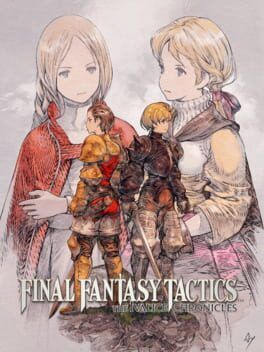

Breaking down how Final Fantasy Tactics: The Ivalice Chronicles cleared one million copies in around three months, what we can infer about platform performance, how it fits into Square Enix’s broader remaster strategy, and why it strengthens the case for new Tactics and Ivalice projects.
Final Fantasy Tactics: The Ivalice Chronicles has quietly become one of Square Enix’s most important remasters in years. Crossing one million shipments and digital sales in roughly three months is a solid result for any tactics RPG, but for a premium re-release of a 1997 PlayStation game, it is a clear signal: there is meaningful commercial appetite for Ivalice and for turn-based tactics inside the modern Final Fantasy audience.
Square Enix announced the milestone via the official Final Fantasy social channels, confirming that the remaster, released on September 30, 2025, has topped one million units worldwide as of December 31. There was no granular regional or platform breakdown, but between the launch platform slate and third-party tracking we can still piece together a picture of what is working, how it aligns with the publisher’s remaster playbook, and what it may unlock next.
A tactics remaster that behaved like a mid-tier new release
One of the most striking points about The Ivalice Chronicles is the speed at which it reached the million mark. Launching into a packed Q4 window and carrying a full-price tag in most territories, the game essentially behaved like a mid-budget new release, not a budget catalog revival.
For a turn-based tactical RPG, one million in a quarter puts it in similar territory to Tactics Ogre: Reborn’s lifetime performance, but compressed into a far shorter window and across more platforms. Media and investor reaction has framed this as a “validation test” for tactics inside Square Enix’s HD portfolio, and that is largely how the company itself set expectations pre-launch.
Director Kazutoyo Maehiro and other staff repeatedly described the project as a way to prove the business viability of the genre to upper management. In that context, the sales curve hitting seven figures before the end of the calendar year reads less like a nostalgia play and more like a greenlight for further investment.
Platform landscape: console first, PC as a long tail
Square Enix did not provide a platform split, but we know the game launched on PlayStation 5, PlayStation 4, Xbox Series X|S, Nintendo Switch, Nintendo Switch 2 and PC via Steam. If we look at how similar Square Enix tactics and JRPG releases have behaved, we can sketch some plausible trends.
On the console side, Switch and Switch 2 are almost certainly the volume drivers. Reviews and coverage from outlets like Engadget explicitly called the Nintendo ecosystem “the best place to play the genre,” and early retail charts in territories like the UK and Japan regularly showed the Switch versions of strategy RPGs leading the pack. The combination of handheld play, strong historic overlap with tactics audiences, and a robust digital attach rate makes Nintendo hardware a natural home for this kind of game.
PlayStation 5 and PlayStation 4 likely form the second pillar. Final Fantasy branding still has its strongest console identity on PlayStation, and the remaster’s visual pass, voice acting and higher resolutions read best on Sony’s current hardware. In the United States and Europe, PS5 has typically been the lead platform for Square Enix’s single-player releases, with PS4 adding incremental volume in markets where last-gen hardware remains common.
Xbox Series X|S and PC via Steam round things out as strategically important but smaller pieces of the pie. Steam gives the game a long commercial tail, historically extending the life of JRPGs through wishlists, deep discounts and regional pricing. Xbox offers ecosystem value through Game Pass marketing beats and incremental Western sales, even if absolute unit numbers tend to lag behind PlayStation and Nintendo for Japanese RPGs.
The absence of a precise percentage breakdown means any hard number would be speculative, but the broader takeaway is clear: The Ivalice Chronicles did not rely on a single platform to clear one million. Its success came from simultaneously addressing portable tactics fans on Switch and Switch 2, the core Final Fantasy audience on PlayStation, and a growing PC tactics niche that has been nurtured by everything from indie TRPGs to ports of classic Japanese titles.
Positioned squarely within Square Enix’s remaster machine
The Ivalice Chronicles did not appear in a vacuum. Over the past several years, Square Enix has ramped up a two-track strategy for its legacy catalog.
On one track sit large scale, cinematic remakes like the Final Fantasy VII Remake project, which dramatically reinterpret both mechanics and narrative with blockbuster budgets. On the other track are more targeted remasters designed to modernize older titles without fundamentally rebuilding them. Tactics Ogre: Reborn, Crisis Core: Final Fantasy VII Reunion and the Final Fantasy Pixel Remaster series are all part of this second track.
Final Fantasy Tactics clearly belongs to the latter category, and was often compared directly to Tactics Ogre: Reborn in pre-release coverage. Instead of adopting the HD-2D style that Square Enix has used to great effect in Dragon Quest III HD-2D Remake and Octopath Traveler, the team opted for a higher resolution, cleaner take on the original’s isometric sprites and backgrounds, combined with voice acting, quality-of-life tweaks and new difficulty options.
From an industry perspective, this approach is cost-efficient. It leans on existing assets and design while layering in enough new content and audio-visual polish to justify a modern price point. The Ivalice Chronicles aligns with Square Enix’s broader goal of extracting value from its catalog while also testing which sub-franchises still have the traction to justify something more ambitious.
Where this remaster stands out is in how Square Enix framed it publicly. Interviews in the run-up to launch positioned it not just as a preservation effort, but as a barometer for whether Ivalice and tactics can support new, original projects. That is a notable change in tone compared to, say, the Pixel Remasters, which were largely marketed as archival editions for longtime fans.
Reading the million: greenlight data, not just a PR win
Against that backdrop, one million copies in about three months is better understood as internal validation than as a headline brag. For a project of this scale, that sales level suggests that Square Enix can comfortably recoup development and marketing spend while building a fresher audience for the IP.
This outcome becomes even more meaningful when stacked against Square Enix’s mixed performance in recent years. The company has seen several new IP and mid-tier releases underperform relative to expectations, and has publicly acknowledged the need to be more selective and focused. Catalog exploitation through remasters is one way to stabilize earnings while taking fewer big risks, but those remasters still need to prove that the underlying brands can move units.
Tactics now joins a shortlist of catalog projects that have done exactly that. Along with Tactics Ogre: Reborn and the Pixel Remasters, it proves that the audience for classic-style JRPGs and tactics has not only persisted but expanded, particularly across PC and Nintendo’s hybrid consoles.
It also gives Square Enix a clean data point when arguing that tactics battles and dense, politically-charged storytelling can coexist with the more cinematic, action-oriented direction of mainline Final Fantasy. The Ivalice Chronicles reaching a million indicates that there is enough commercial space for both.
What this means for a new Final Fantasy Tactics
One of the key talking points ahead of release was that strong sales could pave the way for more. Maehiro and his team were unusually frank about this, openly floating the idea that a successful remaster would “open doors” for:
New entries in the tactics sub-series, whether set in Ivalice or elsewhere.
A similar revival for Final Fantasy Tactics Advance and its sequel.
Further exploration of Ivalice in other formats.
Now that the sales bar has been cleared, what could the next steps realistically look like?
The most immediate and least risky move would be a remaster or enhanced port of Final Fantasy Tactics Advance, possibly bundled with A2, using a similar treatment to The Ivalice Chronicles. Bringing the handheld entries forward to modern hardware would give Square Enix a cohesive Tactics line that spans the original PlayStation game and its Game Boy Advance and Nintendo DS follow-ups across all current platforms.
Beyond that, a brand new Final Fantasy Tactics is no longer a remote fantasy. The commercial performance of the remaster gives Square Enix cover to prototype a mid-budget sequel, particularly if it can share technology and pipelines with The Ivalice Chronicles. The company has already demonstrated with projects like Triangle Strategy and Various Daylife that it is willing to fund new tactical RPGs; tying such a project directly to the Final Fantasy brand would be a natural escalation.
The question is less “if” there is demand and more “how” to position it within the broader Final Fantasy slate. A new tactics entry could operate as a prestige, lower-budget counterpart to the flagship action RPGs, focusing on depth and replayability rather than spectacle.
The wider Ivalice question
Ivalice has always occupied a curious place inside Square Enix’s portfolio. It is one of the most fully realized worlds in Final Fantasy, spanning Final Fantasy Tactics, Vagrant Story and Final Fantasy XII, yet its development has been sporadic, and many players know it only in fragments.
The Ivalice Chronicles puts that world back in front of a global audience in a much more accessible form than the original PlayStation release or the PSP’s War of the Lions port. Fully voiced story scenes, scalable difficulty and modern UI make it significantly easier for newer players to engage with the dense lore and political intrigue that define Ivalice.
If Square Enix decides to lean deeper into the setting, there are several directions it could go.
It could commission additional remasters or ports of related works. Vagrant Story in particular is frequently cited as a prime candidate for a modern treatment, given its cult status and narrative ties. Final Fantasy XII itself has already been remastered as The Zodiac Age, but a coordinated “Ivalice collection” pushing Tactics, XII and potentially Vagrant Story under a single branding umbrella is not out of the question.
It could build new projects explicitly anchored in the setting rather than the numbered series, similar to how the company has used Eorzea for Final Fantasy XIV. A tactics-focused live service project is unlikely in the near term given Square Enix’s recent retreat from some live service bets, but single-player spin-offs or smaller-scale digital titles are more realistic.
And it could simply continue to use Ivalice as an occasional prestige venue for special projects, allowing veteran creators attached to the original games to revisit the world without committing to a full transmedia push.
Whichever route it takes, the commercial data from The Ivalice Chronicles strengthens the case that Ivalice is not just a critical darling but a viable brand pillar.
A proof of concept for Square Enix’s mid-budget future
Perhaps the most important industry-level takeaway is that Final Fantasy Tactics: The Ivalice Chronicles shows what a sustainable, mid-budget Square Enix can look like.
Big-budget flagship titles will always dominate headlines, but they are slow to produce and risky. By contrast, tactics remasters like this can be delivered on shorter timelines, reuse existing design and narrative, and still generate non-trivial revenue across a wide hardware base. When they succeed, they not only monetize nostalgia but also seed the audience for future, original games.
This is particularly relevant as Square Enix reassesses its portfolio after a run of uneven launches. The publisher has talked about narrowing focus and improving profitability. Reinforcing proven sub-brands like Final Fantasy Tactics, while using remasters as a low-risk proving ground for genres and settings, is a logical response.
One million units is not a blockbuster number by Final Fantasy VII Remake standards. For a tactical RPG that began life on the original PlayStation, though, it is exactly the kind of performance Square Enix needed to justify more Ivalice and more turn-based tactics. The Ivalice Chronicles has done its job: it reminded players why the original is revered, modernized it for contemporary platforms, and handed Square Enix a data-backed argument for taking the next step.
What comes next is up to the publisher, but from a business and audience standpoint, the message looks straightforward. There is room in the modern market for a dedicated Final Fantasy tactics pillar alongside the mainline series. The million players who returned to, or discovered, Ivalice over the past three months have just helped make that case.