

How Final Fantasy Resonance turns Brave Exvius into a full-fledged HD-2D RPG, revives pure turn-based combat, and carves out a unique place in modern Final Fantasy.
Final Fantasy Resonance is not just another spin-off with a nostalgic filter slapped on top. It is the first fully fledged Final Fantasy built around Square Enix’s HD-2D aesthetic, and it uses that visual style as the foundation for a console scale reimagining of Final Fantasy Brave Exvius.
Square Enix and Lancarse are taking a mobile gacha success story and rebuilding it as a traditional, self-contained RPG for consoles and PC. In the process they are leaning into three big ideas: richly lit HD-2D presentation, a deliberate return to pure turn-based battles, and a new way of preserving Brave Exvius through its story and Visions system.
HD-2D As A Final Fantasy World, Not Just A Gimmick
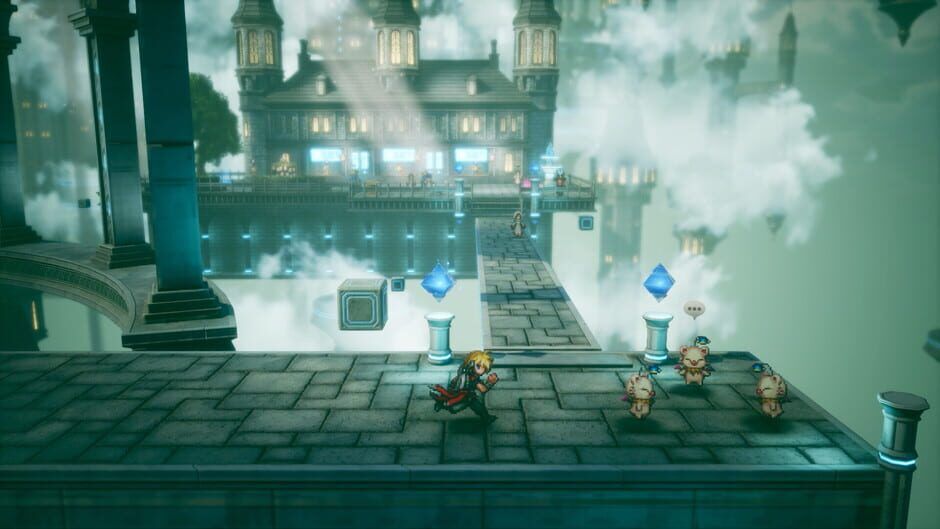
HD-2D has already proven itself through Octopath Traveler and other Square Enix projects, but Final Fantasy Resonance is the first time the flagship series has fully embraced that look for a mainline scale story. It is not an upscaled SNES throwback. Instead, Resonance builds layered environments where pixel characters walk through volumetric lighting, depth of field, and reflective surfaces.
The effect suits Brave Exvius particularly well. The original game’s key art and sprites always hinted at a more cinematic world than phones could comfortably show. In Resonance, those ideas are realized as full towns with height, narrow alleyways that fall into bokeh blur, and battle backdrops that glow with magical particle effects. Rain and his companions still have concise pixel animations, but every attack is framed by lighting and camera work that sells impact without abandoning the 2D roots.
What stands out is how the HD-2D style supports exploration. Screenshots and early footage highlight an expanded overworld with multiple biomes, daylike lighting shifts, and large scale structures rising in the background. That gives Brave Exvius’s familiar locales a sense of place that the chopped up mobile maps never had. Resonance looks like it wants you to absorb the atmosphere as much as the battle numbers.
A Straightforward Turn-Based Revival
Where recent mainline Final Fantasy games have chased ever more elaborate action systems, Final Fantasy Resonance steps deliberately back toward classic structure. Combat is fully turn-based rather than using an Active Time Battle gauge or real time action. You select commands, watch your party and enemies take turns, and plan around clear initiative.
That change is not just nostalgia. Brave Exvius on mobile was built around timing chains and touch inputs that rewarded tapping in sync. Translating that one to one to consoles would have felt awkward and potentially overcomplicated. By rebuilding battles around turn order, Square Enix gives players time to think through job synergies, buffs, and debuffs in a way that fits the slower pacing of a story first RPG.
The Visions system also benefits from this structure. Each Vision is an iconic Final Fantasy character that can be equipped to Rain and his allies to unlock new jobs and abilities. Warrior of Light can skew a character toward tanking, Terra can provide powerful magic roles, and Cloud can bring aggressive physical and Limit Break inspired skills. In a pure turn-based format, mixing and matching these jobs pushes you to build defined roles and then tailor your strategy around them instead of just chasing raw damage.
Reimagining Brave Exvius Without The Gacha
Final Fantasy Resonance takes the first season arc of Final Fantasy Brave Exvius and uses it as a narrative skeleton rather than a script to copy. Rain, Lasswell, and Fina return, along with the core beats about crystals, visions, and a looming threat that spans nations. Those elements now unfold in a linear, handcrafted RPG that is meant to be completed rather than endlessly updated.
That shift alone makes Resonance feel different from most modern Final Fantasy projects. Brave Exvius lived on constant banners, events, and crossovers. The story was often experienced in pieces between resource grinds. Resonance condenses and refines that material into a console length campaign supported by 33 new musical tracks and a proper overworld that can be traversed with different means of transportation.
Most importantly, Visions in Resonance are not gacha pulls. They are structured content that plugs into progression and party building like jobs or Espers once did. The crossover spirit of Brave Exvius lives on through characters like Warrior of Light, Terra, Cloud, Zidane, Shantotto, and Y’shtola, but they are integrated as collectible class options within a fixed game instead of a monetized banner system. That preserves the playful side of Brave Exvius while stripping out the friction that kept some players from ever engaging with it.
Multiplatform From Day One
Final Fantasy Resonance arrives on Nintendo Switch, Switch 2, PlayStation 5, Xbox Series X|S, and PC on October 22. That broad launch marks a quiet shift in how Square Enix treats its HD-2D projects. Earlier titles in this style often arrived on Switch and PC first, with other consoles waiting months or missing out entirely.
Resonance being announced during a Nintendo Direct but launching across every current platform suggests Square Enix sees it as more than a mid tier experiment. HD-2D is being elevated to a core presentation style that deserves the same reach as big budget 3D Final Fantasy titles. It also means that Brave Exvius fans, many of whom migrated from mobile to various home systems, can pick up the sequel successor wherever they currently play.
That strategy helps Resonance function as a bridge release. It gives veteran Final Fantasy players who prefer traditional turn-based design something substantial on modern hardware, while new players who may have bounced off gacha systems get a way into the Brave Exvius setting without committing to a service game.
Where Resonance Fits In Modern Final Fantasy
Placed alongside Final Fantasy 7 Rebirth and Final Fantasy 16, Resonance reads as a different pillar of the brand. Those games chase cinematic action and real time spectacle. Resonance focuses on clarity, character sprites, and methodical combat. It is not a throwback in the sense of copying a specific SNES entry, but it does channel what many people associate with foundational Final Fantasy design.
What makes the project stand out is the combination of that classic heart with a modern meta concept. It is a preservation effort for Brave Exvius, a visual showcase for HD-2D tech, and a statement that turn-based Final Fantasy can still exist as a headline release instead of a small scale side project. Its cross series Visions play directly into fan nostalgia, yet the structure around them is built to be finished, discussed, and revisited like any other standalone RPG.
If it works, Final Fantasy Resonance could become the template for how Square Enix approaches other mobile stories and anthology style content. More importantly, it promises a version of Final Fantasy that remembers how to slow down, let players take their time in combat, and linger on the details of a world painted in pixels and light.