
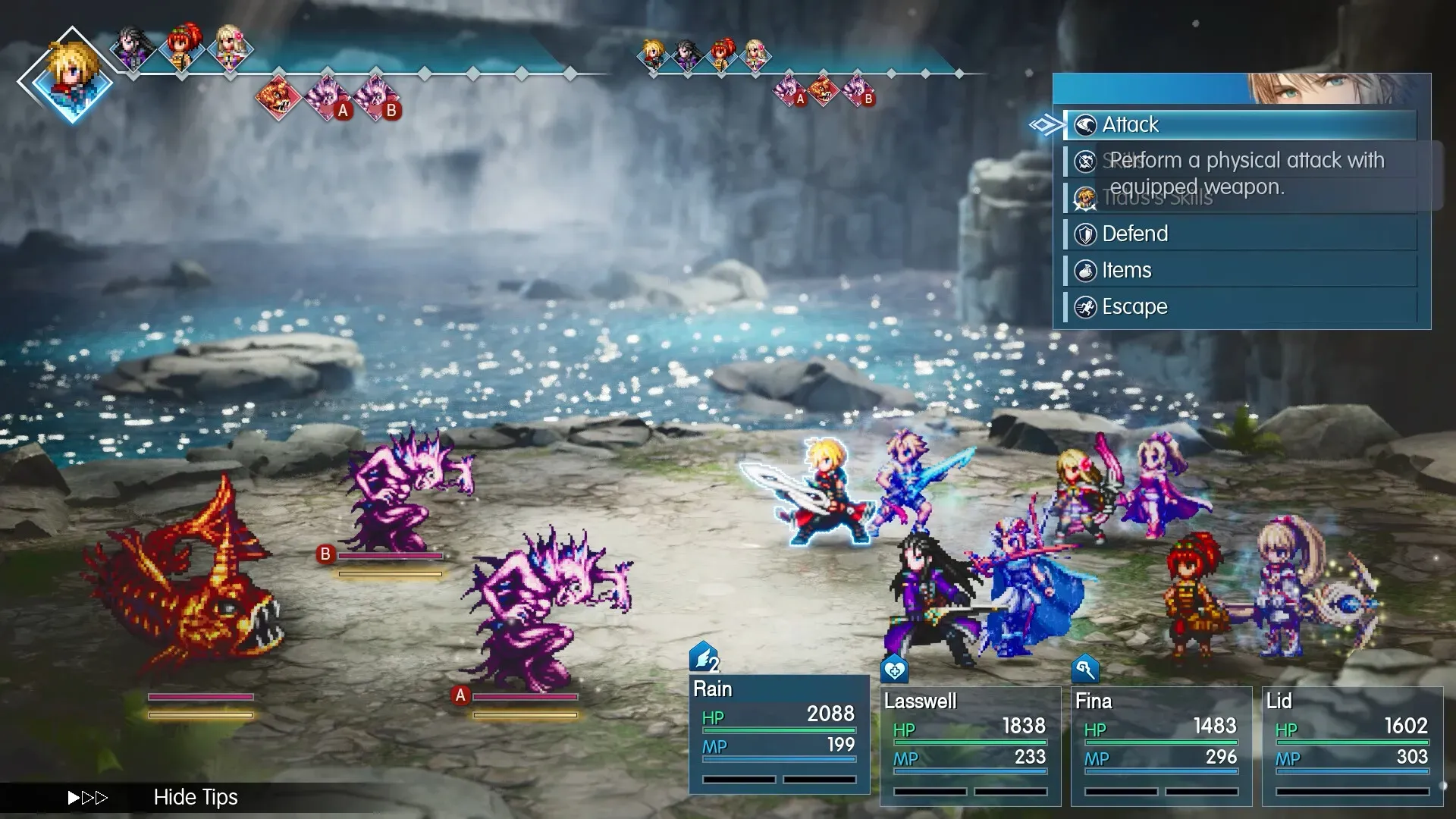

Square Enix says Final Fantasy Resonance combat began as an experiment mixing FF5 jobs, FF6 character identity, stagger, and Visions.
Image: ffresonance.wiki
Square Enix is pitching combat as a controlled experiment, not a pure throwback
The most concrete new detail around Final Fantasy Resonance combat is also the one party-builders should examine most carefully: producer Keisuke Nakashima told Kotaku that the battle system began with the question of what would happen if Square Enix combined the Final Fantasy V job system with the unique character traits associated with Final Fantasy VI.
That is a loaded comparison for RPG players. Final Fantasy V is shorthand for flexible party construction, while Final Fantasy VI is often discussed through the lens of characters who bring their own identities into battle. According to Nakashima, Resonance’s team did not treat those references as nostalgia labels. He described the concept as an “experiment,” saying it required “research and innovation,” and added that the team also reexamined the stagger system before folding the pieces together.
The result, as Nakashima described it to Kotaku and as GoNintendo later quoted from the same interview, is a system with “distinct characteristics” while still allowing “that additional customization element.” That phrasing matters. Square Enix has confirmed a hybrid goal, not a one-to-one return to the Final Fantasy V job system. Players expecting completely free job swapping across blank-slate party members should keep that distinction in mind until the publisher details the full progression rules.
The FF5 side of the pitch is customization, but the limits are still unannounced
When players search for the Final Fantasy Resonance job system, they are usually asking a practical question: can I build a party around roles, job synergies, and long-term ability planning, or am I mainly equipping cameos and pressing elemental weaknesses? The sources available so far answer part of that, but not all of it.
Square Enix’s own interview comments, as reported by Kotaku, confirm that Final Fantasy V’s job system was a design reference. They do not confirm the exact structure of Resonance’s jobs, whether jobs can be freely changed at save points, whether abilities carry across roles, whether characters have job restrictions, or whether late-game builds will reward grinding and experimentation in the way job-focused RPG fans expect.
That uncertainty is visible in the player conversation already. A Steam Community thread is titled, “Does this game has ‘Job’ system? (Not Vision),” which captures the distinction many systems-minded players are trying to make. The captured Steam page does not include a developer answer in the provided material, so the safe read is that Square Enix has sold the inspiration, but has not publicly clarified the full job mechanics in the sources at hand.
For now, the confirmed expectation should be narrower: Final Fantasy Resonance gameplay includes a customization layer inspired by Final Fantasy V, but the current public explanation frames it as part of a larger battle architecture rather than as a standalone job sandbox.
The FF6 side is character identity, which may be the real constraint on builds
The second half of Nakashima’s comparison is Final Fantasy VI style character identity. In practical terms, that suggests Resonance is not being built around interchangeable units alone. Kotaku’s interview quote says the team wanted distinct characteristics alongside customization, which points to party members retaining meaningful personal differences even as players adjust their roles.
That is the tension at the center of this combat pitch. A pure job system tends to invite optimization through role assignment: who becomes the healer, who becomes the breaker, who carries utility, who spends turns setting up damage. A character-identity-first system asks a different question: how do you build around what a character already is?
If Resonance follows the design philosophy Square Enix is describing, the interesting choices may come from the friction between those two ideas. The strongest party may not be the one where every slot can do everything. It may be the one where a character’s fixed traits, job-like customization, Vision support, and stagger timing all line up.
That is interpretation, not a confirmed build guide. The confirmed point is Nakashima’s: Resonance is designed to preserve distinct character characteristics while adding customization. Until Square Enix shows full menus, progression trees, and late-game encounters, players should avoid assuming this is either Final Fantasy V with a new coat of paint or Final Fantasy VI with optional loadouts.
Stagger and Resonance attacks shift the focus from builds to turn economy
The other confirmed pillar is stagger. GoNintendo’s report, drawing on the Kotaku interview and additional description, says players exploit enemy weaknesses to stagger foes, break their defenses, gain extra turns, and use powerful Resonance attacks. That gives the combat pitch a more modern tactical rhythm than a simple attack-and-cure loop.
For party building, stagger changes the value of customization. In a system built around weakness exploitation, a useful build is not only the one with the highest damage number. It is the one that can reliably reveal, hit, or cover the enemy properties the encounter cares about. Extra turns also make support and setup more valuable if the encounter balance requires them.
The open question is whether the game will demand that level of planning outside boss fights. One r/JRPG poster, describing time with a demo, argued that random encounters felt shallow, that they could mash through fights, and that Resonance attacks sometimes arrived after an enemy was already dead. That is one player’s reaction, not a review sample and not a broad verdict. It does, however, identify the key risk in this combat design: stagger systems only become satisfying when encounters survive long enough, and hit hard enough, to make the player care about sequencing.
Square Enix has confirmed the ingredients. The balance will decide whether Final Fantasy Resonance combat becomes a party-building playground or a familiar weakness-checking routine.
Visions bring Final Fantasy history into the buildcraft, after nearly being cut
Resonance’s other major combat and story device is the Vision system. GoNintendo describes Visions as heroes from throughout Final Fantasy history who aid the player in battle and help uncover the truth behind a force threatening ruin. Director Hiroto Furuya told Kotaku there was a point in development when the team considered leaving Final Fantasy series characters out of the game entirely.
Furuya said the team ultimately included them despite the difficulty of intermixing their worldviews with Resonance’s own. He specifically cited the appeal of using Cloud’s Cross-Slash and the spectacle of “bombastic CG sequences” as part of what made those appearances fun.
That decision has consequences for players who care about party building. Visions appear to be part of the combat identity of Resonance, but the available sources do not define them as jobs. The Steam thread title asking about “Job” system versus “Vision” gets at the same concern: a cameo-powered assist system is different from a job system that reshapes a character’s core role.
The best expectation is to treat Visions as one layer of combat planning rather than the whole build system. They may add attacks, spectacle, and Final Fantasy legacy texture, but the sources do not support saying they replace jobs, duplicate jobs, or provide the same kind of long-term progression associated with Final Fantasy V.
Release details, platform clarity, and whether build-focused players should wait
Final Fantasy Resonance is being positioned as a return to turn-based single-player Final Fantasy after years in which Kotaku says the series has often veered toward action. Kotaku also reports that it is adapted from the mobile game Final Fantasy Brave Exvius and co-developed by Square Enix’s Team Asano, the studio associated with HD-2D games. GoNintendo describes Resonance as a deeply reworked version of Brave Exvius, originally released on mobile in 2015, rather than a direct port.
On platforms and timing, GoNintendo reports that Final Fantasy Resonance is coming to Switch and Switch 2 on October 22, 2026. The provided source set also includes a Steam Community page tied to the game’s app ID, but it does not provide a captured Steam store listing with release date, price, system requirements, or Steam Deck information. Based on these materials, price, PC availability details, performance targets, and upgrade paths remain outside the confirmed record.
For players drawn mainly by the phrase “Final Fantasy V job system,” the cautious advice is to wait for either a full systems breakdown from Square Enix or detailed impressions that cover progression past the early hours. The pitch is promising for anyone who likes party roles, weakness planning, and character-specific kits, but the public description is still high-level.
For players more interested in a turn-based HD-2D Final Fantasy with classic series iconography, Resonance’s confirmed ingredients are clearer: crystals, airships, espers, moogles, Visions from across Final Fantasy history, stagger-based battles, and cinematic Resonance attacks. The unresolved question is how much depth sits underneath that familiar surface. That is where this experiment will either justify the Final Fantasy V and VI comparisons, or reveal that those comparisons were a useful starting point rather than a complete description of the game.