

Early hands-on impressions of Fatekeeper ahead of its Steam Early Access launch, breaking down its reactive first-person combat, Haven hub progression, lore foundations, and how it might stand out in the crowded action RPG survival space.
Fatekeeper does not open with a crafting bench or a hunger bar. Instead, you wake in the aftermath of a cataclysm, blinking against sickly twilight as ruined stone and twisted trees frame a horizon of dead gods and broken monuments. It is a familiar dark fantasy image, but Paraglacial’s first-person action RPG immediately makes two things clear: this is not another co-op crafting grind, and your sword arm matters more than your resource hoard.
Fatekeeper enters Steam Early Access on June 2, positioning itself in a space currently clogged with survival-crafting hybrids and Soulslikes. After several hours with a pre-release build and poring over the studio’s recent dev blogs, it feels closer to Dark Messiah of Might and Magic and Arx Fatalis than Valheim or Enshrouded. It is about tight, reactive combat in handcrafted spaces, a hub you slowly reclaim, and a world that wants you to read its scars as much as its tooltips.
Combat: Dark Messiah DNA with more forgiveness
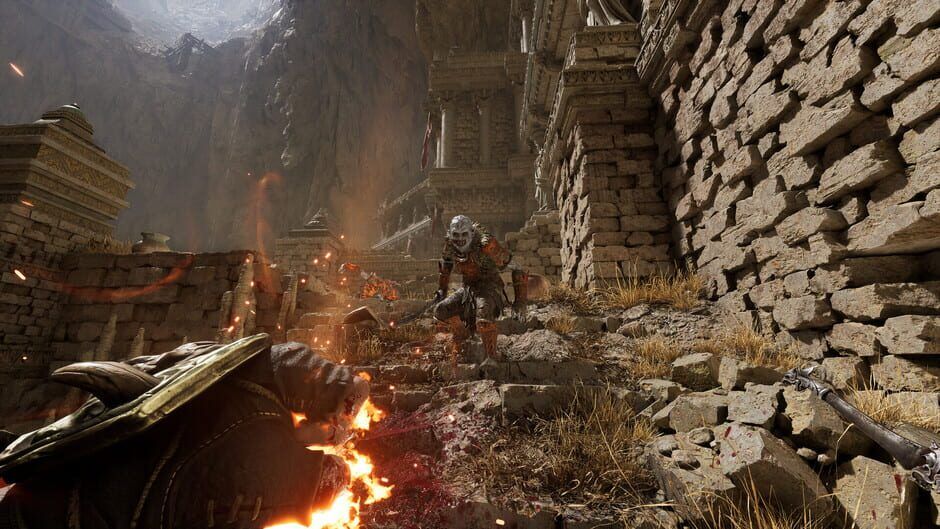
The combat is the part of Fatekeeper that immediately stands out. Battles are built around a first-person mix of melee and magic with a strong physicality to every swing. Your sword has weight and follow-through, enemies flinch or stagger correctly, and you are constantly watching spacing and timing rather than juggling hotbar cooldowns.
Encounters start deceptively simple: a corrupted soldier telegraphs a slash, a lunging beast tests your dodge timing. But as you push deeper the game expects you to study attack chains, tells and positioning. The feel is more deliberate than a standard action RPG, yet Paraglacial intentionally avoids ultra-strict Soulslike frames. There is room for imperfect timing, which makes successes feel earned without punishing you for every misread.
Magic weaves through this in a way that feels more like a toolkit than a separate role. Early spells let you control space, interrupt attacks or line up powerful finishers, and the developers are clearly leaning into the idea that a good build is one where your sword and sorcery are constantly feeding into each other. You might stagger a shielded brute with a spell, dart to their flank while they recover, and then trigger a heavy strike that sends them reeling toward a ledge or hazard. That kind of interplay is where the Dark Messiah comparisons start to really click.
Crucially, enemies are not just health bars. Dev blogs highlight distinct behaviors and weaknesses for different factions, and in practice that means you cannot just kite everything in the same circle pattern. Packs of fast creatures punish greedy swings, while heavily armored foes demand you either chip away smartly or reconfigure your approach with different weapons and spells. The Early Access build still needs tuning in places, but it already encourages experimentation over grinding.
Haven: A hub that reflects your choices
Instead of a shared open-world server or a procedurally generated base, Fatekeeper centers you in Haven, a hub that functions as both narrative anchor and mechanical spine. It begins as a fragile refuge in a drowning world, populated by a handful of survivors and flickers of dying magic. As you progress, Haven grows through your actions in the field.
Return from expeditions with relics and materials, and you can rebuild structures, strengthen defenses, and unlock new services. NPCs with their own agendas and histories drift in, offering side objectives, crafting options and lore fragments. Over time the place evolves from a crumbling sanctuary into a reflection of your playstyle and priorities.
Haven’s design sets Fatekeeper apart from pure survival sandboxes. You are not placing modular walls or perfecting farming layouts. You are making fewer but more meaningful decisions about which refuge to restore, which faction to support, and which upgrades to chase first. That same philosophy flows into progression overall: Fatekeeper wants each choice you make about your character and your hub to be tangible and visible, not buried in spreadsheets.
Progression: More than numbers on a sheet
Paraglacial has been clear that progression in Fatekeeper is built around builds, not just stats. In practice that means several interlocking layers: relics that alter playstyle, spells that reframe encounters, and gear that supports the way you want to approach the world.
Relics act like specialized modifiers with lore attached, nudging you into different rhythms. One might reward aggressive parries with bursts of damage, another could encourage cautious spacing by amplifying your ranged spells after successful dodges. Rather than showering you in loot, the game seems keen on fewer, more evocative items that genuinely shift how you think about a fight.
Character growth is framed as mastering roles within this ruined world. You are not simply a number going up. The more you invest in certain combat approaches, the more related narrative threads open up in Haven and beyond. Talk to the right NPC and a spell tree is not just a menu but also a story about where this forbidden magic came from and why it was locked away.
Early Access will of course bring more weapons, relics and spells over time, but the skeleton that is already present looks promising: a progression system that supports expressive builds without demanding you follow a rigid meta.
Lore and worldbuilding: Ruins that remember
Fatekeeper’s lore is not front-loaded in cutscenes so much as layered into the world. Ruins, shrines and battlefield remnants speak to prior cataclysms, while the people who cling to Haven carry different interpretations of what went wrong and what is coming next.
The developers have published dedicated lore blogs that help frame what you encounter: the notion of an order tasked with holding back fate itself, the cost of repeatedly rewriting destiny, and the way that strain has physically reshaped the land. In-play, that translates to a world that feels weary rather than simply grimdark. Structures sag under impossible weight, skies bruise around distant anomalies, and the remnants of previous guardians hint that you are just the latest in a long line of desperate last stands.
This focus on a coherent, handcrafted world helps Fatekeeper feel distinct from survival games that rely on procedural generation. Each dungeon or region you explore has been authored, with clear thought given to sightlines, enemy placement and environmental storytelling. It makes revisiting areas less of a chore and more of an opportunity to notice new details or access paths you could not before.
Standing out in a crowded space
So where does Fatekeeper land in the current sea of dark fantasy action games and survival-leaning RPGs? At least in this early state, it does not chase the usual survival beats. There is no emphasis on chopping trees for half an hour, no race to craft tiered armor sets just to survive the weather. Instead, Paraglacial seems far more interested in whether your sword swing feels right and whether a corridor encounter tells a small story.
That focus could be what gives Fatekeeper room to breathe. Handcrafted spaces, a reactive combat loop and a hub that evolves with your decisions are all pointed away from commodified co-op grinds and toward something more curated and story-conscious.
The flip side is that Early Access will need to maintain momentum. A focused, authored RPG can risk feeling thin if updates are slow or if build diversity does not keep pace with player expectations. Fatekeeper is entering Early Access promising new relics, spells, creatures and hub expansions shaped by community feedback. The challenge will be to expand without bloating, keeping its tight combat and strong sense of place intact.
For now, Fatekeeper feels like a dark fantasy first-person RPG that understands why people still talk about Dark Messiah nearly two decades later, and why players are hungry for handcrafted worlds amid survival sandboxes. If Paraglacial can keep sharpening its combat and layering depth into Haven and its surrounding ruins, this could be one of the more interesting Early Access journeys on Steam this year.