
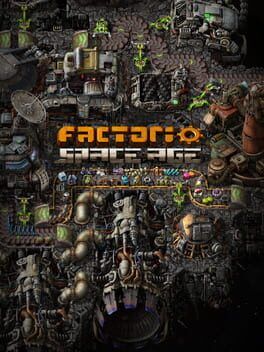

With Factorio heading to Nintendo’s next‑gen handheld hybrid alongside the $35 Space Age expansion, we break down why this could finally be the definitive console version for hardcore strategy and automation fans.
Factorio has spent years as one of PC gaming’s most respected strategy sandboxes, a ruthlessly efficient factory simulator that rewards planning, iteration and an almost obsessive love of optimization. With the game now heading to Nintendo’s next system alongside its massive Space Age expansion, console strategy fans are about to get the deepest automation experience yet on a portable machine.
Why Factorio Works So Well On PC
Factorio’s reputation was built on how cleanly it turns complex systems into readable problems. You start with an engineer stranded on an alien world, mining ore by hand and placing your first burner drills and transport belts. Before long you are planning bus layouts, balancing multiple resource lines, timing smelting ratios and designing self-healing production blocks that can be stamped down across the map.
On PC, mouse and keyboard input makes this feel almost like programming with tiles. Hotkeys let you flick between blueprints, copy entire factory sections, and adjust inserter directions in seconds. The isometric view is clear, zoom levels are generous and performance on mid-range machines is famously strong, which together make sprawling megabases more manageable than they have any right to be.
The other reason Factorio is so beloved is its respect for player time. There is no forced reset or roguelike wipe, no scripted story funnel. You solve production bottlenecks at your own pace, decide when to research oil, trains or robots, and choose how aggressively to provoke the local fauna. Every failure is readable, every success is tangible, and once the automation loop clicks, it can swallow hundreds of hours.
What the Switch 2 Version Offers
Nintendo’s updated store page confirms that Factorio is coming to Switch 2 with a December 22 launch window and a modest footprint of around 2.5 GB. More importantly, it arrives on the new hardware with full support for the Space Age expansion, giving the console edition immediate parity with the PC version’s endgame.
Pricing follows the PC structure: the base game is sold separately, while Space Age is a substantial paid expansion set at around $35 on Switch 2. This is not cosmetic DLC. Space Age effectively becomes a second campaign arc layered on top of the original rocket launch goal, extending the life of a save file far beyond the classic “first rocket” milestone that historically signaled the end of Factorio’s tech tree.
For strategy players who skipped the original Switch release due to hardware limitations, the move to Switch 2 should matter more than the modest file size implies. A higher resolution portable screen, stronger CPU and more RAM translate directly into smoother late-game performance and larger, more complex factories without the same degree of slowdown.
Controller and Handheld Considerations
Factorio’s systems were originally designed around precise pointing and dense hotkey access, so console ports live or die on controls. The Switch 2 version will again need to make smart use of radial menus, context-sensitive actions and generous snapping to keep factory building comfortable on a gamepad.
The previous Switch edition already proved that the core loop can feel good with a controller once players rewire their expectations. Placing belts in long runs, dragging ghost blueprints across the landscape, and quickly rotating assemblers all mapped reasonably well, with cursor acceleration and grid snapping helping overcome the lack of a mouse.
On a more powerful handheld, those fundamentals are likely to feel better simply because frame pacing and responsiveness improve as factories scale up. Zooming in to fine-tune a smelter block, then panning out to check train networks, should be smoother, which in turn reduces the friction of playing long sessions in handheld mode.
The challenge remains fine text and dense UI elements. Factorio’s tooltips, production statistics and recipe lists can be intimidating even on a large monitor. For Switch 2, clear font scaling options and strong default zoom levels are crucial if the game wants to serve both docked television play and handheld sessions without constant manual adjustment. Strategy players who enjoy poring over numbers will be watching closely to see whether the port makes this data legible without sacrificing information density.
Space Age: Why the New Planetary Layer Matters
Space Age transforms Factorio from a single-world industrial story into a multi-planet logistics puzzle. In the base game, your goal is to build and launch a rocket, effectively proving your factory can sustain high-volume, high-tech production. Space Age asks what happens next.
Once rockets are flying, the expansion opens up new celestial bodies to explore and exploit. Each world presents distinct resource profiles, environmental challenges and alien threats, which means your existing blueprints are no longer universally optimal. You are not just scaling up a single bus but planning entire interplanetary supply chains.
This additional layer is particularly attractive for console strategy fans because it deepens the planning horizon. Instead of optimizing one massive base until UPS and frame rates falter, you are designing a network of specialized factories, coordinating launches and returns, and deciding which planet should host which stage of production. The fantasy shifts from “ultimate factory” to “industrialized star system,” a change that suits players who enjoy grand strategy pacing but prefer Factorio’s deterministic logic.
Could This Be the Definitive Console Edition?
From a console-strategy perspective, the Switch 2 and Space Age combination makes a strong case. On the content side, having the expansion available on day one at its full $35 price puts Switch 2 in step with PC, rather than trailing behind as an afterthought. Space Age’s longer tech curve and multi-planet structure give console players the same long-tail progression that has kept PC veterans engaged.
On the hardware side, Switch 2’s upgraded performance should address many of the concerns that trailed the original Switch release. Larger factories, smoother scrolling and more stable late-game performance bring the core PC experience much closer to handheld. For a genre that depends heavily on responsiveness when reworking production lines, that extra headroom matters as much as raw resolution.
The remaining question is how well the interface scales. If the port nails controller mapping, offers robust UI customization and keeps text readable in handheld modes, Factorio with Space Age on Switch 2 has every chance to become the default recommendation for console players who want a truly hardcore sim they can play from the couch or on the go.
For PC purists tied to mouse and keyboard, the desktop version will likely remain the gold standard for sheer speed and precision. But for strategy fans who live on console, the Switch 2 release looks far closer to a “no-compromise” Factorio. With the full game, the Space Age planetary layer and the flexibility of both docked and handheld play, this could be the first time console owners get a factory sim that genuinely rivals its PC counterpart instead of merely approximating it.