
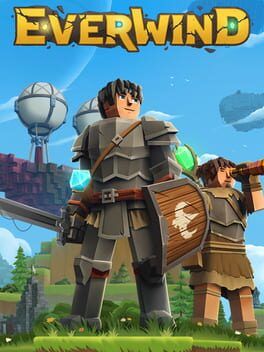

Breaking down Everwind’s Steam demo feedback and the devs’ roadmap for runes, monsters, and systems as it heads toward early access in a crowded voxel survival space.
Everwind’s time-limited Steam demo is over, but it clearly did its job. Enjoy Studios’ voxel survival RPG drew more than 355,000 unique players and over 246,000 hours of playtime, plus around 1,400 user reviews according to the team’s postmortem. For an in-development co-op sandbox built on flying island-ships rather than traditional terrain, that is a serious stress test and a strong signal that players are at least curious about a world above the clouds.
The studio characterizes the overall sentiment as positive, and the broader coverage around the web largely backs that up. Players responded well to Everwind’s core fantasy of living on a mobile floating base, its bright, semi-realistic voxel look, and the promise of sailing an airship fortress between islands with friends. The first person perspective, destructible terrain and the sense of verticality from stacked islands and looming sky ruins give it a different immediate feel from flatter, more grounded voxel survival games.
That said, the demo was clearly early. Feedback threads on Steam and social channels repeatedly called out performance issues, uneven frame pacing on mid-range rigs, and some clunky systems in need of iteration. Crafting and cooking in particular were criticized as feeling too barebones or one-button simple, with several players asking for more engaging mini-systems to match the otherwise immersive presentation. Others wanted clearer progression hooks, more threatening enemies in the early hours, and better onboarding for co-op groups to get their skyships built and traveling faster.
Enjoy Studios did not shy away from those critiques in its post-demo update. The team framed the demo as a data-gathering exercise as much as a marketing beat, and says it is now prioritizing broad performance improvements and “core mechanic refinement” ahead of early access some time next year. Instead of rolling straight into a content sprint, the roadmap they are teasing focuses on tightening the game’s backbone systems first, then layering progression depth over them.
A central part of that future identity is the rune system, which the devs recently previewed in a work-in-progress update. Runes are designed to be the primary way you push your gear beyond basic tier swaps. Rather than simply jumping from wooden tools to iron and then to some arbitrary magical metal, runes will socket into weapons, armor and potentially tools to modify both stats and behavior. The intent is to give survival players who enjoy tinkering with builds something to chase that fits within the game’s crafting fantasy.
Although details are still intentionally light, the previews suggest several interesting directions. Some runes appear to directly boost raw numbers like damage or durability, while others look more utility focused, hinting at faster gathering, movement tweaks or interactions with specific enemy types. Because Everwind is first person and leans into tighter combat encounters compared to a pure builder like Minecraft, tuning runes so they feel meaningful without trivializing survival will be important. The studio stresses that the system is still in flux and that feedback from future test phases will shape how complex it becomes, but they clearly see it as a foundational piece of progression rather than an optional side system.
On the creature side, Enjoy Studios showed off a run of “cute but deadly” enemies that will populate the islands in greater variety than what players saw in the demo. The highlights so far include a small, almost toy-like raptor, a chunky crab and lumbering ents. All three lean into Everwind’s soft but detailed voxel style, with rounded silhouettes and readable animations, yet are intended to be genuinely dangerous once properly tuned. The goal is to make the skies feel alive with distinct predators rather than reskinned fodder.
The team has hinted that different island biomes will mix these creatures in ways that encourage preparation and experimentation. A coastal or reef-like island might be crab territory where armor and crowd control shine, while dense woodland can belong to ents and pack-hunting raptors that punish players who ignore positioning or vertical escape routes. As runes are layered onto weapons and armor, the dance between your build and each monster type should become a quiet narrative of its own. Finding a particular rune that makes short work of ents, for example, could organically nudge a group toward tackling more forest islands.
All of this slots into the wider tuning pass that is planned before early access. Enjoy Studios has flagged several areas under active iteration, starting with core systems like resource pacing, combat feel and base mobility. One of the big distinguishing ideas in Everwind is that your “house” is also your ship, so the friction involved in upgrading and moving that flying island is crucial. The demo proved the concept of building a home that sails, but many players felt the early stages could be faster and more guided, with clearer milestones for unlocking engines, sails or magical propulsion.
The studio’s messaging suggests that early access will lean harder into that sense of staged ship progression. Expect a more defined ladder of hull upgrades, propulsion systems and onboard facilities that give your island-ship a stronger RPG arc. Instead of only chasing new biomes for better raw resources, the plan appears to be that you will chase runes, rare monster drops and crafted components that meaningfully transform how your ship handles and what it enables your group to do. That could mean anything from better storm resistance and longer range flights to on-board crafting stations that synergize with late-game gear.
Within the broader landscape of voxel survival sandboxes, that focus matters. Minecraft remains the default point of comparison for anything blocky and destructible, while Valheim and its many followers have carved out a space for progression-driven, boss-focused survival in more grounded, Norse-inspired worlds. Everwind borrows familiar survival beats from both, but its pitch is more specific. It wants to be the co-op RPG where your base is not anchored to a single patch of land, where the moment-to-moment loop is as much about piloting a shared sky fortress as it is about mining ore.
Visually, it also separates itself from the pack. Instead of chunky, toy-brick cubes, Everwind goes for a softer, almost diorama-like aesthetic, with detailed voxel models and warm lighting that make its floating islands feel like handcrafted models suspended in a lightbox. The combination of first person immersion, layered vertical spaces and a ship that is always there in the sky behind you gives it more of an airship adventure vibe than a typical survival grind. It edges closer to how Valheim uses its world to create a sense of journey, but trades forests and seas for a maze of clouds and skybound ruins.
Whether that is enough to carve out a lasting niche will depend on execution between now and early access. The demo has already shown that there is an audience hungry for a more guided, RPG-leaning voxel survival game where co-op progression feels structured and shared. If Enjoy Studios can turn runes into a satisfying, flexible way to define your playstyle, tune monsters so that each biome tells a distinct combat story and smooth out the rough systems that held the demo back, Everwind could settle comfortably between the creative freedom of Minecraft and the directed adventure of Valheim-likes.
Right now, Everwind is in that promising but precarious pre–early access window where potential and risk are closely balanced. The foundations are clearly there: a memorable setting, a strong visual identity, and a central mechanic that invites long-term co-op investment. Over the next year, how the team shapes runes, monsters and systems will determine whether flying your island-ship feels like a novel novelty or the start of a long-term home above the clouds.