
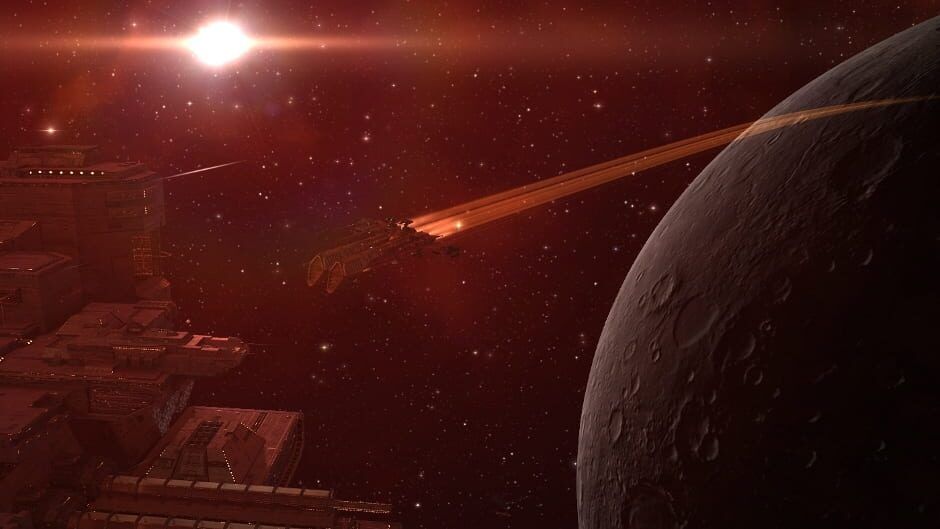
A gameplay-first look at EVE Online’s Catalyst major update, from the capital-ship role shakeup and harsher travel logistics to the Gallente election event that turns everyday activity into live narrative.
Catalyst as a systems update, not just a story beat
The Catalyst major update lands on top of EVE Online’s Catalyst expansion with a clear intent: tighten up ship identities, put real friction back into long-distance movement, and then tie all that systemic change into a live Gallente election that listens to what players actually do.
On paper it looks like a familiar CCP patch cycle, full of numbers and niche hulls. In practice it changes who you bring to a fight, how quickly you can move a fleet across New Eden, and what you will be doing for the next month if you care about the game’s main narrative.
This is a breakdown of what shifts for active players, not just what lines exist in patch notes.
Ship roles after Catalyst: fewer generalists, clearer specialists
Catalyst continues CCP’s recent theme of pruning generalists and sharpening specialist roles, especially in the capital and pseudo-capital space. If you fly Black Ops, Carriers, or popular Triglavian and SOCT hulls, your theorycrafting habits need an update.
Black Ops battleships: harder punches, softer faces
Black Ops battleships have been rebalanced to lean harder into their identity as sneaky, high-impact raiders instead of brawling bricks that also happen to teleport fleets.
In practice this means more offensive power and less durability. The damage output and application tools are better, so a blops drop that gets on top of its target has more ability to actually secure kills before reps land or the target extracts. At the same time the reduced tank punishes lazy positioning and overconfidence.
If you are an FC or small-gang organizer this incentivizes:
You treat blops fleets more like glass hammers, built around quick execution and fast extraction, not slow grinding brawls. Hunters and scouts grow in importance, because failed target selection is more often lethal to the attackers. Mixed fleets that bring dedicated tanky line ships and logistics to support blops become more attractive in situations where you once relied on blops alone.
For solo and duo hunters the risk profile is higher, but the reward for good target calling increases. Catalyst is effectively telling you to stop trying to make Black Ops into general-purpose frontline battleships and instead commit to them as high-skill ambush tools.
Carriers: real PvE capitals again
Carrier pilots gain new opportunities through both direct buffs and the introduction of the CONCORD Rogue Analysis “Crab” Beacon. Catalyst raises fighter damage and folds in tuning that makes carriers feel more like dedicated PvE workhorses instead of awkward, half-displaced capitals.
Day to day, this means a few concrete things:
Carriers push higher effective ISK per hour in sanctioned PvE content like the new Crab Beacon, where their fighters can chew through waves quickly. The gap between a properly fit carrier and a battleship doctrine in structured PvE is wider again, which gives capital specialists a clearer niche. Risk scales up with reward. The Crab Beacon is explicitly framed as high-risk high-reward; you are lighting a visible objective, inviting dangerous NPCs and letting other players know there is value on grid.
Catalyst does not make carriers the all-purpose apex of null-sec again. What it does is create a more legible path for capital progression: if you invest into carrier skills and fittings, you now get clearer, more rewarding PvE content that justifies undocking the hull instead of leaving it parked.
Triglavian and SOCT ships: power reined in
Triglavian ships and Society of Conscious Thought hulls were in an awkward spot. They offered strong performance, flexible fittings, and powerful mechanics for relatively modest investment. Catalyst hits these ships with tuning meant to bring their efficiency back into line.
For active players this shifts the economic and strategic calculus.
If you lived in a world where “slap a Trig hull on it” was the default answer to PvP and PvE questions, you now have to think twice. Their performance, especially in terms of raw power and accessibility, has been capped, so more traditional faction or T2 hulls re-enter the conversation for certain roles. For corps that standardized on SOCT or Trig doctrines, doctrine updates are not optional. You either lean into the revised stats with more careful fits and tighter roles, or you pivot into other hull families as primary line ships.
None of this removes Triglavian or SOCT ships from the meta. Instead Catalyst ensures that bringing them is a conscious choice with tradeoffs again, rather than a reflex.
Travel and force projection: New Eden gets bigger again
The other big pillar of Catalyst is the shift away from convenience in long-distance travel. CCP has been explicit about wanting risk to scale with reach, and the update codifies that idea in several systems.
Less convenient movement as a design goal
Over years of incremental changes, New Eden quietly shrank. Better infrastructure, safer logistics patterns, and efficient projection tools meant that capital-heavy blocs could appear almost anywhere on relatively short notice. Catalyst is part of a countertrend.
Force projection and related travel mechanics are being made more demanding to use. You can still move fleets across large distances, but it costs more in time, planning, and exposure.
On a practical level this encourages:
More regionalized conflict. If it is harder to rage-form a coalition and drop multiple regions away, local disputes stay local longer, which can give small and mid-size groups more space to operate. Real logistics gameplay. Moving doctrine hulls, capital assets, and fuel is more noticeable work. Haulers and logistics wings regain strategic importance instead of being a solved side task handled by a few specialists on autopilot. Tactical choices between staging systems that favor reach versus safety. You cannot have everything at once as cheaply.
Wormholes, filaments, and Pochven also feel the impact indirectly, since any friction applied to standard travel options makes alternative routes and risky shortcuts more tempting.
Pochven tweaks: risk and reward rebalanced
Pochven has long been a region where travel oddities, high-end income, and tight-knit PvP collide. Catalyst adjusts rewards there to push players toward more sustained activity and reduce some of the outlier advantages that made Pochven farming and travel routing so strong.
If you used Pochven as a high-efficiency income engine or as an ultra-convenient travel overlay, expect a need to re-evaluate your routines. The region still offers unique perks, but Catalyst nudges it away from being the default choice for any corp or alliance that can access it.
For PvP groups that specialized in hunting there, this can be positive. More considered use of Pochven tends to mean a higher signal-to-noise ratio of valuable targets versus pure farmers cycling the same optimally safe loops.
Carriers and the Crab Beacon: capital PvE with teeth
The CONCORD Rogue Analysis “Crab” Beacon is the most direct new gameplay hook for carrier pilots. On the surface it is another structured PvE encounter. Underneath, it interacts strongly with Catalyst’s broader goals.
When you activate a Crab Beacon you are not just spawning NPCs. You are advertising to the system that there is content worth third-partying.
Because carriers have been buffed to perform better in this environment, the site becomes a calculated risk. Carrying more power onto grid translates into faster completions and better income, but it also increases what you stand to lose if a roaming gang or hostile standing fleet decides to drop in.
For groups that want to live on the edge of high-value PvE and organic PvP, the Crab Beacon is essentially an opt-in content generator. Catalyst uses this to restore a sense that high-end ISK should always carry an elevated chance of interaction with other players, not sit behind layers of nearly risk-free optimization.
The Gallente election: live narrative as daily activity
Alongside the mechanical shakeup, Catalyst is framed by the Gallente Presidential Election, running from March 19 to April 16. This is not just a lore event. It is a month-long mechanism that turns routine gameplay into narrative votes.
Players can back one of three candidates, each representing a different vision for Gallente and by extension the future tone of New Eden’s politics: Soraya Roden, Lucas Tenzin, and Alix Moreau. You do not cast ballots through a menu. You contribute by playing.
Challenges tied to everyday activities award points to your candidate. You run sites, fight, haul, explore, and those actions turn into influence within the election framework. The more you lean into the seasonal objectives, the more weight your preferred candidate gains.
For active players this matters in two layers.
In the short term, the event is a parallel progression track. It gives you extra rewards and reasons to vary your gameplay as you pursue objectives that align with your usual activities. If you are a PvE grinder you get structure to your sessions. If you are a PvP roamer you have incentives to go looking for fights during a heightened-traffic season. In the longer term, the winning candidate shapes upcoming story arcs and potentially future features. Faction warfare developments, regional security politics, and the flavor of future events can all be bent by the outcome.
CCP is putting its live narrative where its systems are. By tying the election outcome to aggregate player activity, Catalyst treats the player base as the electorate in both lore and design terms.
How it all links together for active players
Taken as separate pieces, the Catalyst changes are easy to file mentally as just another balance patch and another seasonal event. Put together, they pull on the same rope.
Ship roles are being sharpened so that fleets are made of defined tools rather than overlapping generalists. Travel and force projection are being made less effortless so that space feels large and choices about where to live and fight matter. Capital PvE is being re-centered around risk-infused activities like the Crab Beacon so big ships feel consequential again. The Gallente election watches what you do under these new constraints and rewards paths you collectively choose, then locks those choices into the unfolding story.
For an individual pilot this translates to a few concrete shifts.
If you are a capital or blops specialist you will spend the next weeks refitting, re-theorycrafting, and stress-testing your doctrines. You are rewarded for mastering sharper, riskier roles rather than relying on forgiving generalist stats. If you are a logistics or industrial player your movement plans matter more. Efficient hauling, staging, and route planning reclaim their place as core strategic contributions. If you are a narrative-minded pilot or a faction loyalist, your day-to-day activity now has a clear line into the direction of Gallente politics and future content.
Catalyst is not a total reinvention of EVE’s sandbox, but it meaningfully tilts the table. You feel it when you plot a route, when you choose a hull, and when you decide whether to run one more Crab Beacon or push one more election challenge before logging off. For a long-running MMO, that kind of systemic nudge is exactly what keeps the universe feeling alive rather than static.