
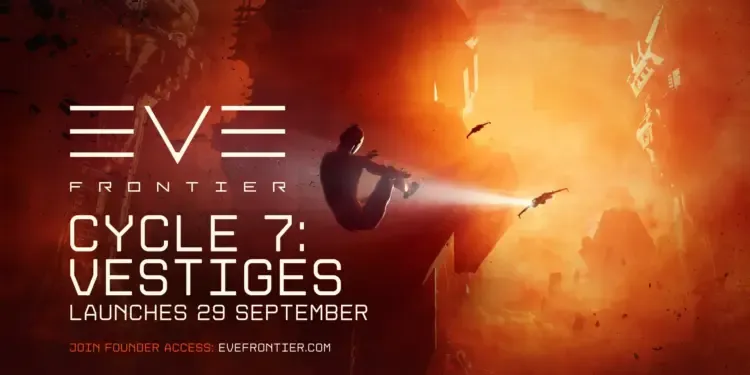

EVE Frontier Cycle 7: Vestiges launches September 29 with Aim Flight, deeper exploration, dynamic Feral Drones, physical docking, progression changes, and a full universe reset.
Image: geekmetaverse.com
Vestiges launches with a wipe, not a gentle patch
EVE Frontier Cycle 7: Vestiges is scheduled to launch on September 29, 2026, and the most important practical detail is also the harshest one for an in-progress survival MMO: the update begins with a full universe reset. MMOHuts reports that Fenris Creations says the reset is required because several Cycle 7 systems change how the game’s universe is generated and discovered. BlockchainGamer.biz likewise describes the reset as part of the start of the next three-month cycle for the in-development blockchain MMORPG.
That framing matters because Vestiges is not being presented as a balance pass around an otherwise stable world state. The EVE Frontier universe reset is tied to the structure of space itself, the way players find locations, and the way threats operate inside that space. For returning players, that means old routes, assumptions, and infrastructure plans should be treated as temporary. For new players, the wipe creates a rare synchronized entry point, but one where the opening hours will be shaped by unfamiliar flight controls, hidden signatures, and Feral Drones that behave less like static hazards.
The tension in EVE Frontier Cycle 7 is simple: Fenris is giving players a fresh universe at the same time it is changing the basic act of moving through it. In a survival sandbox, that affects nearly every progression decision, from what ship parts feel worth building toward to how much risk a player takes while scouting unknown space.
Aim Flight turns piloting into a build and execution problem
The headline mechanical change is the EVE Frontier flight overhaul. According to MMOHuts and BlockchainGamer.biz, Aim Flight becomes the new default control scheme in Vestiges. Players point their ship using a mouse or gamepad, while keyboard inputs remain available for acceleration, braking, and other actions. Ships can strafe, roll, and move beyond a fixed flight plane, which Fenris describes, via BlockchainGamer.biz, as a step toward manual flight with full freedom of movement.
This is a major shift for a game built around travel, threat evaluation, and survival logistics. Under the new model, a ship’s facing, weapon aim, momentum, and intended path can become separate problems rather than one flattened movement decision. MMOHuts reports that the older WASD controls remain available, and that WASD still allows movement and targeting to be separated, letting a player fly in one direction while aiming weapons elsewhere. That fallback matters for veterans who have internalized the previous scheme, but the new default suggests Fenris wants basic piloting to carry more of the game’s skill expression.
There is an accessibility and learning-curve question here that the current source material does not answer. We know Aim Flight is default, gamepad support is included, and WASD remains selectable. We do not yet have detailed information on tuning options, input assists, rebinding depth, or how the new model feels under network stress. In a survival MMO, manual control is only as satisfying as its responsiveness, especially when a player is hauling resources, fleeing drones, or docking near shared infrastructure.
Ship fittings now have more direct consequences in motion
Vestiges also strengthens the link between modular construction and handling. BlockchainGamer.biz reports that thrusters determine propulsion, while engines affect how efficiently fuel is converted to thrust and how the vessel handles. MMOHuts similarly notes that thrusters and engines now shape thrust, fuel efficiency, and feel more directly.
For a systems player, this is the part of the update that could change progression most deeply. If ship fittings have clearer handling identities, then the question is no longer only whether a vessel can mount enough utility or survive enough punishment. A player also has to ask whether the ship can turn, accelerate, brake, and sustain movement in the role it is meant to perform. A scout build, a resource hauler, and a combat-oriented shell of a ship may now diverge through motion as much as through inventory or firepower.
Bleeding Cool’s summary of Fenris’ details also points to a new skill system in which both the Character and Shell, described there as the clone body the player inhabits, improve through experience. MMOHuts reports the same broad change, saying both Character and Shell can improve through experience earned in the Frontier. The exact progression trees, caps, respec rules, and long-term reset implications are not detailed in the provided sources. What is confirmed is enough to suggest that Cycle 7 is tying player capability to three layers at once: the pilot, the body, and the ship. That gives Vestiges a stronger RPG spine, but it also raises familiar MMO questions about grind, specialization, and whether early choices will feel liberating or punishing after the wipe.
Exploration shifts from map knowledge to travel knowledge
The other major loop change is exploration. MMOHuts reports that in-system and inter-system signatures will be discovered while traveling rather than revealed upfront. BlockchainGamer.biz says players will build knowledge of surrounding space by finding new points of interest, ancient constructs, and stellar environments, including multi-star systems with combinations of environmental effects.
That is a meaningful change for the survival side of EVE Frontier Vestiges. If signatures appear through movement, scouting becomes an active job rather than a pre-flight menu check. Routes gain value because someone had to test them. Dangerous systems become dangerous through accumulated evidence, not because every hazard was obvious before departure. The September 29 reset supports that design goal by clearing established universe knowledge before these discovery rules arrive.
The presence of multi-star systems is especially important because overlapping environmental effects can turn navigation and fitting into a single decision. The sources do not provide a catalog of those effects, their severity, or their counters. Still, the confirmed direction is clear: exploration is being designed around uncertainty, and the player’s ship build may determine how much uncertainty they can afford. In progression terms, that makes scouting a form of advancement. A player’s most valuable asset after the reset may be reliable knowledge of what lies between safe services, resources, drone activity, and environmental pressure.
Feral Drones become competitors, not background enemies
Vestiges also reworks Feral Drones into more dynamic actors. MMOHuts reports that they can scan, travel, mine, salvage, and scavenge on their own, while lacking perfect knowledge of nearby space. Instead, they detect signatures, interpret information, and respond based on what they can determine. BlockchainGamer.biz adds that they operate under the same knowledge constraints, rules, and abilities as players, and that their activity can put them in competition with players for resources.
This is one of the more consequential confirmed changes because it connects AI behavior to the same discovery economy that governs players. If Feral Drones need information before they act, then player movement, resource extraction, and repeated routes may become signals in the wider simulation. Bleeding Cool’s summary says drones react to what players are doing around them, while BlockchainGamer.biz reports that player movements and actions will influence nearby Feral activity.
There is a design risk here. Dynamic threats can create memorable stories when they are legible, but they can feel arbitrary if players cannot understand why pressure is increasing. The source material confirms the ambition, not the final tuning. We do not yet know how predictable Feral escalation will be, how much warning players receive, or whether solo players can meaningfully avoid drawing attention. What is confirmed is that resource competition after the reset will not be purely player-versus-player or player-versus-environment. The drones are being positioned as participants in the frontier’s economy of attention and materials.
Physical docking makes safety and service access more exposed
Physical docking is another systems change with practical consequences. MMOHuts reports that docking now physically attaches ships to ports on objects and infrastructure, with the ship still visible in the world. BlockchainGamer.biz says vessels attach to ports on structures and other objects in space to access services, remaining present within the universe while docked.
That detail may sound cosmetic, but in a survival sandbox, persistence changes behavior. A visible ship attached to a structure communicates presence, route activity, and potential vulnerability, depending on how Fenris implements permissions and protection. The provided sources do not specify whether docked ships can be attacked, scanned, blocked, or otherwise interfered with. They do confirm that docking is being moved into the same physical language as the rest of Vestiges: ships have orientation, ports have locations, and service access happens in-world.
Taken together with Aim Flight, modular handling, and discoverable signatures, physical docking makes the universe feel less abstract. It also increases the importance of approach, positioning, and infrastructure placement. Players returning for EVE Frontier September 29 should expect docking to be part of the survival loop rather than a simple transition screen, even if the exact risk model still needs clarification from Fenris.
How to approach the September 29 reset
The practical advice is to treat EVE Frontier Cycle 7 as a fresh survival campaign, not as a patch where old planning cleanly carries forward. The reset is confirmed, Aim Flight becomes the default, exploration information has to be earned through travel, and Feral Drones are being updated to pursue their own scanning, mining, salvaging, and scavenging behavior. If you are returning, log in ready to relearn movement before committing to risky resource routes. If you are new, the wipe may be the cleanest moment to enter, but the opening curve will include manual flight and a universe whose points of interest are no longer fully exposed upfront.
There are still important unanswered questions. The sources do not provide a complete skill breakdown, detailed environmental hazard tables, server performance expectations, or the exact protection rules around physical docking. They also do not give a final account of how punishing the new flight model will be for players who prefer slower, logistics-heavy play over manual piloting. What is confirmed is that WASD controls remain available, which should soften the transition for players who do not want Aim Flight as their primary control style.
BlockchainGamer.biz reports that permanent access starts from $40 through the EVE Frontier website. Anyone considering that purchase should weigh the appeal of participating in an in-development, reset-driven sandbox against the uncertainty that comes with systems still being shaped across cycles. Vestiges is compelling because its confirmed changes all point in the same direction: a frontier where movement, discovery, ship construction, and AI pressure are more tightly connected. That also means the September 29 reset is not a side note. It is the foundation for testing whether those systems can hold together once every pilot has to start charting space again.