
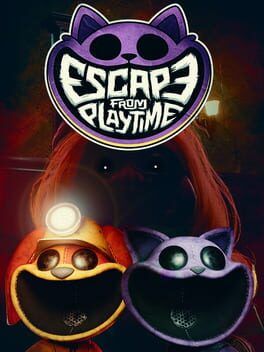

Escape from Playtime is now in Steam Early Access. Here is what horror fans need to know about its 1-8 player co-op setup, solo play, PC launch, price, and whether to wait.
Image: IGDB
Store links: Escape from Playtime on Steam
Escape from Playtime enters Early Access with an eight-player horror pitch
Escape from Playtime is now available in Steam Early Access, and Mob Entertainment is positioning it as a cooperative survival horror extraction game set inside the Poppy Playtime universe. The official Games Press release says the PC launch went live on October 21, 2026, with support for 1-8 players, while Invision Community describes the setup as solo play or teaming with up to seven friends.
That player count is the first practical detail horror fans should lock down before buying. This is not a traditional single-player Poppy Playtime chapter, and it is not being sold as a finished 1.0 release. It is an Early Access co-op horror game built around scavenging runs, assignments, enemy pressure, communication, and the uncertainty that comes from entering the factory with a group that may be brave, loud, disorganized, or all three.
The Steam listing provided in the source material identifies the game as Escape from Playtime on Steam and shows a 10 percent launch discount. TechTimes reports a $9.99 base price, discounted to $8.99 during launch. Gamepur reports that the game is currently PC-only on Steam, lists Windows 10/11, and has partial controller support. No console version is confirmed in the provided sources.
The co-op structure is clear, but the wording around solo and multiplayer needs parsing
The cleanest version is this: Escape from Playtime supports up to eight players, and solo play is also listed. The slight tension is in how different sources phrase that same setup. Mob Entertainment’s press release, distributed through Games Press, calls it a “1-8 player canonical co-op extraction game.” Invision Community says players can enter alone or with up to seven friends. Gamepur, reading the Steam listing, says online co-op supports 2 to 8 players, while single-player is listed separately.
For players, that means the maximum Escape from Playtime player count is eight. If you are asking whether you can go in alone, the sourced answer is yes. If you are asking how many players count as online co-op, Gamepur reports 2-8. The game’s own pitch, however, is clearly built around group play, with teams searching factory zones, carrying supplies back safely, and making moment-to-moment calls about when to stay together or split up.
That last choice is where the design has teeth. In a survival horror environment, a large lobby can be a comfort blanket or a dinner bell. Invision Community notes that proximity voice chat is part of play, and that making too much noise can alert threats. A full eight-player group may cover ground faster, but it also creates more footsteps, more panic, more crossed instructions, and more chances for one careless voice to drag something out of the dark.
A scavenging loop replaces the usual lonely Poppy Playtime pressure
Escape from Playtime is set after the Hour of Joy and before the events of Poppy Playtime: Chapter 1, according to Mob Entertainment’s press release and Invision Community’s launch coverage. Players take the role of the Smiling Critters, the toy characters introduced in Poppy Playtime: Chapter 3, as they try to survive inside the abandoned Playtime Co. factory.
The structure described by Mob Entertainment and covered by Invision Community centers on expeditions into changing factory areas. Players search for resources, complete assignments, transport valuable supplies back safely, and try to avoid rejected experiments roaming the corridors. The assignments come from a mysterious Voice promising sanctuary and a new home. Both the official release and Invision Community frame that promise as suspicious rather than reliable.
Mechanically, the sourced feature set includes scavenging, puzzle solving, tool collection, clue investigation, hiding places, distractions, and alternate routes. That matters for horror pacing. A co-op horror game lives or dies by whether it can keep a team under pressure after the first scream. If the only answer to danger is sprinting away, the fear burns out quickly. The listed systems suggest a loop where survival depends on reading the space, managing risk, and choosing when a haul is worth the noise.
The factory setting also changes when other players are present. Poppy Playtime built much of its identity on isolation, toys watching from impossible corners, and industrial spaces that feel too dead to be safe. Escape from Playtime has to preserve that dread while letting up to eight people talk through it. Proximity chat is the sharpest confirmed tool for that job because it can turn communication into a liability. A whispered warning can save a run. A panicked shout can end one.
Early Access means the factory is open before it is finished
Gamepur reports that Escape from Playtime launched in Early Access on October 21, 2026, and that Mob Entertainment is targeting roughly one year in Early Access. Gamepur also reports that the studio plans to add new zones, enemies, and features based on player feedback. The official Games Press release confirms the Steam Early Access launch, but the one-year target and planned categories of additions come from Gamepur’s guide coverage.
That distinction is important for anyone deciding whether to jump in now. The current purchase appears to be for a game that Mob Entertainment expects to change. In the horror space, those changes can be especially consequential. New zones affect route knowledge. New enemies change the way players listen, hide, and move. New features can reshape whether Escape from Playtime feels like a tense scavenging game, a social chaos machine, or something closer to a lore-driven factory crawl.
Early Access also places some of the burden on the community. Co-op horror games depend on matchmaking health, voice behavior, balance tuning, bug fixing, and content cadence. A solo horror campaign can remain effective even if its audience arrives months apart. A Steam co-op horror release benefits from players showing up in clusters, learning together, and testing the edges of the systems. Buying early means participating in that unsettled period, with all the discovery and roughness that implies.
How it fits beside Project: Playtime and the wider co-op horror crowd
TechTimes frames Escape from Playtime as a departure from Project: Playtime, Mob Entertainment’s earlier multiplayer release in the same broader universe. According to TechTimes, Project: Playtime used an asymmetric PvP model with one player controlling a monster against a team of survivors, and that game has since been discontinued. Escape from Playtime instead focuses on players cooperating against AI threats.
That shift gives the new game a clearer audience. Players looking for a competitive monster-versus-survivors format should not assume this is Project: Playtime revived under another name. The confirmed pitch is cooperative extraction horror: enter the factory, scavenge, complete assignments, avoid what is hunting you, and get out with enough to make the trip worthwhile.
TechTimes compares the structure to the modern co-op extraction horror trend on Steam, specifically citing games such as Lethal Company and R.E.P.O. That comparison is useful, but it should not be treated as a promise of identical pacing or quality. What Mob Entertainment brings, according to the official release, is a canonical Poppy Playtime setting, the Smiling Critters perspective, familiar characters, and lore connections for existing fans. Game director Brandon James said in the official statement that the team wanted to explore a lesser-known chapter of Playtime Co.’s history while keeping the experience approachable for newcomers.
For horror fans, the open question is whether the recognizable Poppy Playtime imagery can sustain repeatable co-op runs. Mascot horror works best when cuteness becomes a threat, when the toy shape makes the violence feel wrong before it becomes loud. Extraction horror works best when greed, time pressure, and bad communication create the monster’s opening. Escape from Playtime is trying to bind those instincts together.
Who should buy now, and who should wait
Based on the sourced launch details, Escape from Playtime Early Access is easiest to recommend to players who already have a group ready. The game supports solo play, but its strongest confirmed systems are social ones: online co-op, proximity voice, group scavenging, and decisions about splitting up under pressure. If you have three to seven friends who enjoy panicked callouts, bad plans, and the sick little silence after someone stops answering, the launch version is aimed squarely at you.
Solo players should be more cautious. Gamepur reports that single-player is listed, and Invision Community says players can venture into the factory alone, so solo availability is confirmed by the provided sources. What is not confirmed here is whether solo balance, progression, enemy behavior, or mission pacing feel as strong without a squad. If you mainly want the next polished Poppy Playtime horror game with a controlled campaign rhythm, waiting for Early Access updates or broader player impressions is the safer move.
PC players with controllers should also note Gamepur’s report of partial controller support. That does not mean no controller support, but it does mean mouse and keyboard may remain the more reliable default at launch. There is no confirmed console release in the source material, so PlayStation, Xbox, and Switch players are waiting unless Mob Entertainment announces more later.
Price may make the early plunge easier. TechTimes reports a $9.99 price with an $8.99 launch discount, and the Steam page title in the provided source material advertises 10 percent off. Still, the better question is not only cost. It is appetite for an unfinished, evolving co-op horror game. If you want to help shape routes, balance, and scares while the factory is still being wired, now is the intended moment. If you want a fuller enemy roster, more zones, and the benefit of post-launch tuning, Mob Entertainment’s reported one-year Early Access target gives you a clear reason to watch from the hallway a little longer.