
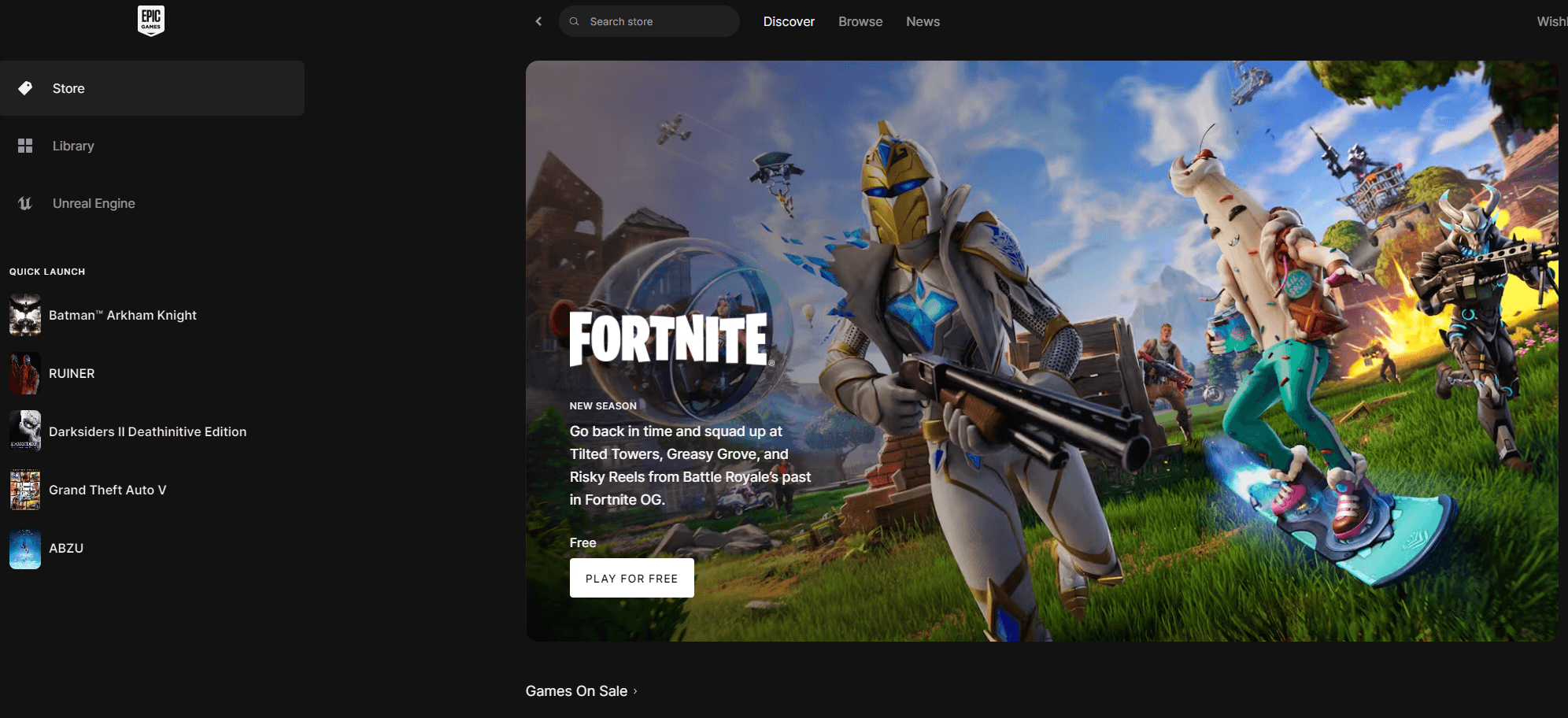

Newzoo analyst Emmanuel Rosier says he does not see how Epic Games Store can recover against Steam. Here is how free games, Fortnite, and Epic's launcher overhaul shape the storefront's future for PC players.
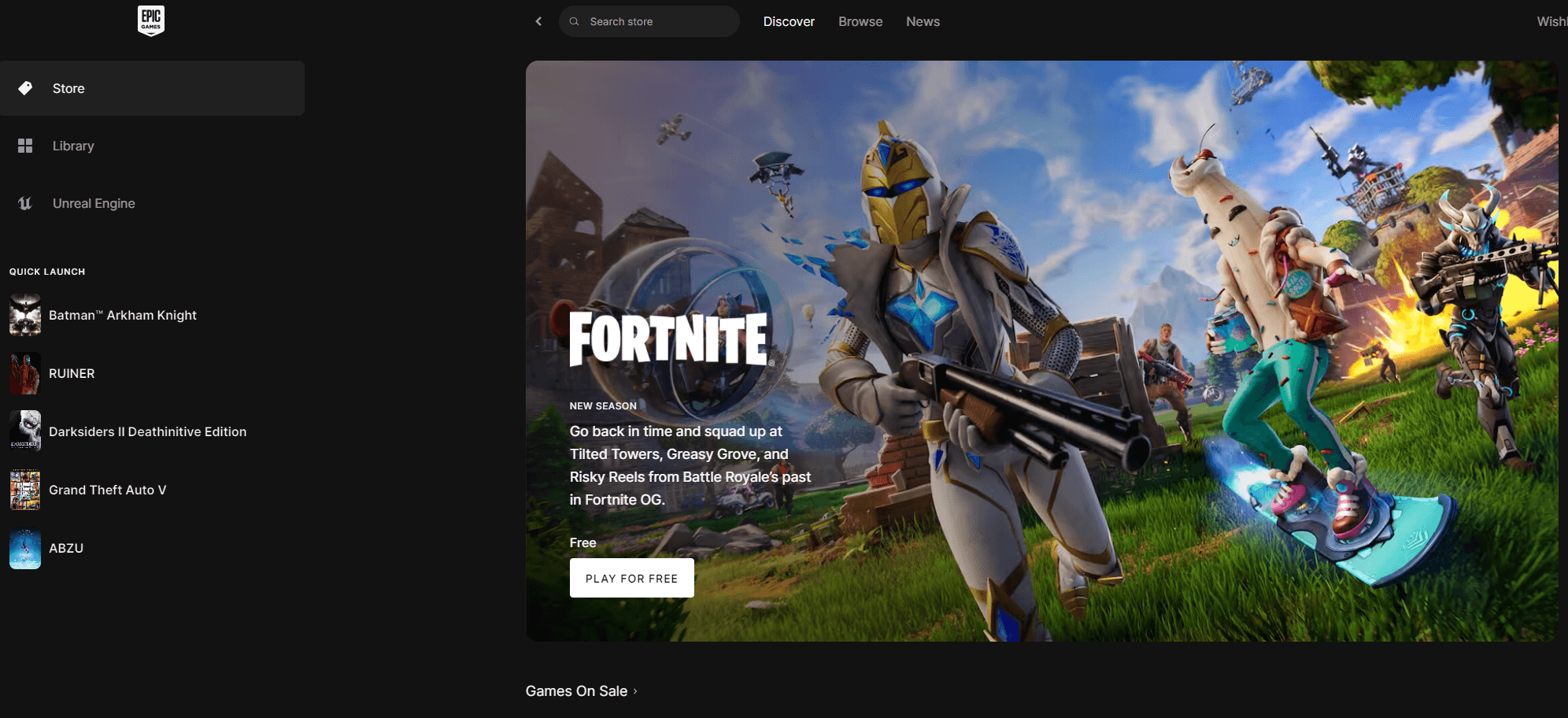
Image: tomshardware.com
Newzoo’s warning puts Epic’s storefront overhaul under pressure
The sharpest new development around the Epic Games Store is not another missing launcher feature or another free game promotion. It is a blunt analyst read on Epic’s ability to recover ground in PC game storefronts. Emmanuel Rosier, director of market intelligence at Newzoo, told PC Gamer, according to Eurogamer’s report, “I don’t see how they can recover at this point.”
That comment lands at an awkward time for Epic. As Eurogamer notes, Epic has spent much of this year promising an Epic Games Store overhaul built around a faster redesigned storefront, tailored recommendations, and quicker ways to browse. TheGamer’s coverage of Epic’s recent roadmap also points to planned library interactions, cross-region gifting, patch notes, player profiles, reviews, discovery improvements, universal controller support, a notifications overhaul, and a move away from Unreal Engine for the launcher.
Those are concrete planned improvements, and they address years of complaints about the store’s everyday feel. But Rosier’s argument is that the recovery problem is no longer only about features. His assessment is that Steam has become so embedded in PC gaming habits that catching up with a better interface may not be enough. That is the tension at the center of the Epic Games Store future: Epic can improve the product and still face a market where users have already chosen where their PC libraries, friends lists, reviews, mods, wishlists, and purchase routines live.
The free games strategy created accounts, but analysts question the habit
Rosier’s critique focuses heavily on the Epic Games Store’s free game giveaways. According to Eurogamer’s account of his PC Gamer interview, Rosier said Epic gets players by giving away free games, but many users log in, claim them, and do not play them. He described the behavior as “almost like collecting games rather than actually playing them.”
That distinction matters because a claimed game is not the same thing as an active storefront relationship. For Epic, the free games program can bring people through the door. For a platform trying to challenge Steam, the harder task is turning that visit into a routine: browsing new releases, buying DLC, reading community feedback, chatting with friends, installing updates, and starting games from the same launcher every night.
The market data included in the supplied sources shows both sides of the issue. Tech Insider’s June 2026 comparison, which says it draws from Epic’s 2025 Year in Review, Steam public data, independent market research, and developer community feedback, lists Epic at a record 78 million monthly active users in December 2025 and says 662 million free games were claimed in 2025. The same comparison reports that Epic’s 2025 daily active users were 31 million, down 2 percent year over year. It also lists Epic’s full-year 2025 store revenue at $1.16 billion and third-party spending at $400 million, up 57 percent year over year.
Those figures do not support the idea that Epic Games Store is dead. They do support Rosier’s narrower concern: scale created by promotions is different from loyalty strong enough to change default buying behavior. In strategy terms, Epic has been excellent at generating acquisition events. The questioned part is retention quality.
Steam’s advantage is the player’s existing PC life
The Epic Games Store Steam competition is often framed around revenue cuts and free games, but Rosier’s point is closer to player psychology. Eurogamer quotes him saying he does not see how Epic can turn the situation around because “Steam has become so inevitable.” He also argued that a giveaway on Epic can sometimes end up helping a game sell on Steam, because players prefer to keep their collection in one launcher rather than fragment it.
That is a brutal dynamic for any challenger. If a free copy reminds someone a game exists, but the eventual purchase, DLC spend, or sequel interest goes to Steam, Epic has paid for awareness without fully owning the downstream value. The store then becomes a coupon stop instead of the player’s PC home base.
Tech Insider’s comparison puts numbers around the gap, reporting Steam at 74 to 75 percent of the global PC digital distribution market and Epic at roughly 3 percent by revenue share. It also lists Steam’s 2025 average monthly active users at 132 million, compared with Epic’s 67 million average and 78 million peak in December 2025. Those figures come from Tech Insider’s synthesis rather than a single platform disclosure, so they should be read as market-research framing rather than a direct side-by-side company filing. Still, they align with the thrust of Rosier’s analysis: Steam is not winning only because it sells games. It is winning because players have built years of frictionless accumulation around it.
Feature depth compounds that lead. Tech Insider’s table lists Steam Workshop, Big Picture mode, Steam Families, full user reviews, Proton, Steam Deck Verified support, and a native Steam Deck ecosystem. The same comparison says Epic lacks equivalents for Workshop, Big Picture, Family Sharing, and a native Linux client, while reviews remain limited. Epic’s roadmap addresses some quality-of-life gaps, but it does not instantly replicate decades of community infrastructure or the gravitational pull of a player’s existing library.
Epic’s overhaul attacks the right problems, but timing is the hard matchup
Epic’s planned improvements are not trivial. A faster storefront, better browsing, tailored recommendations, improved library interactions, profiles, reviews, controller support, and clearer notifications all target practical reasons players avoid using the Epic launcher as their main PC hub. TheGamer’s report also says Epic vice president and general manager Steven Allison has admitted the platform “sucks,” and that the team has pledged to focus on quality-of-life features and performance.
That admission is useful because it shows Epic is not pretending the launcher’s reputation is imaginary. The issue, viewed through Rosier’s comments, is that fixing fundamentals in 2026 has a different strategic value than launching with them in 2018. Steam’s advantage has widened while Epic has been catching up on basics, and players who have organized years of purchases around Steam are less likely to move because another launcher becomes less annoying.
This is where the “too little, too late” reading has force, but it remains an analyst interpretation rather than a confirmed outcome. Confirmed facts from the source material are that Epic is promising and roadmapping store changes, that the Epic Games Store is still operating, and that Epic’s free game program and user numbers remain large. Rosier’s judgment is that those moves may not be enough to change the competitive endpoint.
There is also a reliability layer for players. Epic’s public status page currently lists Epic Games Store functions such as login, download and installation, purchasing and refunding, wallet, store browsing, publishing tools, achievements, and ecommerce as operational. The same status page also records a resolved August 20, 2026 issue where players were unable to update or install games or saw the launcher appear blank. That kind of incident is not unusual for major digital services, but for a challenger trying to earn default-launcher trust, every blank launcher or install failure is strategically expensive.
Fortnite is the bright spot, but it does not solve the storefront problem by itself
Rosier was more optimistic about Epic as a game developer than as a storefront operator. Eurogamer reports that he pointed to Epic’s renewed focus on Fortnite as a rare bright spot, saying Epic has put a lot of thought into Fortnite and that it looks better now than it did six months or a year ago.
His example was Fortnite’s growing crossover economy. Eurogamer’s report cites Sonic the Hedgehog, Pac-Man, Kingdom Hearts’ Sora, and Persona 5’s Joker appearing in the current season. That matters because Fortnite is one area where Epic controls the full loop: content, events, monetization, identity, social presence, and a massive audience that already knows how to spend inside Epic’s ecosystem.
The question is whether Fortnite can meaningfully transfer that strength to the Epic Games Store. It gives Epic leverage, brand visibility, and daily engagement that most storefront challengers would envy. But Fortnite engagement is not the same as buying third-party PC games through Epic. A player can treat Fortnite as a live-service destination while still treating Steam as the default store for everything else.
That split is central to the Newzoo analyst Epic Games Store skepticism. Epic may be executing better in Fortnite while struggling to convert PC storefront behavior. In competitive terms, Fortnite is Epic’s strongest lane, but Steam owns the map control around PC purchasing habits.
Epic has fought too many fronts at once, according to Rosier
Rosier also framed Epic’s problem as one of strategic overextension. Eurogamer quotes him saying Epic tried “to win everywhere” over the past few years: against Steam, against Apple, against Google Play, and across other battles at the same time. His view is that Epic may have run out of capacity to fight all of those fronts simultaneously.
That comment connects the store’s future to Epic’s broader platform ambitions. The Epic Games Store was never only a PC launcher. Epic has pushed lower platform fees, challenged mobile gatekeepers, and tried to make its store a cross-platform distribution force. Eurogamer also notes that earlier this year Epic’s Steve Allison said Xbox had “welcome[d]” the idea of including Epic’s storefront on its hardware and added, “we’re going to be there, like, on day one.”
That Xbox comment is a stated ambition, not evidence that Epic has solved the PC store problem. It does show that Epic still thinks in platform terms. The strategic risk is that expanding to new hardware or fighting mobile ecosystems does not automatically fix low conversion on PC. If Steam remains the default place where PC players buy, review, mod, and organize games, then Epic’s broader distribution thesis still needs a stronger answer to the simplest user question: why should this purchase happen here?
Epic’s strongest answer remains developer economics. Tech Insider’s comparison lists Epic’s revenue cut as a flat 12 percent, versus Steam’s 30 percent standard cut with lower tiers above major revenue thresholds. That is a meaningful publisher and developer incentive. But players do not experience a revenue split when choosing where to click buy. Unless Epic’s cut translates into better prices, stronger exclusives, better services, or player-facing value, it is not enough on its own to move entrenched demand.
For PC players claiming free games, the practical answer is to keep the library but watch your buying habits
For players who still open the Epic Games Store each week to claim free games, Rosier’s comments do not mean those games are going away based on the provided sources. There is no announcement here that Epic is ending the free games program, no announced shutdown of the store, and no source-provided change to ownership of claimed games. Epic’s status page lists the store as operational, and the supplied market data still shows a large audience using the platform.
The practical question is different: should players invest further into Epic as a primary PC library? If you already claim free games there, the low-risk play is to keep doing so, install the Epic launcher when needed, enable any security protections available on your account, and remember which games in your backlog are tied to Epic rather than Steam. Free games remain useful, especially for players who are price-sensitive or willing to manage multiple launchers.
For paid purchases, the decision is more situational. If a game is cheaper on Epic, exclusive there, or meaningfully supported through Epic’s services, buying there can make sense. If you care about Steam Workshop, Steam Deck and Proton convenience, full user-review visibility, family sharing, Big Picture mode, or keeping your library centralized, Steam’s advantages remain concrete according to the feature comparisons in the supplied material.
The long-term Epic Games Store recovery debate is therefore less about whether Epic can make a better launcher. It likely can, and the roadmap suggests it is trying. The harder question is whether better arrives after PC players have already locked in their default behavior. Rosier’s answer is pessimistic. Epic’s answer, judging by its roadmap, Fortnite focus, and platform ambitions, is that the fight is still worth funding. PC players do not need to pick a side out of loyalty. They need to decide which store actually serves the way they play, buy, mod, share, and maintain their library.