
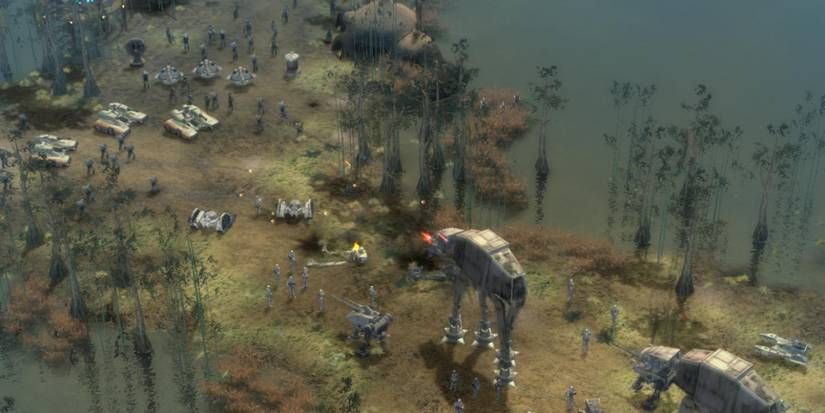

Horu is pitching itself at the exact pressure point Empire at War fans care about: real-time space wars, planetary invasions, and a scale claim that still has to survive performance reality.
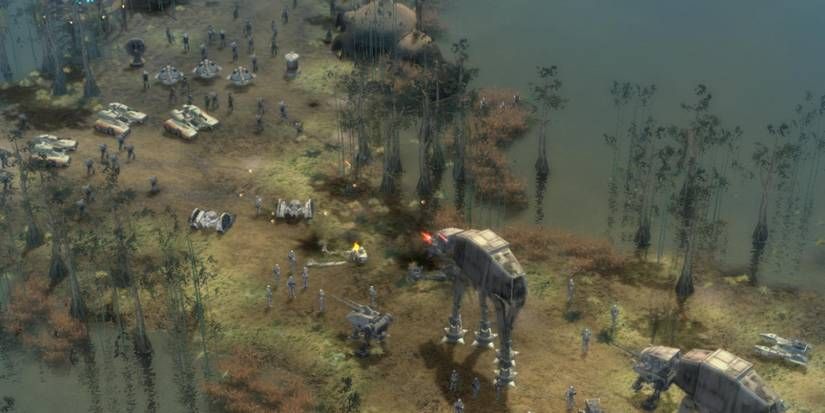
Image: screenrant.com
Horu is selling the dream Empire at War never fully solved
Horu, an in-development sci-fi strategy game from solo developer David “GlassBeaver” Nadaski, is drawing attention because its pitch goes straight at an old RTS fantasy: galaxy-level conquest, space battles, and planetary invasions happening together in real time. Rock Paper Shotgun describes Horu as a real-time 4X strategy game whose Steam page says players can “command hundreds of thousands of units across land and space.” PC Gamer similarly reports that Horu is inspired by Star Wars: Empire at War and Total War, with the project promising colossal space encounters and planetary battles.
That claim is the hook, but it is also the risk. “Hundreds of thousands of units” is the kind of phrase that makes strategy players lean forward and performance-minded players reach for the brake. Horu is not being presented as a finished product. It is still in development, it has been worked on for years, and according to Rock Paper Shotgun it runs on a custom C++ engine. BestGamesWorld reports that GlassBeaver is seeking Kickstarter support to complete remaining assets, sound, and music, and that no specific release date has been announced, though the developer is aiming for the end of 2027.
For Empire at War fans, the appeal is obvious. Petroglyph’s 2006 Star Wars strategy game built its reputation on a hybrid structure that linked galactic strategy to tactical space and ground battles. Horu’s pitch is more aggressive: keep the strategic layer, increase the battle scale, and remove the separation between orbital war and surface invasion. The unanswered question is whether that ambition produces a playable command game or a spectacular simulation that overwhelms its own interface.
The promised loop links orbit, landing zones, and surface control
The most important design promise is simultaneity. PC Gamer reports that Horu aims to run battles at the same time across a solar system, including land and space combat. Rock Paper Shotgun describes offensives as a layered process where dropships that break through a fleet engagement add forces to the ground invasion below. The same report says wormholes are planned as a way to move troops behind a defending armada.
That structure is why the new space RTS is being compared to Empire at War rather than to a conventional skirmish RTS. In Empire at War, the player’s galactic choices fed into separate tactical fights. Horu’s proposed design appears to ask a harder question: what if the orbital battle is still ongoing while the invasion force is already landing? In strategy terms, that creates a timing economy. Fleet pressure, transport survival, reinforcement flow, and ground objectives would all become linked rather than isolated phases.
On the planetary side, Rock Paper Shotgun says the ground combat is built around capturing control points. PC Gamer’s report highlights a planned drop-zone system that would let players designate a landing area on a planet and queue orders for an assigned army to carry out automatically. That matters because the scale claim only works if the game has delegation. If players have to manually babysit every front, every transport, and every control point, the system collapses into attention tax rather than strategy.
This is where Horu’s most promising idea sits. A planetary battles strategy game with simultaneous orbital pressure does not need every unit to be individually interesting. It needs command layers that let players make meaningful allocation decisions while the lower-level war executes those decisions clearly. The sources describe systems that point in that direction, but they do not yet prove that the interface, AI commanders, and battle readability are strong enough to carry it.
The Empire at War comparison cuts both ways
Empire at War still has a long tail because it offered a structure many licensed strategy games never attempted: a galactic map with fleets, planets, production, and tactical battles that felt connected. Rock Paper Shotgun notes that the 2006 hybrid RTS has been the subject of many mods and even references its later 64-bit patch history, which says plenty about the durability of its community. When a new project says it is inspired by Star Wars: Empire at War, that audience hears a specific promise: strategic conquest that leads to recognizable, consequential battles.
Horu’s reported influences broaden that pitch. PC Gamer says it is inspired by Total War as well as Empire at War, aiming to blend huge battles with galaxy-scale strategy. In practice, those influences pull in different directions. Total War thrives on spectacle, formation-level tactical drama, and discrete battles. Empire at War thrives on a campaign layer where fleet position, planetary control, and production shape the war. Horu is trying to fuse both while adding real-time simultaneity across land and space.
That explains the excitement, but it also explains the skepticism. A Star Wars Empire at War successor, official or spiritual, has to do more than fill the screen. The satisfying part of Empire at War was not raw unit count alone. It was the feeling that losing a capital ship or taking a planet changed the map. Horu’s reported systems, including colonization, planet development, shipyards, espionage, research, and a simulated economy, suggest the developer understands that the meta layer must matter.
The harder balance problem is whether those systems produce legible strategic tradeoffs. If the economy is too abstract, the battles become spectacle detached from planning. If the economy is too demanding while battles happen everywhere at once, the campaign becomes administrative overload. The sources confirm the ingredients GlassBeaver wants in the design. They do not yet show the long-term pacing that will decide whether Horu feels like a living war or a feature list stacked on top of a stress test.
Scale is the headline, but command automation may decide the game
The phrase “hundreds of thousands of units” is doing the marketing work, and it is easy to see why. Massive RTS battles have always sold a fantasy of war at a scale traditional RTS interfaces struggle to manage. Supreme Commander, Total Annihilation’s descendants, large-scale Total War fights, and heavily modded RTS games all live somewhere on the same spectrum: the more units you add, the more the game needs clean strategic abstraction.
The reported Horu systems appear designed around that reality. Rock Paper Shotgun says Horu includes semi-autonomous squadron commanders and an orders system that lets players queue objectives before units engage. PC Gamer reports a drop-zone system that can automate assigned ground operations after a player sets a landing area and orders. These are not minor quality-of-life details. They are the difference between scale as strategy and scale as noise.
From a balance perspective, automation creates its own meta. If commanders are too competent, players may feel like spectators nudging a simulation. If they are too weak, players will be forced back into frantic manual correction, which defeats the purpose. The best version of this system would make the player’s skill about sequencing fronts, choosing where to commit transports, deciding when to risk a boarding action, and timing orbital support. The worst version would turn every engagement into a search for the one place the AI has made a mess.
Rock Paper Shotgun also reports a boarding action mechanic where hijackers move through ships room by room, potentially allowing captured enemy vessels to join the player’s fleet. PC Gamer reports the same broader idea of boarding parties taking control of enemy ships. That is a fantastic tactical fantasy, but it sharpens the interface question. A room-by-room ship assault sounds demanding even in a smaller game. In a battle with fleets above, invasions below, magic effects, and economic decisions continuing in the background, the game will need strong alerts and clear priority signals. Otherwise, the cleverest mechanic becomes the one players ignore because they are busy putting out fires.
Space magic, espionage, and markets make Horu stranger than a straight homage
Horu is not being pitched as a clean Empire at War clone. Rock Paper Shotgun reports that the game includes a magic system with battlefield effects such as freezing a tank formation or conjuring a miniature black hole. PC Gamer calls out “space magic” as one of the planned ideas. That choice gives Horu a different identity, but it also complicates the balance model.
Large-scale strategy games can absorb extreme abilities if their costs, counters, and timing windows are clear. A black hole-style battlefield spell could be a dramatic way to punish over-concentration. It could also become a degenerate solution if the optimal play is to stack economy until a few high-impact casts decide every engagement. In a game already promising huge unit counts, area effects need careful tuning because they can either create satisfying macro-level swings or erase the value of army composition.
The broader campaign layer sounds similarly ambitious. Rock Paper Shotgun lists planets to develop, shipyards to build, spy networks, research trees, and stock market manipulation. PC Gamer reports planned world colonization and development, espionage missions, a simulated economy, and research. Those systems make Horu sound closer to a 4X RTS hybrid than a pure battlefield game.
That breadth is encouraging if the campaign supports different paths to power. A player who invests in espionage should be able to win information wars or sabotage key production. A player who leans into shipyards should feel the opportunity cost in planetary development. A player who manipulates markets should be doing something more meaningful than watching a number go up. None of that is confirmed in playable balance terms. The sources establish that these systems are planned, not how deep they are, how they interact, or how much agency they give the player over a long campaign.
The funding and performance questions are still open
The business side is as important as the design pitch. Rock Paper Shotgun reports that the developer is running a Kickstarter “to fund the remaining assets needed for a playable build,” including more spaceships, units, animations, sounds, music, and other production needs. BestGamesWorld reports that the campaign had raised about half of its £16,685 goal at the time of its report. That same outlet says a specific release date has not been announced and that GlassBeaver is aiming to launch at the end of 2027.
Those details put Horu in the watchlist category rather than the preorder-confidence category. The Steam listing exists, and the project has a public trailer and a visible development pitch, but the sources provided do not include a price, system requirements, demo availability, final platform list beyond Steam presence, or measured performance targets. For a game selling itself on scale, the missing performance data is central. Unit count alone does not tell players how the simulation behaves on mid-range CPUs, how pathfinding holds up during planetary landings, or whether late-game wars remain responsive.
The custom C++ engine is a meaningful technical fact, reported by Rock Paper Shotgun, but it is not proof of performance. A custom engine can be built around the exact simulation demands of an RTS, which may be an advantage over a general-purpose engine. It can also place more burden on a small team because tools, optimization, debugging, and content pipelines all have to be maintained alongside game design. In Horu’s case, the project is attributed to a solo developer, which makes scope discipline especially important.
Readers interested in the Empire at War inspired RTS should treat the current material as a promising design pitch with several unproven pillars. The scale claim needs live gameplay evidence under campaign conditions. The automation systems need to show they can reduce busywork without removing command skill. The economy and espionage layers need to prove they produce strategic choices rather than menu density. Until those pieces are demonstrated, Horu is best understood as one of the more intriguing attempts to build a modern spiritual answer to Empire at War, not a proven successor yet.
Who should wishlist Horu now, and who should wait
If your favorite part of Empire at War was the connection between galactic planning and tactical consequences, Horu is worth watching. Its public pitch lines up with a very specific hunger in the strategy audience: a new space RTS where orbital superiority, troop landings, planetary control, and economic expansion are part of one continuous war. The fact that PC Gamer and Rock Paper Shotgun both focused on its scale and Empire at War lineage shows why the project is surfacing now among RTS fans.
If you are sensitive to unfinished systems, Kickstarter risk, or performance uncertainty, caution is the smarter posture. The available reporting describes planned and promised features, not a shipped game. BestGamesWorld reports an end-of-2027 launch aim rather than a firm release date. The provided Steam material confirms a store presence but does not establish price, requirements, or final release details.
The practical move is simple: wishlist if the concept appeals, follow the Kickstarter and developer updates for playable-build footage, and wait for evidence of late-game performance before treating Horu as the Star Wars Empire at War successor many players have wanted. Strategy games live or die in the boring places trailers rarely show: pathfinding under load, UI clarity during multi-front wars, economy pacing after the first hour, and whether the best strategy remains interesting once players optimize it. Horu’s pitch is big enough to earn attention. Now it has to prove that its biggest battles can still be readable, balanced, and fun.