
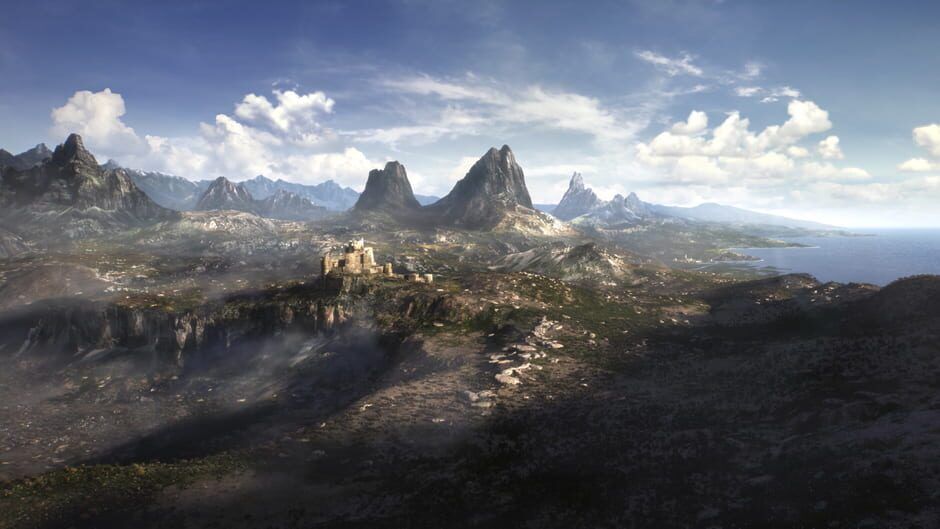
Bethesda has finally lifted the lid on The Elder Scrolls 6’s technology and design direction. Here’s what Creation Engine 3 actually is, how it evolves Starfield’s tech, and what Todd Howard’s promise of a “return to classic style” really means for exploration, quests, and simulation depth.
Creation Engine 3: What It Actually Is
Todd Howard has now confirmed that The Elder Scrolls 6 runs on Creation Engine 3, a full evolution of the tech that powered both Skyrim and Starfield. Internally, Bethesda has treated it less like a single upgrade and more like a long, rolling refit of its entire toolchain, starting from Fallout 76’s tech base, then Starfield’s Creation Engine 2, and now to a version they expect to use for Elder Scrolls 6 and future games.
In interviews, Howard says the team has spent “the last several years bringing Creation Engine 2, which powers Starfield, up to Creation Engine 3.” In practice, that means not a fresh engine written from scratch, but an iterative rebuild of the parts Bethesda felt were holding their games back: streaming, lighting, animation, world tools, and how complex simulations can run in a huge open world without collapsing under their own weight.
Crucially, Creation Engine 3 is still built around Bethesda’s trademark strengths. It is designed to simulate a continuous world full of physical clutter, AI schedules, dynamic quests, and systemic combat. Unlike Starfield’s more fragmented structure, which sliced the experience into instanced tiles and loading screens, Elder Scrolls 6 is being built to support the kind of seamless landmass and freeform exploration that people associate with Morrowind, Oblivion, and Skyrim.
Bethesda’s pitch is that CE3 takes the lessons and tech wins from Starfield but points them at a denser, more reactive fantasy space instead of a galaxy of disconnected zones.
How It Builds On Starfield’s Tech
Creation Engine 2 did a lot of heavy lifting for Starfield. It introduced modern physically based rendering, more accurate lighting, improved character materials, and better tools for generating terrain and structures in bulk. It also had to juggle hundreds of planets, modular interiors, ship building, and space combat.
Creation Engine 3 keeps those upgrades but reorients them around a different design target.
On the streaming side, all that work Starfield did to stream tiles of planets can now be focused on a single, handcrafted world. Instead of trying to quietly load in the next patch of a barren moon, Elder Scrolls 6 can use the same tech to push higher density environments, more detailed dungeons, and thicker wilderness with fewer hard transitions. Howard has hinted, half jokingly, that Elder Scrolls 6 “definitely has more trees than Skyrim,” which lines up with the expectation that CE3 will be able to handle more foliage, more ground clutter, and larger draw distances without the engine buckling.
On the simulation side, Starfield’s faction logic, AI pathing improvements, and systemic combat layers were all built on updated foundations. That gives CE3 a starting point where NPCs can navigate far more complex spaces and overlapping activities than what Fallout 4’s scripts were built for. For a grounded fantasy world, that translates to busier cities with more layered daily routines, more dynamic reactions to crime and reputation, and more intersecting quest logic without the engine getting tangled.
Tools are the other big inheritance from Starfield. Bethesda has been clear that a lot of the time between Skyrim and now has been sunk into rebuilding their editor and pipeline so content can be built faster and tested more safely. That matters for Elder Scrolls 6 in two ways. First, more robust tools mean designers can script more edge cases, systemic reactions, and alternate paths without blowing up the build. Second, whatever creation kit eventually ships to modders will likely rest on the same tech, which could open the door to more ambitious, stable mods than previous entries managed.
If Creation Engine 2 was about dragging an old pipeline into the modern era, Creation Engine 3 is about letting the team finally build the dense, simulation-heavy Elder Scrolls they have been sketching on paper since the end of Skyrim’s major support.
What “Return To Classic Style” Really Means
Alongside the engine news, Howard has been blunt about the studio’s creative course correction. Fallout 76 and Starfield, he says, were “a little bit of a creative detour” from what people normally expect from a Bethesda Game Studios RPG. With The Elder Scrolls 6, he describes the project as “coming back to that classic style that we’ve missed, that we know really well.”
That classic style is not just nostalgia for a fantasy setting. It is a specific design philosophy that runs through Morrowind, Oblivion, Skyrim, Fallout 3, and Fallout 4. You are dropped into a single, contiguous world. You walk everywhere, often distracted by side content on the way. You poke at systems that do not always explain themselves. You join factions, break their rules, and the simulation quietly tries to respond.
When Howard talks about returning to that style, he is talking about building Elder Scrolls 6 around that sense of place first, rather than around an experimental structure or multiplayer experiment.
Exploration: From Galaxy Hopping To Getting Lost Again
Exploration is where you can most clearly see how Fallout 76 and Starfield diverged from the classic template, and where Elder Scrolls 6 is likely to pull back.
Fallout 76 scattered its world design across a live service map structure. Points of interest were often tuned for repeatable events and co-op encounters. Starfield went even further, scattering content over hundreds of planet surfaces and instanced locations. Fast travel and menu hopping became the main way of moving around, and the connective tissue between points of interest was slim.
Classic Bethesda exploration is built around a single, handcrafted landmass and the friction of travel inside it. You walk out of a city, see a ruin on a hill, and make a choice about whether to go there now or stick to your plan. That mix of authored landmarks and emergent detours is what players remember from crossing Cyrodiil or hiking through Skyrim’s mountain passes.
With Elder Scrolls 6, Howard frames the goal as making you feel like you are “experiencing that world for the first time” again. On Creation Engine 3, that implies several likely shifts compared to Starfield:
Travel is expected to lean more on boots-on-the-ground movement across a continuous region rather than being carved up by loading screens. CE3’s streaming upgrades can be used to hide transitions and keep your walk uninterrupted.
Environmental density can be higher, because the tech no longer has to worry about supporting low detail, procedural rock fields on dozens of barren planets. If the engine handles more foliage and longer views, that also gives the art team more room to make navigation itself interesting, not just the markers you are heading toward.
Organic discovery can come back to the forefront. Without the need to populate innumerable random tiles, designers can afford to set up more bespoke interiors, secrets that rely on geography, and multi-stage location arcs that change over time.
Compared to Fallout 76, which had to account for players dragging events around the map and nuking regions, Elder Scrolls 6 can commit harder to persistent world changes that happen because of your character. Cities that rebuild, keeps that stay captured, or forests that regrow after a quest chain all fit better inside a single player sandbox tuned for simulation rather than for live-service resets.
Quests: Back To Deep Single Player Arcs
Starfield did offer long faction questlines, but its overall quest structure often pulled players into modular, repeatable side activities designed to slot cleanly into a galaxy of locations. Fallout 76, meanwhile, had to constantly keep one eye on how its story content would behave in a world full of human players.
When Howard calls Elder Scrolls 6 a return to classic style, it strongly suggests the studio is centering the kind of deep, overlapping questlines that made Oblivion’s Dark Brotherhood or Skyrim’s civil war memorable.
A single player focus removes a huge amount of design overhead. Quests do not need to be replayable in the live-service sense, they do not have to worry about griefing or the presence of other players, and they can lean into permanent consequences. That gives Bethesda room to revive long, branching arcs where your choices can lock you out of certain outcomes without the need to keep content always available for everyone all the time.
Creation Engine 3’s evolution of Starfield’s logic tools should help here too. Faction reputation, AI schedules, crime tracking, and ownership systems were all reworked for Starfield to be more robust. Elder Scrolls 6 can use those systems but let them run wilder inside a purely single player environment.
Quests can safely alter the state of the world in more specific ways. Characters can disappear for good. Shops can change inventory permanently. Factions can control territory in ways that change random encounters. Those are all things previous Elder Scrolls games tried, but often had to implement in brittle, hand-scripted ways. With CE3, Bethesda has more mature data tools to manage complex quest graphs without every change risking a cascade of bugs.
That does not mean Elder Scrolls 6 will become a choice-and-consequence labyrinth like a CRPG, but it does mean more of the quest team’s ambition can be pushed into simulation-backed changes instead of being burned up handling edge cases caused by multiplayer or a fragmented galaxy.
Simulation Depth: Learning From Fallout 76 And Starfield
Despite their “detour” status, Fallout 76 and Starfield both pushed Bethesda to stress test its systemic design. Fallout 76 had to simulate dozens of players, dynamic events, loot economies, and base building, all talking to each other on shared servers. Starfield had to support space combat, ship customization, outpost building, stealth, and ground combat inside a heavily instanced structure.
Those experiments exposed pain points. Fans criticized Starfield for simulation that felt shallow once the novelty wore off, and for NPC schedules, AI, and world reactivity that often fell behind expectations set all the way back in Oblivion.
Creation Engine 3 is Bethesda’s attempt to absorb those lessons without dragging forward every structural constraint. In a more traditional Elder Scrolls setting, that can play out in several ways.
AI behavior can lean harder into the Radiant style schedules that made Elder Scrolls towns feel alive in the first place, but with Starfield’s navigation and performance fixes in place. More granular pathfinding, awareness states, and combat behaviors should let CE3 handle busier city scenes, denser dungeons, and more complex stealth encounters.
World reactivity can afford to be stickier. Where Fallout 76 had to reset events and Starfield often quietly recycled locations, Elder Scrolls 6 can let the outcome of a dungeon clear, a bandit raid, or a political choice persist. CE3’s upgraded save and scripting systems are aimed at dealing with more long term state changes without corrupting saves as easily as previous Creation iterations sometimes did.
Systemic overlap is likely to be a focus. Fallout 76 proved that players enjoy bending systems in unexpected ways, from camp placement tricks to encounter manipulation. Starfield carried that into its perk and ship building. Elder Scrolls 6 can take those impulses but bake them into a world where magic, alchemy, stealth, crafting, and faction reputation all intersect in more tangled combinations.
Crucially, all of this is built for a single player CPU and memory budget. Where Fallout 76 had to spend resources talking to a server and keeping multiple clients in sync, Elder Scrolls 6 can invest more of that budget into local simulation and AI.
Why Bethesda Is Sticking With Creation Instead Of Starting Over
A recurring criticism every time Bethesda announces a new game is that it is “still using Creation Engine.” Starfield’s technical issues and some stiff animation only amplified that feeling. So why not ditch it and license something like Unreal instead of pushing to Creation Engine 3?
Howard’s recent comments give part of the answer. Bethesda’s games are deeply tied to how Creation stores data, runs scripts, and simulates a continuous world full of interactable junk. Starting over would risk throwing away decades of tooling and institutional knowledge, not just a renderer.
By evolving Creation into CE3, Bethesda keeps the parts that work for its brand of RPG while modernizing the pieces players see and feel the most. Streaming, physics, animation playback, lighting, and editor usability have all been targets over the last several years. That also lets the studio bring forward the modding ecosystem. Even with necessary changes, modders will be dealing with an engine lineage they understand rather than a totally foreign tech stack.
The bet is that a better tooled version of the engine that built Skyrim, Oblivion, and Fallout 4 is more likely to deliver a “classic Bethesda” experience than a fresh, generic engine that excels at shooters but chokes on tens of thousands of persistent objects and scripts.
The Big Picture: A Next Gen Skyrim, Not A Fantasy Starfield
Put together, the messaging around Creation Engine 3 and a return to classic style paints a clear picture. Elder Scrolls 6 is not trying to be a fantasy flavored Starfield, and it is not chasing live service structure. It is trying to be the next evolutionary step of the Skyrim and Oblivion lineage.
Creation Engine 3 is the technical backbone that lets Bethesda push a more detailed, more reactive single world than they managed on Xbox 360 and Xbox One hardware, while carrying forward core systems in a more robust form than Starfield’s turbulent launch suggested. The design reset away from detours like Fallout 76’s always online structure and Starfield’s menu driven galaxy means Elder Scrolls 6 can embrace slow travel, handcrafted exploration, heavy simulation, and deep single player quest arcs without compromise.
Howard repeatedly stresses that there is “still a lot of innovation” left inside that classic formula. The goal is not to freeze Elder Scrolls in 2011, but to use new tech to double down on what those games were reaching for. If Bethesda can actually marry Creation Engine 3’s upgrades to that design intent, Elder Scrolls 6 could end up feeling less like a reaction to Starfield and more like the long awaited culmination of everything the studio has been building toward since Morrowind.
For now, there is no release date, and Howard is careful to say it is still “a long way off.” What has changed is clarity. Fans can stop wondering whether Elder Scrolls 6 will follow Fallout 76 or Starfield’s structure. With Creation Engine 3 and a declared return to classic style, Bethesda has drawn the map. The only question left is how far they can push that old formula now that the tech is finally catching up.