
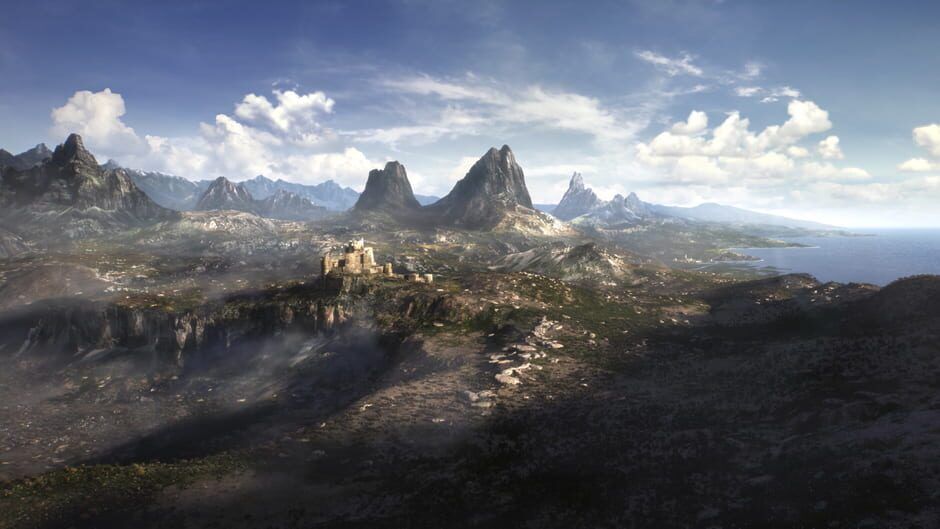

Todd Howard says The Elder Scrolls 6 is using Creation Engine 3 and returning to Bethesda’s classic RPG style. Here’s what that likely means for exploration, quests, simulation depth, and modding on next‑gen hardware.
Todd Howard has finally started to sketch the outlines of what The Elder Scrolls 6 actually is. In a new round of interviews, he confirmed two crucial pillars for the long‑awaited sequel: it runs on a significantly upgraded Creation Engine 3, and it is being built as a return to Bethesda’s “classic style” of single‑player RPG.
We still don’t have a release date, a full trailer, or even a concrete setting, but those two points already tell us a lot. When Bethesda says “classic style,” they are consciously contrasting Elder Scrolls 6 with Starfield and Fallout 76 and aligning it with Skyrim, Oblivion, Fallout 3 and Fallout 4. When they say Creation Engine 3, they are talking about a multi‑year overhaul of the tech that powered Starfield, designed around current and next‑gen hardware rather than cross‑gen compromises.
Put together, it suggests Elder Scrolls 6 is being built as a dense, simulation‑heavy fantasy RPG that leans back into hand‑crafted exploration, reactive quests and deep modding support rather than systemic galaxy‑spanning exploration or live‑service structures.
Creation Engine 3 vs Creation Engine 2
Howard explains that Bethesda has “spent the last several years bringing Creation Engine 2, which powers Starfield, up to Creation Engine 3,” and that this new version will power Elder Scrolls 6 and whatever comes after it.
Creation Engine 2 was already a big jump from the Skyrim era. It brought vastly improved lighting and volumetric effects, more complex materials, more detailed character models, streaming for enormous world spaces and a new animation system that finally dragged Bethesda away from Gamebryo’s most obvious relics. It was built first and foremost to support Starfield’s planetary streaming and huge number of discrete locations.
Creation Engine 3 is less about changing the studio’s core tools and more about hardening and expanding them for a pure fantasy RPG on modern hardware. It is still the same underlying toolchain that Bethesda has used since Morrowind, but the studio has now had the benefit of an entire AAA project shipping on CE2 to see which parts held up and which needed rebuilding. The “3” here reflects that multi‑year refit.
That likely means heavier investment in:
Streaming and memory management tuned for one enormous, contiguous landmass instead of thousands of small planetary tiles.
Higher fidelity animation, especially for melee combat, stealth and magic, in response to long‑standing criticism of how Bethesda games feel in first person.
More robust scripting and quest tooling, so designers can build the kind of interlocking quest chains and reactive side stories that defined Skyrim and Oblivion without fighting the engine.
Expanded support for physics, AI crowd behavior and environment interaction to make towns, dungeons and wilderness spaces feel more alive.
Where Starfield used Creation Engine 2 to spread its tech across a massive number of locations, Elder Scrolls 6 using Creation Engine 3 is Bethesda saying that now these tools will be focused on depth inside a single fantasy sandbox rather than breadth across a galaxy.
What “classic style” actually signals
Howard calls Fallout 76 and Starfield “a little bit of a creative detour” and says Elder Scrolls 6 is consciously built in the mold of Skyrim, Oblivion and the studio’s single‑player Fallouts. That is about more than just tone. It is a statement about structure.
Classic Bethesda design means a few specific things:
The game is a single‑player first design, with no live‑service backbone to feed and no multiplayer compromises on pacing or systems.
The world is one big, contiguous open space you can walk across, with secret dungeons, hand‑placed points of interest and emergent encounters on the way, instead of a galaxy map of disconnected tiles.
Questing is centered on role‑playing factions, branching storylines and exploratory side content rather than bounty boards, timed events or seasonal checklists.
Character building is closer to Elder Scrolls and Fallout archetypes, with skills, perks and gear intertwined in a way that invites experimentation and replaying the game with different builds.
In interviews, Howard has noted that “the majority of people who made Skyrim are still here” and have “missed” making that style of game. That continuity matters, because it suggests Elder Scrolls 6 will lean into the studio’s old strengths instead of trying to reinvent itself around service game retention or a galaxy of loading screens.
Exploration on next‑gen hardware
If you take Creation Engine 3’s improvements and plug them into a Skyrim‑style structure, exploration is the first place that benefits.
On Starfield, Bethesda’s solution to scale was procedural generation and instanced tiles. On Elder Scrolls 6, they can funnel that tech into making one landmass feel impossibly dense instead of infinitely wide. That should mean more hand‑authored locations connected by smarter procedural dressing rather than the other way around. The streaming gains from CE2 and CE3 also let them push view distances, foliage density and crowd sizes in a way Skyrim on the old Creation Engine never could.
One likely outcome is more seamless exploration. Starfield already cut many obvious loading doors compared to past games. With the extra memory and SSD throughput of current machines, Elder Scrolls 6 can afford to keep interiors, city districts and wilderness zones more tightly stitched together. You wander from a bustling market, through city walls, out onto the plains and toward a distant ruin that you saw an hour earlier. The engine is doing more streaming and less hard scene swapping to make that work.
The other side of that is verticality and environmental storytelling. Creation Engine 3’s rendering and lighting upgrades should allow for more complex underground spaces, larger city silhouettes and more reactive weather that ties into gameplay. A storm rolling over the mountains no longer has to be a simple skybox change. It can be an event that affects visibility, NPC schedules, perhaps even magical rituals and creature behavior.
Classic Elder Scrolls exploration was always about seeing something weird on the horizon and walking to it. Creation Engine 3 simply lets Bethesda support that fantasy with more detail, more simulation and fewer immersion‑breaking seams.
Quests and systemic storytelling
Howard’s talk about a return to classic style is perhaps most important for quest and story design. Fallout 76’s live model flattened quest structures around repeatable loops, while Starfield devotes huge resources to main quest cinematics and faction lines that have to fit into a more rigid, voiced protagonist framework.
Elder Scrolls 6 is almost certainly going back to the looser, more reactive style of Skyrim and Oblivion. That implies a few likely design directions:
Questlines designed to be discovered through exploration and rumor rather than UI markers alone, something Bethesda has historically done well in its fantasy settings.
Factions that can oppose or intersect with each other in ways the engine can track, making your role‑playing choices feel persistent and occasionally messy.
Dialogue and quest scripting tools reworked in Creation Engine 3 so that writers and designers can stage more complex scenes without breaking save files or performance.
Creation Engine’s great strength has always been how deeply quests can reach into simulation systems. It lets Bethesda do things like quests that remember which artifacts you stole 30 hours ago, or NPCs who react to radiant events in ways that feel bespoke. The CE3 upgrade is less about changing that philosophy and more about giving it modern reliability and scale.
If Bethesda leans into that, Elder Scrolls 6’s quests can take fuller advantage of persistent world states. A faction war that slowly redraws patrol routes, merchant inventories and town dialog over dozens of hours is more plausible now than it was when Skyrim shipped on Xbox 360.
Simulation depth and “living world” systems
Creation Engine 3 is also where Bethesda can address some of the simulation compromises of their older games.
Starfield improved animation and AI scheduling but often felt static because of its instanced, segmented structure. Elder Scrolls 6, by contrast, is being built specifically to simulate one persistent region. NPCs, wildlife, crime systems, magic, stealth, physics and settlement life can all share more of the same sandbox.
With CE3 running on current hardware only, you can expect:
More varied AI behaviors for citizens, guards and creatures, including routines that react to dynamic world states like damaged infrastructure, faction control or magical phenomena.
A crime and stealth system that better accounts for sightlines, sound and lighting, which CE3’s rendering tech can actually model with more granularity.
Magic that interacts more visibly with the world, using improved physics and particle systems. Think spell effects that interact with foliage, water and destructible objects with less smoke and mirrors.
Environmental systems like weather, day‑night cycles and regional events feeding into AI decision making instead of just providing visual dressing.
None of that changes the fact that Elder Scrolls 6 will still be a Bethesda sandbox, with all the emergent chaos that implies. If anything, Creation Engine 3 gives the team more levers to create the strange interactions that have always made the series memorable, whether it is a dragon attacking a town in Skyrim or a conjuration experiment going sideways in a mage’s tower.
Modding and tools in the Creation Engine 3 era
Perhaps the most important piece of Creation Engine’s legacy is its modding ecosystem. From Morrowind to Skyrim and Fallout 4, Bethesda’s games have lived for a decade or more on the back of fan‑made content, script extenders, UI overhauls and full conversion projects.
Howard’s comments about Creation Engine 3 make it clear that Bethesda is not throwing that history away. They are iterating the same family of tools the studio and its community already understand, not swapping to something like Unreal and resetting twenty years of accumulated know‑how.
In practice, that should be very good news for Elder Scrolls 6 modders. An engine that is an evolution of CE2 rather than a total replacement makes backward‑inspired tool design more plausible. Bethesda can modernize file formats, scripting languages and asset pipelines while still exposing similar hooks for community tools.
Next‑gen hardware also gives the modding scene more headroom. Bigger memory pools and faster storage on PC and Xbox mean more complex script mods, AI overhauls and texture packs can coexist without instantly breaking performance. Creation Engine 3’s work on streaming and threading can help the game stay stable even when players stack hundreds of mods, something Bethesda knows is a huge part of its audience’s behavior.
While Bethesda has not detailed the exact form of an Elder Scrolls 6 Creation Kit yet, it is safe to assume one will arrive. The studio has consistently shipped official tools and has every incentive to continue that pattern, especially now that mod support on consoles is established.
A classic Bethesda RPG, powered by modern tech
Bethesda is still keeping Elder Scrolls 6 close to the chest, but the pieces that are visible already sketch a clear direction. Creation Engine 3 is not a ground‑up reboot. It is a years‑long refinement of the toolset that already underpins Starfield, rebuilt to better serve a huge, single‑continent fantasy RPG. The design goal, meanwhile, is not to chase live‑service retention or space‑sim scale, but to recapture the studio’s strengths: wandering into trouble, stumbling into stories and bending a living, reactive sandbox around your character.
For fans who have been waiting since Skyrim for another pure Elder Scrolls adventure, that might be the most exciting reveal yet. The tech is finally catching up to the fantasy Bethesda has been sketching since Morrowind, and for the first time in years the studio seems intent on using it to make the kind of game it knows best.