
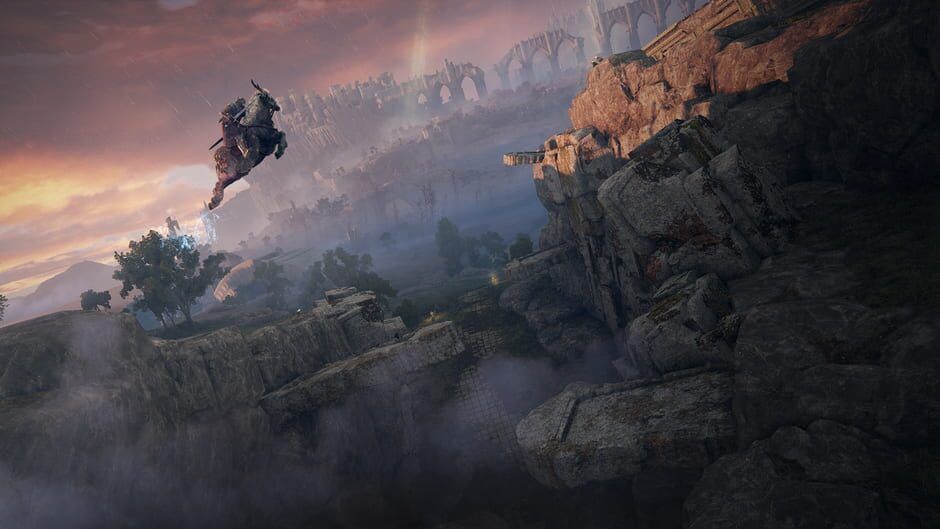

The A24 Elden Ring film’s big budget, prestige cast and distant 2028 date are less about Hollywood hype and more about Bandai Namco and FromSoftware planting a long‑tail flag for the brand as a multimedia fantasy franchise.
The Elden Ring movie finally has a face, a date and a number attached to it. A prestige-heavy cast led by Cailee Spaeny and Ben Whishaw, Alex Garland writing and directing, A24 footing a budget reportedly well north of 100 million dollars and a March 3, 2028 theatrical and IMAX window.
On the surface that is standard Hollywood announcement cadence. For Elden Ring as a game property and for Bandai Namco and FromSoftware as long-term brand builders, it reads less like a one-off adaptation and more like a declaration that The Lands Between are here to stay for the rest of the decade.
A four-year runway for a 2022 game
The first thing that jumps out is the release date. By the time the film opens, Elden Ring will be a six-year-old game. In traditional licensed movie logic, that would be ancient history. The fact that the project is calibrated around 2028 instead of trying to strike while the initial sales iron is hot tells you how Bandai Namco now views Elden Ring.
This is not a box checked in a transmedia slide deck so much as a long-tail pillar. Since 2022 the game has sold tens of millions, spawned the enormous Shadow of the Erdtree expansion and even a multiplayer-focused spin-off in Nightreign. That arc already looks more like a platform life cycle than a single release, and the movie timing pushes that mentality further.
A 2028 date lines up with a likely second wave of Elden Ring activity. That could mean another major content beat, some form of re-release on whatever hardware landscape exists by then, or even the next project from FromSoftware that cross-pollinates with Elden Ring’s audience. Regardless of the exact form, the strategy is clear. The film is positioned as the cultural event that keeps the brand top of mind, not as a trailer-length commercial for copies on store shelves in the same quarter.
Why the cast list matters for the IP, not the red carpet
The cast reveal doubles down on that long-game approach. Cailee Spaeny, fresh off prestige and genre projects, and Ben Whishaw, a fixture in British drama and modern blockbusters, are not stunt stunt casting names for social media. They are signals.
For FromSoftware, which built its reputation on dense world-building and opaque characters rather than celebrity, attaching actors associated with nuanced and sometimes difficult material suggests the adaptation will lean into the texture of The Lands Between instead of sanding it down. From a brand perspective that matters more than any early box office tracking number. It tells existing players that the authorial voice of Elden Ring is not being discarded in the jump to film.
Bandai Namco also gets something more structural from a cast filled out by Kit Connor, Tom Burke, Havana Rose Liu, Sonoya Mizuno, Jonathan Pryce, Ruby Cruz, Nick Offerman and others. These are actors with significant reach across streaming, prestige television and theater. If the adaptation lands, their involvement gives the IP cultural touchpoints far away from game awards shows and Steam charts. For a Japanese publisher that has historically relied on core gamer awareness to sell its biggest properties, that kind of ambient mainstream resonance is valuable in itself.
A24’s biggest gamble as a statement of confidence
Budget is usually the least interesting number in a movie announcement, but the claim that Elden Ring is “well over” 100 million dollars, potentially the largest production in A24’s history, reframes the project. A24 built its brand in opposition to traditional franchise logic and has only cautiously stepped into genre event territory. For its biggest swing to be rooted in a FromSoftware universe is a marker of how far game IP has traveled in a decade.
For Bandai Namco this is effectively outsourced capital risk. Instead of standing up an in-house film division, it gains the halo effect of an auteur-driven, high-budget fantasy film without carrying the full financial load or bearing the reputational baggage of a failed blockbuster. If the film works, Elden Ring becomes the rare Japanese-created fantasy setting that can sit in the same conversational neighborhood as Western literary adaptations.
For FromSoftware, a studio that has historically been content to let its games speak for themselves, the scale of this project signals that its worlds are now perceived as cinematic infrastructure, not just mechanically revered playgrounds. That kind of validation feeds back into the games. Future FromSoftware pitches to partners and platforms can treat large-scale multimedia support as an expectation rather than an unpredictable bonus.
From cult aesthetics to shared universe potential
Elden Ring occupies a hybrid space. It has the sales profile of a blockbuster and the authorial weirdness of a cult favorite. That tension is part of what made the game feel fresh in 2022, and it is also what makes it tricky as a multimedia property. Many successful adaptations have come from cleaner, more archetypal IP.
The cast reveal suggests the film is not running from that tension. Alex Garland’s filmography is full of projects that embrace ambiguity and discomfort. Pairing that sensibility with actors who have shown they can carry psychologically dense material implies an adaptation that leans into FromSoftware’s elliptical narrative style rather than replacing it with a conventional hero’s journey.
If that gamble pays off, Elden Ring shifts from “hit game that once got a movie” to “fantasy universe that supports multiple kinds of stories.” That subtle repositioning is central to Bandai Namco’s long-tail ambitions. It opens the door to spin-off series focused on specific factions, animated explorations of side lore, or cross-media experiments that would not make sense for a single-title IP.
The Miyazaki and Martin factor
George R. R. Martin’s reported role as a producer on the film, after providing world-building support on the game, ties the project back to the original creative DNA. Hidetaka Miyazaki’s involvement has not been fully spelled out publicly, but the pairing of names carries enormous weight when negotiating with talent, financiers and distribution partners.
From the game industry side, that continuing association serves a brand function. It reinforces that Elden Ring is not just “FromSoftware does open world” or “Dark Souls but bigger” but a specific collaboration between notable creative figures that persists across mediums. As long as Martin’s name remains on marketing materials, Elden Ring can be sold to audiences who have never rolled a Tarnished simply as a new fantasy world from the author of A Song of Ice and Fire, with FromSoftware benefiting from that borrowed prestige.
Bandai Namco’s evolving franchise playbook
The Elden Ring movie is also a window into how Bandai Namco is rethinking its role in a landscape where game IP is increasingly the fuel for streaming wars and cinema schedules. Historically, the company’s multimedia efforts have revolved around anime and merchandise tied to series like Dragon Ball, Gundam and Tekken. Those properties grew in step with Japanese media ecosystems, then traveled outward.
Elden Ring inverts that flow. It is a global-first phenomenon, born on modern consoles and PC, nurtured by Western critical discourse and social media virality. Partnering with A24 and tapping an English-language auteur like Garland for a live-action film acknowledges that the fastest route to long-term cultural saturation now probably runs through Western-led production pipelines.
That does not mean Bandai Namco is abandoning its roots. If anything, the movie’s existence makes other forms of expansion more viable. An anime anthology suddenly has a broader audience if it arrives in the wake of a successful film. High-end collectibles, art books and music releases can anchor themselves to a shared mental image of the world that has circulated beyond controller owners.
A test case for game IP as enduring mythology
By 2028, the industry will have a clearer picture of whether game adaptations are a bubble or a new normal. The Elden Ring film is arriving at the tail end of that first gold rush, not at the beginning. That timing, coupled with its scale and the creative team involved, effectively turns the project into a referendum on how far game-born mythologies can travel.
If Elden Ring can sustain audience interest six years after release, draw crowds to an original-story fantasy film that is not built on a decades-old book series and in turn feed renewed engagement with the game itself, it becomes proof of concept for treating major game launches as the starting point of multi-decade narrative franchises.
For FromSoftware and Bandai Namco, that is the real prize. The cast list and 2028 date are not just PR beats. They are the visible contours of a strategy that aims to keep players and now viewers wandering the Lands Between long after the credits have rolled on a first playthrough.