
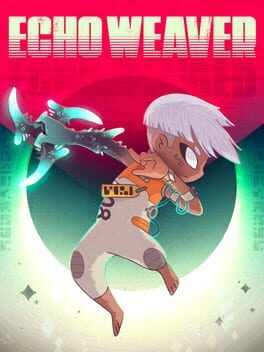

Echo Weaver is out on Game Pass with a knowledge-gated metroidvania structure from Moonlight Kids and Akupara Games. Here is how its time loop works, where it is available, and what players should know before starting.
Image: IGDB
Store links: Echo Weaver on Steam
Echo Weaver arrives on Game Pass with a risky promise
Echo Weaver launched on October 8, 2026, with day-one Game Pass availability, putting Moonlight Kids’ new time-loop platformer in front of a large Xbox and PC audience from the start. The immediate hook is unusually bold for a metroidvania: according to publisher Akupara Games and Xbox Wire coverage cited by HappyGamer, Echo Weaver is built around knowledge rather than traditional ability gates. Moonlight Kids says that if a player looked up every answer beforehand, they could boot the game and finish it in minutes.
That premise creates the tension at the heart of the Echo Weaver Game Pass release. A typical metroidvania teaches players to search for double jumps, grapples, keys, and late-game traversal tools. Echo Weaver, by contrast, appears to hand players most of the functional possibility space almost immediately, then asks them to understand what they already have. Rock Paper Shotgun, after four hours with the game, described it as a “freeform Metroidy puzzler” where there are a few upgrades, but no core skills to unlock. Polygon’s review, based on nearly 20 hours, similarly frames the experience around discovering what the glaive and the loop can really do, rather than waiting for the game to award a missing move.
For Game Pass players, that makes Echo Weaver a strong curiosity and a slightly fragile one. The subscription model lowers the cost of experimentation, but the game’s core pleasures are clearly tied to discovery. If you want the best version of this premise, resist the urge to search for solutions early. Echo Weaver’s strangest advantage is that the first hour may be less about getting stronger and more about realizing the game has been quietly trusting you with dangerous tools.
A metroidvania where time is the resource, not gear
The Echo Weaver metroidvania structure revolves around a repeating countdown. HappyGamer, summarizing the Xbox Wire launch post, describes the setting as the space colony of Provenance after an event called the Collapse, with the player trapped in place and time. Polygon says the loop begins after the hero falls into a shallow pool, and that no matter how far they travel, the next cycle starts back in that familiar chamber.
The mechanical wrinkle is that time is both a limit and a currency. Rock Paper Shotgun reports that the loop starts very small, giving the player roughly a minute to act, then expands as players gather blue crystals near the starting area. Polygon says the meter can eventually reach a maximum of 13 in-game hours. Those descriptions point to the same core idea: Echo Weaver gives you a timeline you can stretch, spend, and route around, rather than a simple fail-state timer.
Rock Paper Shotgun also notes that time can be actively burned to restore health, consuming a bar from the timeline. That is a clean little design knot. Healing is available, but it costs future action. In a game about repeating paths faster and smarter, taking a hit is not only a health problem. It is a routing problem. The outlet says enemies are relatively scarce, so this does not appear to be a combat-heavy endurance test. The greater pressure comes from being in the right place at the right moment, learning when doors close, when hazards trigger, and how far a given expedition can realistically go before the cycle collapses.
Akupara has called the game a “Metroidbrainia,” according to HappyGamer and Windows Forum. It is an ungainly label, but a useful one. It signals that Echo Weaver is closer in spirit to knowledge-driven games such as Outer Wilds than to a loot ladder. Buddy Solá, Akupara’s Head of Publishing, compared the game on Xbox Wire to a cross between Outer Wilds, Edge of Tomorrow, and Celeste, according to HappyGamer. That is a heavy set of references for a small project, but it also clarifies the intended rhythm: repeat, observe, execute, then return with a better plan.
Moonlight Kids is asking players to break the map with understanding
The most interesting reported detail is not the countdown itself. It is how little Echo Weaver seems to lock away. Rock Paper Shotgun writes that most, possibly all, of what players need to complete the game is available from the moment they wake up. Moonlight Kids stressed to the outlet that the main thing gained across the game is knowledge. That is a brave design choice because it invites sequence breaking, accidental discovery, and the risk that some players will feel lost before they feel clever.
The glaive sits at the center of that design. Polygon describes it as the player’s only weapon, a large throwing-star-like tool that returns unless interrupted. Rock Paper Shotgun goes deeper on its uses: it can be thrown horizontally or vertically, tossed and caught like a boomerang, used to kill enemies, smash debris, collect crystals, and lobbed with enough force to travel off-screen until it lodges or reaches the top of the playable area. The key detail, which Rock Paper Shotgun discusses as part of the game’s puzzle vocabulary, is that there is a way to teleport to the glaive’s position.
That toolset explains why Echo Weaver is drawing attention. A metroidvania with no conventional skill locks needs a different source of friction. Here, friction comes from recognizing that an ordinary-looking throw, recall, or platforming setup may be part of a larger trick. Polygon says the combat itself is not especially satisfying, but also says there is little of it, and that the glaive becomes more impressive as a tool once players understand its potential. Rock Paper Shotgun’s early verdict also highlights “refreshingly minimal combat,” while noting some rough edges.
The practical advice is simple: treat the first sessions as experimentation rather than progress mining. Press buttons. Throw the glaive into places that look too far away. Watch how the world changes at specific moments in the loop. Echo Weaver appears designed to reward the player who asks, “Can I do this already?” before asking, “Where is the upgrade that lets me do this?”
The story is fragmented, and some descriptions do not line up neatly
The broad setup is clear, but the available coverage uses slightly different language for the protagonist and world. Rock Paper Shotgun describes the player character as a perpetually rewinding robot boy investigating an ethereal, shattered lunar civilization. Polygon describes the hero as a weaver, possibly the last of their kind, in a world where few humans remain after a horrific event. HappyGamer’s launch coverage places the story in the space colony of Provenance after the Collapse.
Those accounts do not necessarily contradict one another, but they emphasize different parts of the fiction. The safest reading is that Echo Weaver intentionally begins with limited context, then uses exploration and “echoes” of past events to reconstruct what happened. Polygon says players learn through echoes of events that led to the protagonist’s arrival, including moments dating back many years, gradually assembling a tragic story involving ambition, friendship, betrayal, and possible redemption. Rock Paper Shotgun mentions holographic flashbacks tied to the circumstances of the character’s creation.
That fragmented approach fits the mechanics. A time-loop game works best when narrative knowledge and spatial knowledge reinforce each other. If the player is repeatedly returning to the same opening chamber, then every new story fragment also changes the emotional temperature of that reset. Polygon also notes the presence of a ghostly “pizza cat” ally who comments along the way, though the apparition learns as the player does and rarely begins with useful information.
For spoiler-sensitive players, this is the part to protect. The launch coverage makes Echo Weaver sound like a game where a guide can spoil both puzzle solutions and narrative momentum at once. If you are coming through Echo Weaver Game Pass out of curiosity, give yourself room to be confused. The game seems built around confusion becoming competence.
Game Pass access, platforms, and the Xbox One question
Windows Forum reports that developer Moonlight Kids and publisher Akupara Games released Echo Weaver on Thursday, October 8, 2026, and that it is included with Game Pass from launch. The Xbox side is clear for Xbox Series X|S and PC, which Windows Forum attributes to Microsoft’s Xbox Wire launch post. The same report says Akupara’s launch announcement lists PS5, Xbox Series X/S, Xbox Game Pass, Switch 2, and PC. For PC storefronts, Windows Forum cites earlier Gematsu reporting that Steam, Epic Games Store, GOG, and Microsoft Store were planned.
There is one platform wrinkle worth spelling out. Windows Forum says Microsoft’s Xbox Wire launch post names Xbox Series X|S and PC, while Notebookcheck and TrueAchievements had listed Xbox One in pre-launch coverage. That is a discrepancy, not a confirmation. If you are on Xbox One, do not assume support from older listings. Check the Xbox Store listing on your console before planning around it.
The Game Pass tier details also matter. Windows Forum reports that the Microsoft Store page lists Echo Weaver as cloud playable through Xbox Game Pass Ultimate. For Xbox Game Pass Essential or Premium, the same report says purchase is required to stream. In other words, the “Echo Weaver Game Pass” label does not automatically mean every subscription tier gets the same cloud access. If your plan is to play entirely through cloud streaming on a low-power device, Ultimate appears to be the key tier named by the Microsoft Store.
Windows Forum also reports Xbox Play Anywhere support, citing Xbox’s release announcement and Pixeltwelve. If that holds as listed, progress should carry between Xbox console and Windows PC under the same Microsoft ecosystem. For a time-loop game built around route refinement, that cross-device continuity is genuinely useful. Losing the thread between sessions can hurt a discovery-driven game more than losing a few minutes of combat progress.
Who should jump in now, and who may want to wait
Echo Weaver sounds best suited to players who enjoy being trusted before being instructed. If you like the metroidvania map-reading loop but sometimes tire of waiting for the obvious upgrade key, Moonlight Kids’ approach has a sharp appeal. Rock Paper Shotgun says Echo Weaver locks almost nothing off and challenges players to break it. HappyGamer, citing Xbox Wire, says the team is firm that this is not a roguelike: nothing is random or procedurally generated, and each reset is the same clockwork puzzle to understand more efficiently.
That also means some players may bounce off it. A knowledge-gated game can feel magical when a new insight snaps a room open. It can feel inert when you have missed the one observation that makes the next route obvious. Polygon says the game is stingy with information, while ultimately arguing that this restraint supports the discovery. Rock Paper Shotgun’s early hands-on impression praised the game as vivid and thoughtful, but also mentioned rough edges. Neither source frames Echo Weaver as a breezy action showcase.
Difficulty, based on the supplied coverage, seems less about reflex-heavy combat and more about patience, platforming, and route logic. Polygon mentions hazards including brambles, pits, water, and falling blocks. Rock Paper Shotgun says enemies are scarce enough that healing by burning time is not always necessary, though distant regions may require farming crystals before an expedition. Expect deaths, resets, and occasional friction, but not a traditional grind for stats or gear.
For most Game Pass subscribers with access, the recommendation is to try it before watching solution videos. Play long enough to expand the loop, test the glaive, and see whether the game’s logic clicks. If you need constant forward rewards, quest markers, or combat-driven pacing, wait for broader player impressions. Echo Weaver’s release is exciting precisely because Moonlight Kids is trusting players to make meaning from a system that appears open from the start. That trust can be thrilling, but it asks for attention in return.