

EA Sports FC 27 gameplay changes target PlayStyles, manual defending, set pieces and attacking AI. Here is how the FC 27 preview could affect Ultimate Team, Clubs and competitive players deciding whether to upgrade.
Image: ea.com
EA is pulling power away from automatic boosts
The most concrete shift in the latest EA Sports FC 27 gameplay preview is a broad rework of PlayStyles, with Operation Sports reporting that EA’s Gameplay Deep Dive identifies 10 PlayStyles or PlayStyle+ variants being changed for launch. The tension is clear for anyone who played last year’s cycle seriously: EA is trying to keep signature player traits meaningful while reducing the feeling that certain badges can override ratings, timing and manual input.
According to Operation Sports, the affected list includes Finesse Shot, Technical Dribbler, Intercept, Rapid, Quick Step, Pinged Pass, Tiki Taka, Jockey, Precision Header and Low Driven Shot. That is a direct hit on several areas that tend to define high-level metas: burst acceleration, controlled dribbling, interception reach, first-time passing security and specialty finishing.
The strongest thread across the reported FC 27 PlayStyle changes is that EA appears to be restoring more weight to attributes. Operation Sports says the Finesse Shot adjustment increases the impact of attributes on shot outcomes, while also updating spin, animation speed and off-angle effectiveness to better represent the player. Intercept is being adjusted so players without the PlayStyle but with high attributes get better reach and success rate. Jockey is also being pulled in two directions, with its PlayStyle acceleration boost reduced when leaving jockey while non-PlayStyle players get improved jockey sprint and acceleration.
That is the design bet for FC 27: elite traits still matter, but the card, pro or squad member without the perfect badge should no longer feel as if they are fighting the system before the user even touches the stick.
Ultimate Team could become less badge-first, but the market will test that quickly
For Ultimate Team, the PlayStyle tuning is the change most likely to be felt immediately. FC’s economy rewards anything that produces reliable goals, reliable separation or reliable defensive automation, so nerfs to Finesse Shot, Rapid, Quick Step and Low Driven Shot are not small balance notes. They potentially change which early-cycle attackers become expensive and which defenders survive the first competitive weeks.
Operation Sports reports that Rapid and Rapid+ are having their dribbling speed boost reduced while the speed of players without those PlayStyles stays unchanged. Quick Step and Quick Step+ are also seeing reduced speed boosts during dribbling and acceleration. In Ultimate Team terms, that points toward a smaller gap between a fast card with the ideal PlayStyle package and a fast card that simply has strong pace, dribbling and body-type suitability. It does not confirm that the market will stop chasing those PlayStyles, but it gives players a reason to be skeptical of paying early inflated prices for a badge if the raw stat profile is closer in practice.
The finishing changes may matter even more. Finesse Shot has been one of the clearest examples of a PlayStyle shaping shot selection, while Operation Sports says Low Driven Shot will still affect accuracy but will no longer apply speed boosts to a shot. If that tuning holds in live play, players who rely on repeated specialty finishes from low-percentage positions may need to adapt. The likely winners are cards with balanced shooting attributes and users who create higher-quality chances rather than building every attack around the same animation family.
There is still a major unanswered question for Ultimate Team: pack demand and promo design can reintroduce pressure even when gameplay tuning narrows the gap. If EA continues to release cards whose best selling point is a specific PlayStyle+ combination, the marketplace may still treat those combinations as mandatory until the player base has enough match data to challenge that assumption.
Manual defending is being rewarded, with fewer excuses for passive play
Console Creatures’ FC 27 preview, based on press comments from Executive Producer Sam Rivera, says manual defending is intended to be the most effective way to stop opponents. The outlet reports that, compared with last year, FC 27 has a reduced amount of auto tackles, while the range for manual tackles has increased so defenders can reach farther to win the ball.
That is the clearest EA FC 27 manual controls signal in the preview cycle so far. The game is not simply changing which defender trait is strong. It is changing how much help the game gives users who sit in shape and wait for AI contact to solve the possession for them. Console Creatures also reports that interceptions have been improved to feel more consistent, with players keeping the ball more often after making the interception.
The combination is important. If auto tackles are toned down but manual tackle range and interception retention improve, defending should be less about hoping the AI chooses the right collision and more about picking the lane, stepping at the correct angle and earning possession instead of a loose deflection. That is the ideal version. The risk is that stronger manual reach can become its own frustration if recovery animations, foul logic or tackle angle windows are too forgiving.
Competitive players should read this as a reason to wait for hands-on consensus rather than assuming FC 27 will automatically be cleaner. The preview points in a skill-forward direction, but high-level play will expose whether manual tackles reward timing or become a new pressure tool for defenders who can spam from slightly safer distances.
Attacking AI and set pieces are shifting toward timing and positioning
The attacking changes reported by Console Creatures follow the same theme: more manual intention layered over smarter AI movement. Rivera told press, according to the outlet, that FC 27’s attacking spatial awareness has been worked on so players make contextual, decisive runs based on positioning. The preview describes a pass-and-follow input where pressing L1 or LB helps a player move into position and find space, along with Triggered Curved Runs activated with both triggers to send players diagonally between defenders.
That matters for modes where players are deciding whether the upgrade offers enough new on-pitch texture. In Ultimate Team, diagonal triggered runs could change how narrow defenses are punished, especially if offside awareness has genuinely improved. Console Creatures reports EA has worked on better offside awareness after feedback about players going offside, with fewer unnecessary offsides. That could make manual runs feel less like a gamble against AI positioning and more like a tool that rewards timing.
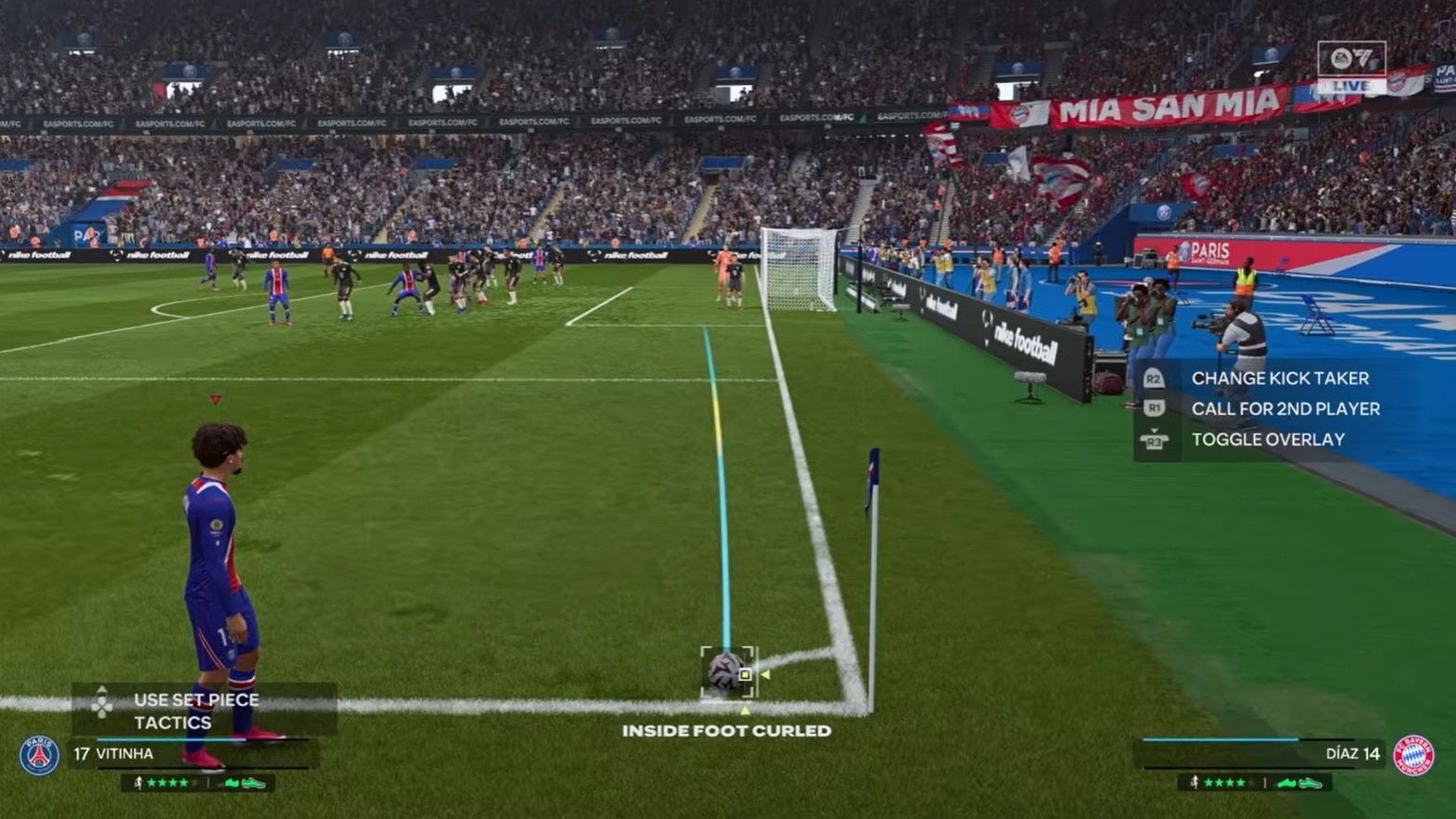
Set pieces also appear to be moving away from static routines. Console Creatures reports that FC 27 introduces a skill-based corner mechanic where players aim the corner as usual, then during power-up can switch to a player in the box and move into position to score. The outlet frames this against EA’s previous reluctance to make corners too powerful because they did not require enough skill to score or win headers.
That system could have a large Clubs impact if it works as described. Human-controlled players already turn set pieces into rehearsed patterns, and giving users more direct control over the receiver’s positioning may widen the skill gap between casual delivery and coordinated teams. It could also create early cheese if defensive switching or marking tools do not keep pace. Until players can test it in live environments, the confirmed fact is the mechanic’s direction, not its balance.
Clubs players should watch the attribute thresholds, not only the headline features
For Clubs, the most interesting detail may be Off-balance Dribbling. Console Creatures reports that the mechanic is inspired by Messi and requires dribbling, balance and agility higher than 85 to get the most out of it with a character. That makes it especially relevant to created pros, where height, weight and attribute allocation are always part of the mode’s competitive puzzle.
If the 85-plus threshold proves important, Clubs builds may face sharper tradeoffs. Smaller attackers and midfielders who can reach elite agility, balance and dribbling may gain new value in tight spaces. Taller forwards or physical wide players may have to decide whether the mechanic is worth sacrificing other attributes. That is not confirmed balance data, but it is the practical mode question created by the previewed requirement.
The PlayStyle changes also feed into Clubs differently than Ultimate Team. In UT, the market adjusts around supply, promos and chemistry. In Clubs, teams adapt through builds and role assignments. A reduced boost to Technical Dribbler+ compared with the regular version, as reported by Operation Sports, could lower the advantage of stacking a single elite ball-carrier profile. Changes to Pinged Pass and Tiki Taka may also reshape midfield builds. Operation Sports says Pinged Pass no longer increases the receiver’s trap success rate, while Tiki Taka has lost the animation playback speed and receiver trap boost effects it had in FC 26.
That could make first touch, positioning and receiver quality more relevant in team play. A midfielder with a passing trait may still help move the ball, but the receiver may no longer be carried through the trap phase by the passer’s PlayStyle. For Clubs squads, that points toward cleaner spacing and smarter support angles rather than treating one passing build as a universal pressure escape.
The upgrade decision depends on whether you play the meta or fight it
RealSport101’s FC 27 guide lists the game’s release date as September 25, 2026, and says EA has officially unveiled FC 27 with Kylian Mbappé on the cover. The same guide also points to broader announced features, including The Grounds open-world social hub and Career Mode transfer changes, but for players focused on match feel, the current case for upgrading rests on whether these gameplay changes survive contact with the live meta.
For Ultimate Team grinders, the preview is promising if last year’s frustrations came from repetitive finesse shots, acceleration PlayStyle dependency and automated defending. The reported nerfs target exactly those pressure points. The cautious read is that Ultimate Team’s live-service structure can create new dominant patterns quickly, especially once early promos introduce stronger PlayStyle+ mixes.
For Clubs players, the upgrade question is more mechanical. Skill-based corners, triggered curved runs, Off-balance Dribbling and reduced receiver assistance on certain passing PlayStyles could make coordinated teams feel fresher. They could also make the mode harsher for casual groups if manual inputs and attribute thresholds become required knowledge rather than optional mastery.
For competitive players, the deciding factor should be the defensive model. Console Creatures’ preview says FC 27 reduces auto tackles and increases manual tackle range. If that creates a cleaner reward for user timing, it is a meaningful competitive change. If it simply shifts the meta from AI blocks to extended manual lunge pressure, the upgrade will feel less transformative than the pitch notes suggest.
The safest advice is to treat this FC 27 preview as a strong signal of EA’s intent, not proof of the final meta. The confirmed direction is clear: less automatic PlayStyle dominance, more attribute influence, more manual defending and more active set-piece control. Whether EA Sports FC 27 gameplay feels like a real reset will depend on tuning, online conditions and how quickly the community finds the next optimal shortcut.