
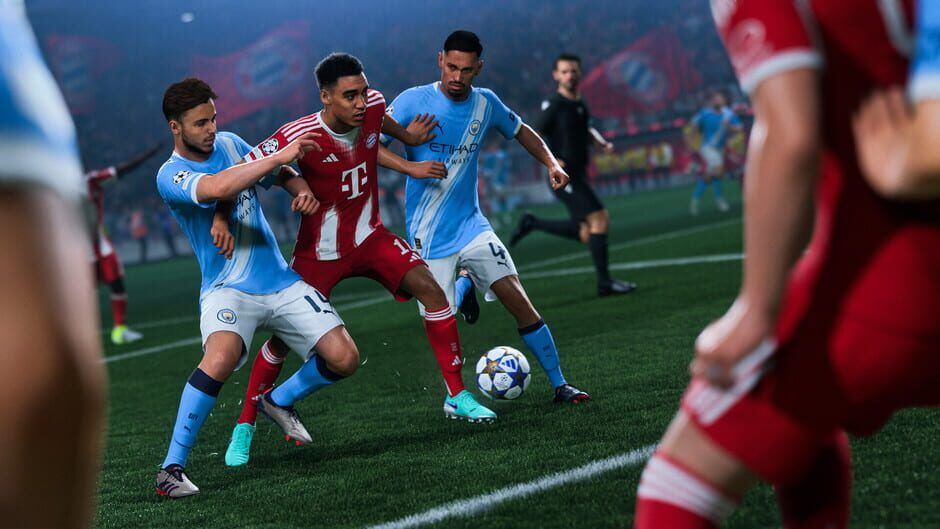

How EA Sports FC 26 uses an AI replica of Guy Mowbray’s voice for name calls, what stays fully human, and what this experiment means for future sports games.
EA Sports FC 26 is doing something no FIFA or FC game has ever done so openly: it is turning the commentary booth into a controlled AI experiment. The result is not a robo‑caster taking over the mic, but a targeted test of where generative tools can slot into a broadcast without players noticing the seams.
At the center of it all is BBC commentator Guy Mowbray, who has confirmed in a BBC interview (as reported by VGC, PCGamesN, MMOHuts and GamesIndustry.biz) that EA is using an AI replica of his voice for specific parts of the English commentary track in FC 26.
What Guy Mowbray actually agreed to
Mowbray is not being replaced in FC 26. He is still one of the lead English commentators, paired primarily with Sue Smith. The key change is that he has explicitly licensed EA to train a generative model on his voice and then use that model to produce certain lines without him being in the booth.
The permission is narrow. According to Mowbray and EA’s statement to the BBC, the AI version of his voice is used for:
- Some player name calls from the pool of more than 20,000 real footballers in the database
- Variations of those names in different emotional and match contexts
The important nuance is that Mowbray opted in. This is not scraped audio thrown into a random text‑to‑speech system. EA worked with him as a partner, and uses the model under a specific agreement that still leaves the bulk of the commentary work in his hands.
In practice, he still spends most weeks from November through to July in recording sessions for FC, but the most mind‑numbing part of the job is finally being shared with a machine.
Why name calls are being handed to AI
If you have ever heard a commentary pack repeat the same turn of phrase too often, multiply that by the sheer scale of modern football databases. EA’s official line is that there are more than 20,000 licensed players in FC 26, and Mowbray explains that historically he has had to record each of their names several times, changing the emphasis and delivery to fit different situations.
In the booth, that means reading something like a star striker’s surname in:
- A neutral tone for a simple pass
- A tense, rising tone for a shot on goal
- An explosive shout for a finish into the top corner
He has said he might do “about five different” versions of a single name. Multiplied across tens of thousands of players and team sheets that change every season, this is an enormous, intensely repetitive workload that does not actually draw on his strengths as a broadcaster. It is a data‑entry task performed with vocal cords.
That is where FC 26’s AI testbed comes in. EA now trains a model on Mowbray’s recorded voice and then uses it to generate some of these high‑volume, low‑creativity name clips. The model learns his pronunciation, cadence and accent, then can be steered to produce different stresses and emotional weights.
The goal is not to dynamically improvise new sentences during play, but to mass‑produce clean, consistent reads on demand. In other words, the AI is acting like an infinite reserve session for a very specific type of line.
How AI name‑call generation likely works under the hood
EA has not publicly released a full technical breakdown, but between the BBC reporting, EA’s own comments and how other modern TTS pipelines are built, you can piece together a plausible workflow for FC 26.
First, Mowbray records a base set of samples. These include:
- Long form commentary that captures his natural range
- Targeted reads of names and phonetic fragments, especially for challenging or less familiar languages
- Emotional variations across calm, excited, disappointed and surprised deliveries
From there, EA’s audio and R&D teams train a voice model that can be driven by text and control signals for pitch, speed and intensity. When the design team needs a new name or variation, they do not drag Mowbray back into the booth. Instead they:
- Input a text string or phonetic breakdown of the name.
- Tag the intended context, such as “goal celebration,” “substitution,” or “simple pass.”
- Let the system output several reads, then have humans listen and pick the most natural take.
For especially tricky pronunciations or names from under‑represented languages, they can still bring Mowbray back to record a ground‑truth version, then refine the AI output to match. The model can also be retrained or nudged each cycle so it stays aligned with how he actually sounds, including any subtle changes in tone over the years.
Crucially, nothing in the coverage suggests that FC 26 is auto‑generating freeform sentences like “Mowbray‑bot” improvisations. This is targeted voice cloning for small, modular clips where consistency matters more than spontaneity.
What parts of FC 26’s commentary are still fully human
Almost everything players recognize as personality, analysis or storytelling in FC 26 comes from Mowbray and Sue Smith themselves. The AI is there for the grunt work, not the craft.
Here is what remains human performed:
Play‑by‑play and moment‑to‑moment calls
Describing the build‑up to an attack, reacting to a near miss, framing a derby as it boils over. These lines are written, rewritten and recorded in the studio. Mowbray has talked about needing to come up with ten slightly different versions of essentially the same event, so that the game can rotate between them and avoid obvious repetition. That creative exercise is not offloaded to AI.
Color commentary and analysis from Sue Smith and other pundits
Smith’s job is to add insight. That means tactical breakdowns, reactions to controversial decisions and short stories about players or clubs. These are written with her, honed by the dev team and recorded in multi‑hour sessions. The nuance in timing and emphasis is what sells the illusion of a real broadcast, and that is not something an FC 26 voice model is handling.
Back‑and‑forth banter
One detail that came out of the BBC piece is how much of the commentary is scripted as a conversation. Mowbray and Smith often record together or in ways that simulate interruption, overlap and spontaneous responses, so the final lines can be stitched as a natural dialogue. Those human rhythms are very hard to fake without dipping into uncanny territory, so EA is still fully reliant on the real commentators here.
Special event packs and bespoke lines
Derbies, cup finals, career milestones, Ultimate Team promos, story‑driven challenges. All of these require bespoke commentary that references specific years, story beats or player achievements. Because they date the game and carry a particular emotion, they are all recorded by the real talent. AI might assist with cleanup or subtle processing, but not with inventing or delivering the lines.
In short, FC 26’s generative element lives in the most modular, least creative slice of the commentary track. Everything that feels like a human responding to the match is still a human.
Why EA is using FC 26 as an AI testbed
From EA’s point of view, the annual football game is the perfect laboratory. The series already leans on large pipelines, heavy localization and vast databases of licensed content. Production realities are brutal, and commentary is one of the most time‑consuming, least obvious to market improvements each year.
By carving out name calls as the first AI‑powered piece in FC 26, EA gets several wins:
- It reduces repetitive recording hours for commentators.
- It future‑proofs the pipeline as more clubs, leagues and players are licensed.
- It gives audio teams granular control over pronunciation and pacing, rather than hoping a tired commentator nails version number five of a tongue‑twister.
- It lets EA publicly frame AI as a collaborative tool instead of a replacement, which is important in a world where synthetic voice use is under scrutiny.
It is also a relatively low‑risk test. If some AI‑generated name reads fall flat, they can be quietly swapped for human‑recorded versions in patches or down the line, without re‑architecting the system.
What this means for localization
The broader implication of FC 26’s approach is what it might unlock for non‑English commentary teams in future games.
Today, each local language crew faces the same problem Mowbray described, often with smaller budgets and fewer recording days. Latin American Spanish, French, German, Italian, Arabic and other tracks have to cover the same global database of players, many of whom do not have names that sit comfortably in the caster’s native phonetics.
An FC 26‑style pipeline could:
- Let EA train language‑specific models on each commentator, then auto‑generate exhaustive sets of name calls that respect pronunciation rules.
- Make it more feasible to add niche or regional leagues with full local commentary without exploding recording costs.
- Allow quick updates when players transfer or new youth prospects are added, instead of waiting until the next cycle to get them into the booth.
There are challenges. Local voice actors would need the same kind of opt‑in agreements Mowbray has. Cultural sensitivities around synthetic voices may differ by market. And quality control in languages where EA’s internal teams are smaller could be harder.
But FC 26’s experiment suggests a path where localization can expand rather than shrink. If AI kills anything, it will likely be the awkward silence when a commentator has to avoid saying a name the track does not support.
Authenticity versus synthetic assistance
For long‑time FIFA and FC players, commentary authenticity lives or dies on two pillars: whether it sounds like the real broadcasters they know, and whether it reacts believably to what is happening on screen. AI name calls touch the first pillar, not the second.
On one hand, voice cloning makes it easier to preserve the continuity of a well known commentator. As Mowbray ages, the base model can be retuned using fresh sessions so that newly covered players or leagues do not suddenly sound like a different broadcaster. For players, the illusion remains that “this is that BBC guy from the World Cup,” even as the game’s content balloons.
On the other hand, any mis‑step in the AI output could be jarring. Slightly odd stress on a syllable, a regional accent slip, an emotion that is too hot or too cold for the moment. These are the cracks that make players say the commentary feels robotic.
EA’s decision to keep the reactive, contextual lines fully human in FC 26 is a direct hedge against that perception. It means the parts of the track that most strongly impact the sense of a live broadcast are still written and performed by real people, so the underlying texture remains authentic even if a few name snippets are synthetic.
There is also a trust question. Because voice synthesis in games has been controversial, EA is stressing the collaborative nature of FC 26’s experiment. The company told the BBC and multiple outlets that AI has long been part of its pipeline for animation and gameplay, and that when it touches commentary, it is framed as support for their talent, not a stealth replacement. If that framing holds and commentators continue to speak positively about the arrangement, players are less likely to feel like they are listening to something fake.
Commentator workloads and the annual sports treadmill
For the people behind the mic, FC 26’s AI test is as much a working‑conditions story as it is a tech demo.
Mowbray describes commentary for EA as a near year‑round gig. Sessions happen every few weeks from late autumn through to the summer, often running four or five hours at a time. Co‑commentator Sue Smith notes that one of the hardest parts is maintaining vocal consistency across months of work. If she shows up a bit hoarse, or her tone does not quite match an earlier batch, they sometimes have to abandon the session, because the game will stitch lines recorded half a year apart into a single match.
By letting AI take over repetitive name reads, FC 26 can lower some of the physical strain. Commentators can invest their studio time in the lines that matter most, taking more passes at tricky exchanges, rewrites and nuanced reactions, instead of burning their voice boxes on endless rosters.
Looking ahead, similar tools could:
- Shorten yearly recording calendars or allow the same calendar to produce more varied lines.
- Reduce burnout so commentators can stick with the series for longer stints.
- Make mid‑cycle content updates more realistic, such as bespoke commentary for mid‑season tournaments or late‑window transfers, without demanding last‑minute, high‑stress sessions.
There is a flip side. Once a robust voice model exists, publishers might be tempted to rely more on it over time, pressuring talent to sign broader rights agreements, or using synthetic lines in ways they are less comfortable with. FC 26’s controlled, opt‑in setup is a positive signal, but there is no guarantee every game or company will handle it as cautiously.
What FC 26 hints at for the next generation of sports games
Pulling the threads together, FC 26 looks like a quiet blueprint for how annualized sports titles could use AI across the next decade.
Short term, expect more of what this game already does:
- AI handling modular, repetitive elements such as name calls, stadium PA announcements and potentially referee or VAR snippets.
- Human talent focusing on high‑impact lines, story‑driven content and bespoke game modes.
- Gradual expansion of localized commentary options, supported by language‑specific voice models.
Long term, once publishers are confident the tech will not break immersion, it is easy to imagine commentary systems that go further while still keeping humans at the creative heart.
A future FC or NBA game could have:
- Human commentators write and record a core library of phrases and reactions.
- AI systems smartly remix those elements, altering emphasis, stitching in fresh name calls and slightly varying timing so that the same basic story beat never sounds identical twice.
- Granular localization on top, letting a star’s name sound correct whether the player selects English, Spanish, Arabic or Japanese commentary.
In that world, the commentary team is still the author and performer. The AI is the invisible assistant, helping adapt their work to ever more leagues, languages and player careers.
FC 26 is not that fully dynamic future yet. It is the pilot program, starting at the most mechanical layer. But by putting an AI clone of Guy Mowbray’s voice into the game for selected lines, with his consent and collaboration, EA is showing where it thinks the line sits right now between authenticity and automation.
For players, the ideal outcome is simple. You never notice anything has changed, except that the commentary slowly starts to feel like it fits every player, every league, and every new career save just a little bit better.