
How Duskfade channels Kingdom Hearts and Jak & Daxter through its traversal, combat, and dreamy art direction, and why PS2-style 3D platformers are thriving again.
A New PS2 Classic That Never Existed
Duskfade does not pretend its inspirations are subtle. Developer Weird Beluga and publisher Fireshine Games pitch it as a coming-of-age action platformer built directly on the foundations of PlayStation 2 greats. Kingdom Hearts, Jak & Daxter, Ratchet & Clank, even a touch of Spyro, are called out by name in trailers, press materials, and interviews.
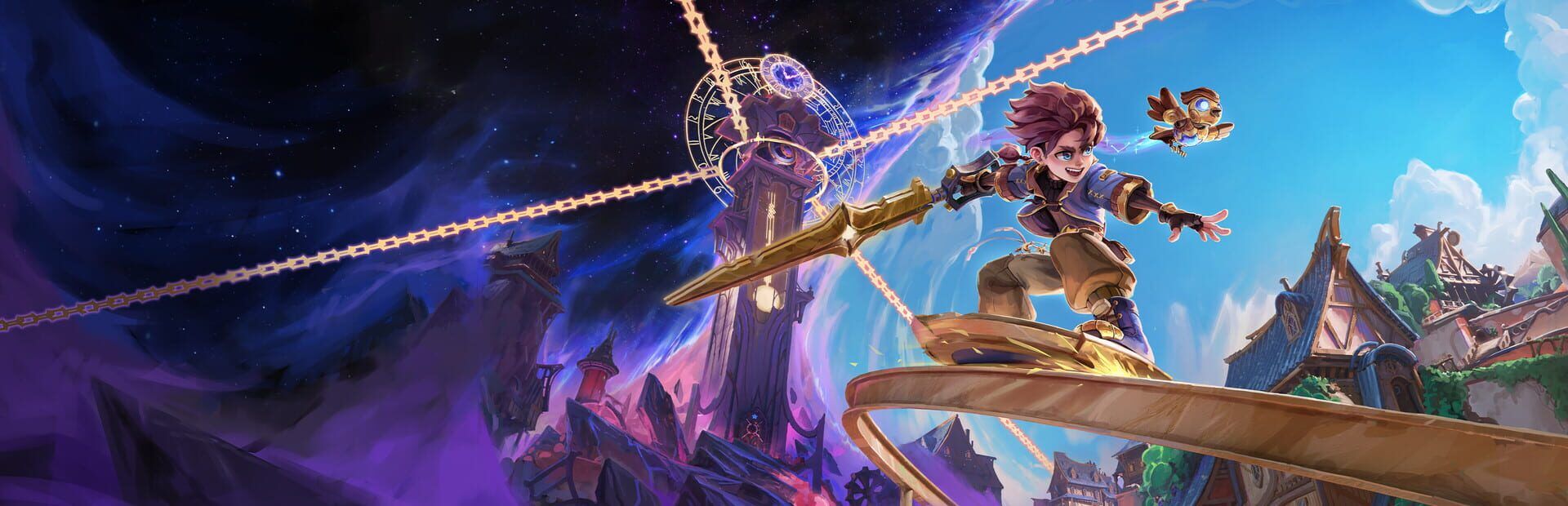
Rather than chasing cinematic realism, Duskfade aims to feel like the big-budget platformer you somehow missed in 2004, now rebuilt with modern tech. It stars Zirian, a young hero whose world has fallen into a literal eternal dusk. His sister is imprisoned in a looming Clock Tower, the world is stitched together by the machinery of ancient Master Clockmakers, and his main weapon is a clock-hand blade that might as well be its own Keyblade variant.
What makes Duskfade interesting is not just that it nods to the PS2 era, but that it deliberately breaks that nostalgia apart into systems: traversal tuned around flow, combat that borrows Kingdom Hearts spectacle and Ratchet & Clank punch, and art direction that leans into dreamlike melancholy rather than pure Saturday-morning cartoon.
Traversal: Jak & Daxter’s Momentum, Modernized
Weird Beluga cites Jak & Daxter and Ratchet & Clank as the primary touchstones for movement. That shows in how Zirian is designed to string actions together. Instead of rigid, stop-start platforming, levels are built as connected runs where jumps, dodges, grapples and grinds form one continuous line.
In classic Jak & Daxter fashion, the protagonist has a broad but readable kit: double jumps, air control, melee swings that can be woven into platforming, and environment-driven tricks like rail grinding and grapple points. A lot of modern 3D platformers lean on precision above all else. Duskfade leans on rhythm. Its levels encourage you to look ahead and improvise a route, more like a skate line or a speedrun path than an obstacle course of isolated gaps.
This is also where Duskfade diverges from the PS2 template. Where older games often had more rigid camera and input latency, early impressions of the PC and PS5 demo point to tight control response and generous coyote time, plus camera behavior that tracks momentum instead of fighting it. It is chasing how you remember those games feeling, not how they actually handled on a DualShock 2.
The environments reinforce that flow-first approach. Forests, underwater ruins, deserts and sky islands are not presented as tiny, discrete stages but as zones peppered with rails, grapple points and secrets that loop you back into the critical path. Like Jak & Daxter’s best hubs, they are built to be read at a glance, then mastered with repetition.
Combat: Kingdom Hearts Flash In A Jak & Daxter Shell
If traversal is Duskfade’s Jak & Daxter half, combat is where the Kingdom Hearts DNA is most obvious. Zirian’s clock-hand sword shares that same exaggerated silhouette and spinning, arcing moveset fans will recognize. Encounters are built around swift melee strings, air juggles and quick dodges rather than cover or stamina bars.
Preview coverage and interviews point to Ratchet & Clank also being a key reference. That influence comes through less in gunplay and more in the feel of impact. Hits have weighty knockback, enemies telegraph large, readable attacks, and combat arenas are sprinkled throughout platforming segments rather than carved off as self-contained combat rooms.
This mixture gives Duskfade a distinct tone. Kingdom Hearts provides the flashy, almost balletic feel of swinging an oversized, magical blade through slow-motion explosions of light. Jak & Daxter and Ratchet bring a more grounded, toybox-like readability where enemy silhouettes and color coding communicate danger at a glance. Duskfade adds modern expectations on top of that with snappy animation cancel windows and a quicker baseline movement speed, so fights flow straight out of traversal instead of forcing you to slow down.
Crucially, combat is not isolated from movement. Grinding into a group, popping into a jump-attack, grappling to another platform mid-combo, and chaining into a dodge-roll keeps Zirian in near-constant motion. That helps Duskfade avoid the clunky start-stop feeling that some PS2-era brawling had when it pulled you out of the platforming groove.
Art Direction: Kingdom Hearts Melancholy In A Clockwork World
On the visual side, Duskfade leans much closer to Kingdom Hearts than to Jak & Daxter. Instead of muted, grungy sci-fi or purely slapstick fantasy, it goes for a dreamy, wistful atmosphere. The entire world is stuck at twilight, bathed in oranges, purples and deep blues that recall Kingdom Hearts’ Destiny Islands sunset or Twilight Town’s perpetual evening.
The clockwork motif ties everything together. Zirian’s blade mimics a clock hand, his mechanical owl companion Cuckoo fills the sidekick role while reinforcing the theme, and environments are layered with gears, suspended mechanisms and floating architecture. The result is that same slightly surreal quality that defined early-2000s Square Enix worlds, but reframed around memory and grief instead of pure Disney crossover whimsy.
Character designs walk a similar line. Proportions sit squarely in that PS2 sweet spot: exaggerated but not chibi, readable at distance but detailed enough up close to feel modern. Enemy silhouettes channel Kingdom Hearts’ Heartless in their simplicity and clear shapes, while their textures and motion give them more of a haunted, memory-distorted presence.
Technically, Duskfade benefits from modern lighting, higher fidelity textures and smoother animation, but the team seems careful not to lose the bold color blocking and strong, readable shapes that made PS2-era platformers so easy to parse on CRTs. It is less about realism and more about evoking the feeling of booting up a new memory card and seeing a strange but inviting world.
Why PS2-Style 3D Platformers Refuse To Fade
Duskfade arrives at a moment when players are actively seeking out PS2-style 3D platformers again. Ratchet & Clank: Rift Apart, the Crash and Spyro remasters, Psychonauts 2, and indie darlings like Blue Fire and Lunistice have all shown that there is an audience hungry for tightly designed, colorful action-platformers.
There are a few reasons this formula works so well in 2026. First, the PS2 generation is now the nostalgia core for a huge chunk of players. For them, platformers like Jak & Daxter and Kingdom Hearts were not side dishes, they were the main course. Duskfade consciously markets itself as “a love letter to PS2 classics,” and that honesty resonates. It is not ashamed to be a 3D platformer in an era dominated by open-world checklists and live-service loops.
Second, the structure of these games fits modern life. Self-contained levels, clear objectives and a strong sense of progression make them easy to play in sessions without getting lost, while still offering depth for completionists. Duskfade’s mix of secret-filled zones, optional challenges and expressive movement sits neatly in that space.
Finally, PS2-style platformers are uniquely well suited to smaller teams with modern tools. You do not need open-world scale or photoreal assets to make them work. What you need is a strong movement kit, clever level design and cohesive art direction. Weird Beluga’s approach with Duskfade reflects this. By focusing on a single, evocative theme and remixing proven mechanics from Kingdom Hearts and Jak & Daxter, the studio can deliver something that feels both nostalgic and new.
If the full game can maintain the flow teased in its demos, Duskfade has a real chance to join the growing list of modern platformers that do more than reference the PS2 era. It could feel like a lost classic finally getting the hardware it always deserved.