
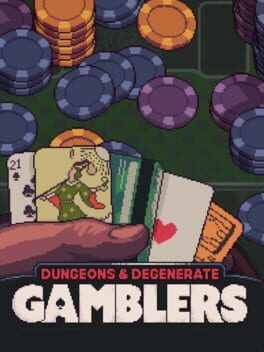

Yogscast Games and Purple Moss Collectors are bringing the blackjack roguelike deckbuilder to Nintendo Switch with the 2.0 Doubling Down update included from day one.
Image: IGDB
Store links: Dungeons & Degenerate Gamblers on Steam
A blackjack roguelike arrives on Switch as a current build
Dungeons & Degenerate Gamblers is coming to Nintendo Switch on October 9, 2026, with publisher Yogscast Games and developer Purple Moss Collectors confirming the console release through a press release carried by Games Press and reported by Nintendo Everything. The same announcement also names PlayStation 5 for the October 9 console launch, so this is not a Switch-only move, but Nintendo players are getting the blackjack roguelike Switch release at the same time as Sony’s current console.
The important detail is the build. Yogscast Games says the console edition will include the latest content updates and PC improvements from day one, including the 2.0 “Doubling Down” update. For strategy players, that changes the buying calculation. Switch owners are not being asked to start with the original PC launch version and wait for the meta to catch up. They are being dealt a version that already folds in a major content expansion, balance reworks, daily challenges, custom run tools, and additional progression space.
That is the immediate tension around the Dungeons and Degenerate Gamblers Switch launch: the game is built around blackjack’s volatility, but the console version is arriving with systems that appear designed to give repeat players more control over how that volatility is tested.
The hook is blackjack, but the decisions are deckbuilder decisions
Yogscast Games describes Dungeons & Degenerate Gamblers as a blackjack-inspired roguelike deckbuilder. The premise keeps blackjack’s central pressure, getting close to 21 without going over, then mutates the surrounding rules into a dungeon run full of strange cards, opponents, rewards, and run-shaping choices.
According to the publisher’s rundown, standard suits are replaced by stranger card types including tarot cards, business cards, store loyalty punch-cards, hall passes, and birthday cards. These cards can manipulate point totals, deal direct damage, or steal opponents’ chips. Players choose a starter deck, equip Lucky Charms, and move through branching dungeon floors while facing corrupt high-rollers in a tavern setting.
That matters for deckbuilder Switch players because the game’s strategy does not appear to sit only in drawing good cards. The described loop asks players to manage blackjack thresholds, card effects, chip economy, opponent pressure, and route selection at the same time. The closer-to-21 rule creates an immediately readable objective, while the roguelike layer asks the harder question: how much risk can your current deck actually support?
Based on the publisher’s description, this is the strategic lane where Dungeons & Degenerate Gamblers could stand out. Many deckbuilders let the player build toward overwhelming inevitability. A blackjack structure keeps each hand tied to a failure state that cannot be ignored. Even a powerful synergy still has to respect bust risk unless the deck has tools to manipulate, absorb, or exploit it.
Doubling Down gives the Switch version a broader strategic base
The Switch edition launches with the 2.0 “Doubling Down” update included, according to both the Games Press release and Nintendo Everything’s report. Yogscast Games lists four new floors for that update: Surveillance, Laboratory, Anxiety, and Apathy. Each floor is described as having its own events and dangerous foes.
The same update brings more than 50 Lucky Charms, custom runs, daily runs, three new cards, a new Unique Chip, reworked existing cards and Unique Chips, and new foes on existing floors, according to the publisher. That is a significant amount of material to arrive with the first console version, especially for a game whose long-term value depends on run variety and build discovery.
The Lucky Charms are especially interesting from a strategy standpoint. Yogscast describes them as effects that remain active throughout a run. Persistent modifiers tend to reshape the entire decision tree in a roguelike deckbuilder because every later card pickup, route choice, and risk calculation gets evaluated through that ongoing bonus or constraint. If a charm rewards aggressive chip play, conservative blackjack discipline becomes less attractive. If another supports damage, healing, or point manipulation, the optimal deck may shift away from simple card value consistency.
Custom runs and daily runs also point in different directions. Custom runs give players tools to tune parameters and experiment with rules and modifiers. Daily runs standardize the start with a fixed deck and pre-selected modifiers, which makes strategic comparison cleaner. That combination can serve both lab players who want to test edge cases and competitive-minded players who want to compare the same puzzle with everyone else.
The appeal for strategy players is controlled risk, not pure chaos
Dungeons & Degenerate Gamblers has an obvious randomness problem on paper because blackjack is partly about incomplete information and draw order. The question for a strategy audience is whether the game gives enough levers to turn luck into managed exposure. The confirmed features suggest that is the design target, though final judgment depends on how the Switch version feels in play.
The publisher’s examples point to several layers of control. Cards can alter point totals, deal damage, steal chips, heal, generate money, or otherwise change the outcome of a hand. Wikipedia’s gameplay summary, based on the PC release, similarly describes battles where players try to approach 21 without busting, losers take hit point damage, and money can be spent after fights on options such as healing, exchanging cards, or adding cards to the deck. It also notes that some cards have unusual effects, including random values or ways to interfere with an opponent’s cards.
For deckbuilder veterans, that creates a familiar strategic question in an unfamiliar shell: do you draft for consistency, explosive combo potential, resource generation, or survival? The blackjack framework makes consistency unusually valuable because an overpowered card can still be dangerous if it pushes the total past 21. At the same time, effects that change values or punish opponents may let players deliberately operate near the edge.
That is where the game may appeal to players who enjoy strategy under uncertainty. The best runs in this kind of design are rarely about removing randomness completely. They are about building a deck that knows when to hit, when to stand, when to spend resources, and when a risky line is statistically worth taking because the reward path is strong enough.
The console launch follows a PC debut with visible traction and mixed critical signals
Yogscast Games says Dungeons & Degenerate Gamblers grossed over $1 million in its first month on sale for PC. That figure comes from the console announcement distributed through Games Press and repeated by XPN Network, and it gives the Switch release a clearer business context. This is not an untested concept being moved to console on premise alone. The publisher is positioning it as a PC success that now has enough content and momentum for a wider audience.
The game’s earlier PC history is also relevant. Wikipedia lists Dungeons & Degenerate Gamblers as a 2024 roguelike deck-building game developed by Purple Moss Collectors and published by Yogscast Games, with the original release on August 8, 2024 for Linux, macOS, and Windows. The same page notes that the 2.0 update arrived on July 30, 2026.
Reception should be treated carefully. Wikipedia summarizes the game as having “mixed or average” reviews on Metacritic and says OpenCritic assessed it as fair approval with 63 percent of critics recommending it. That signal fits the design risk. A blackjack roguelike can be inventive and frustrating at the same time if randomness feels too dominant, if balance spikes too sharply, or if the player’s agency is unclear after a bad draw.
The Switch version’s strongest argument is that it arrives after that initial PC period, with reworked cards and Unique Chips included in the 2.0 package. Reworks do not automatically solve reception concerns, but they show that the console launch is tied to a later state of the game rather than a frozen port of the first release.
What is confirmed, and what remains unanswered before October 9
The confirmed information is straightforward: Dungeons & Degenerate Gamblers releases on Nintendo Switch and PlayStation 5 on October 9, 2026, according to Yogscast Games and Purple Moss Collectors. The Dungeons & Degenerate Gamblers release on console includes the latest content updates and PC improvements from day one, with the 2.0 “Doubling Down” update named specifically in the announcement.
The sources provided do not list a Switch price, file size, frame rate target, resolution, touchscreen support, physical edition, eShop preorder status, or any Switch 2-specific version. Readers should treat those details as unannounced unless Yogscast Games, Purple Moss Collectors, Nintendo, or a storefront listing confirms them. There is also no review basis here for judging the Switch port’s performance or interface quality.
For players deciding whether to watch the launch, the best practical guidance is genre-based. If you want a deckbuilder Switch release built around careful risk management, daily challenge routing, and build experimentation, Dungeons & Degenerate Gamblers has a clear pitch. If you dislike card games where draw variance can swing a run, it is worth waiting for Switch impressions or footage of the console build before buying.
The most promising part of the Switch arrival is timing. Dungeons & Degenerate Gamblers is coming to Nintendo’s platform after a PC launch, after a major 2.0 content update, and with custom and daily run structures already in place. For strategy players, that means the real question on October 9 will not be whether blackjack can become a roguelike deckbuilder. It will be whether this version gives enough tools to make every risky hand feel like a decision rather than a coin flip.