
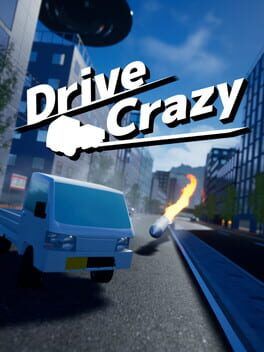

How DriveCrazy’s first Switch trailer teases a wild, stunt‑heavy twist on driving games, blending alien invasion chaos, Kei truck rallies, and arcade aggression that should tempt Burnout and Crazy Taxi fans.
A Kei truck, an alien invasion, and a collapsing Japan
DriveCrazy is not the usual sleek supercar fantasy that dominates racing shelves. Coming to Nintendo Switch in 2026 from Amata Games and TubezGames, it is a driving‑action curio built around one of the least glamorous vehicles imaginable: a battered little Kei truck. That underdog hero is dropped straight into a Japan on the verge of collapse, as aliens crash‑land in a rice field mid‑rally and trigger an invasion that literally tears the country apart.
The setup is knowingly absurd. You are a driver in the Kei Truck Rally 20XX when a UFO plummets out of the sky, panicked aliens zap the population somewhere else, and the landscape starts folding in on itself. From the first trailer and existing PC version, Japan becomes a surreal obstacle course of tumbling highways, sliding buildings, and improvised routes that defy common sense. It is less a grounded depiction of disaster and more a playground built to justify constant panic‑driving.
Stunt‑heavy driving instead of clean racing lines
What immediately separates DriveCrazy from typical racers is how little it cares about traditional concepts like clean lines, braking zones, or even gravity. If you think it is a road, the game treats it as one. The Kei truck happily races up walls, through the insides of buildings, along crumbling overpasses and across whatever geometry happens to be in front of it. The physics lean into spectacle rather than realism, letting you bounce between surfaces, maintain momentum through wild angles, and improvise routes in the chaos.
Destruction is not a penalty but a core mechanic. Smashing streetlights, road signs, roadside clutter, and other debris is actively rewarded, feeding a nitro gauge that lets you chain speed boosts together. The developers jokingly admit they have no idea why destroying property refuels nitro, but it turns the act of panicked swerving into a score‑chasing loop. You are encouraged to sideswipe everything in sight, threading the Kei truck through collapsing streets while deliberately clipping anything that explodes into fragments.
Combat is layered on top of this destructive driving. The trailer and Steam footage show the truck weaving between laser fire, debris and enemy formations, then using that same high‑speed movement to counterattack. You can slam into alien drones, outmaneuver projectiles with wall rides, and build up momentum to hit weak points on gigantic bosses. It feels closer to an action game built around a vehicle than a racer that happens to include hazards.
Stage‑based chaos instead of open‑world cruising
DriveCrazy’s structure is stage‑based rather than open world, which gives its designers room to lean into specific set pieces. Official descriptions talk about stages that feature swarms of smaller enemies, others that revolve around towering boss fights, and some that have no enemies at all, focusing instead on precision driving and survival through environmental collapse.
That variety comes through in the trailer, which cuts rapidly between scenes of hectic urban runs, rural stretches torn apart by alien tech, and rally‑style courses packed with spectators and signage. One moment the Kei truck is dodging bright green alien beams while a highway peels up like a carpet, the next it is threading through tight indoor corridors that feel more like a platformer. The rigid stage format also underpins online rankings, with each course tracking clear times and scores so players can compete for route optimizations and perfect, crash‑filled runs.
This design hints at something more akin to a score attack arcade game than a campaign you meander through. Stages look built for repeat play, where shaving seconds off your time involves learning which walls can be ridden, which props are best for nitro refills, and how to time boost chains through waves of enemies.
Tone: slapstick panic over grim apocalypse
Despite the apocalyptic premise, DriveCrazy’s tone in its first Switch‑focused trailer leans more slapstick than somber. The Kei truck itself, by virtue of being a humble work vehicle thrust into a world‑ending crisis, gives the game a self‑aware sense of humor. Promotional text pokes fun at its own mechanics, warning players not to imitate the death‑defying wall rides in real life and playfully dismissing any attempt to explain the nitro system.
On screen, that humor manifests as exaggerated destruction and gleeful excess. Buildings topple at just the right angle to turn into ramps. Vacuum‑like contraptions, kaiju‑sized creatures, and bizarre alien machinery clutter the roads. The camera often sits low and close to the truck, emphasizing the chaos as it plows through crowds of props and narrowly avoids being crushed. It is the kind of game where the panic is part of the punchline, and failure tends to be visually spectacular.
That tone should translate well to handheld sessions on Switch. The clear visual language of hazards, bright boosts, and breakable objects helps sell the action even on a smaller screen, while the absurd premise makes it easy to dip in for a couple of stages without keeping track of a dense plot.
Why Burnout and Crazy Taxi fans should pay attention
DriveCrazy’s pitch almost sounds targeted at a specific kind of arcade racing fan. If you grew up mastering Takedowns in Burnout or memorizing fare routes in Crazy Taxi, the Switch version looks poised to scratch a familiar itch while twisting it in bizarre directions.
From Burnout, DriveCrazy borrows the love of aggressive driving and spectacular crashes. Destroying the environment is mechanically central, keeping your nitro topped up and your speed at the edge of control. Chaining boosts and threading traffic recalls Burnout’s high‑risk rhythm, except here the track itself might fold over you or lead straight up the side of a skyscraper.
From Crazy Taxi, it channels that frantic improvisation and urban chaos. There is a similar sense of barreling through semi‑recognizable cityscapes, cutting corners across sidewalks and stairways, and treating every bit of geometry as a potential shortcut. The difference is that instead of delivering customers under a timer, you are outrunning alien doom and turning every escape into a high‑score chase.
The Kei truck twist is what helps DriveCrazy feel like its own thing rather than a throwback. Its low profile and boxy shape give collisions a distinct weight compared to supercar‑focused racers, and its underdog status amplifies the comedy of surviving scenarios that look designed for a blockbuster action movie. Add in online rankings and stage‑by‑stage leaderboards, and there is clear potential for a niche but passionate community to form around route‑finding, stunt discovery, and score chasing.
DriveCrazy is already out on PC, so the 2026 Switch release will not arrive in a vacuum. But this first wave of console trailers makes a strong case for the game as one of the stranger, more personality‑driven driving projects on Nintendo’s hybrid. For anyone tired of pristine circuits and po‑faced car culture, a panicked Kei truck hurtling up the side of a collapsing Tokyo tower might be exactly the sort of chaos to watch in 2026.