
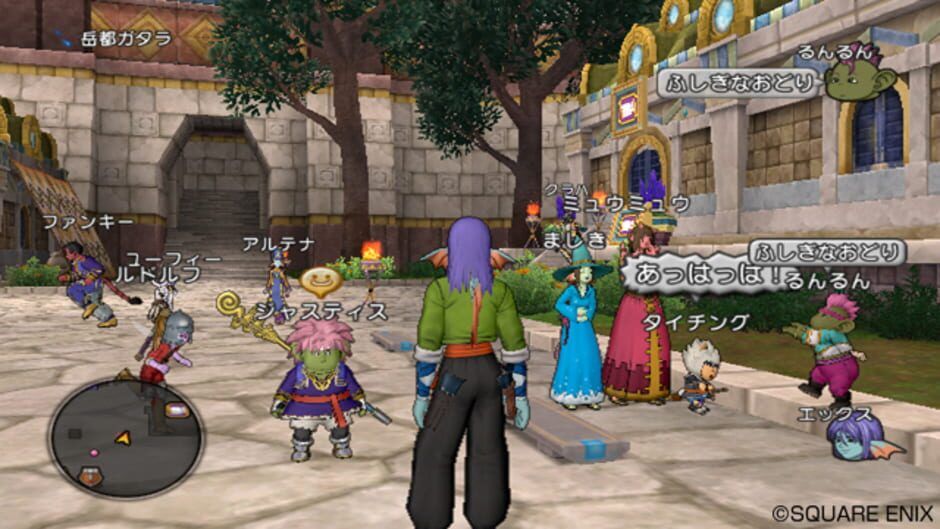

Square Enix is wiring Google’s Gemini into Dragon Quest X as a talkative slime companion. Here’s what Chatty Slimey actually does, how it could smooth out one of the most intimidating onboarding curves in MMOs, and why it matters for an aging live-service RPG.
Dragon Quest X is about to get something most MMOs desperately need: a patient friend who never logs off.
Square Enix’s long-running Japan-only MMO is integrating Google’s Gemini model into a new in-game companion called Chatty Slimey, a bouncing blue slime that lives in your UI and talks to you about the game. On paper it sounds like just another “AI in games” headline. In practice it looks more like a classic MMO problem being tackled with a new tool: how do you keep new players from bouncing off a 10‑plus‑year-old live service loaded with systems, expansions, and unspoken community knowledge?
This is less a tech story and more a support and onboarding story. Chatty Slimey is being built explicitly to keep new Dragon Quest X players from getting lost, overwhelmed, or just lonely in a world where everyone else is already at the level cap.
What Chatty Slimey actually is
Based on details from Square Enix’s Dragon Quest X Spring Festival broadcast and follow-up reports, Chatty Slimey (Oshaberi Slimey in Japanese) is a conversational assistant that sits in your HUD.
You can type to it in chat, and it responds with AI-generated text and voiced lines. It reads the game screen, recognizes what is happening around your character, and reacts. Square Enix describes moments where Slimey comments when you beat a strong enemy, notice your outfit change, or pick up a rare item. It is not just a floating help button. It is designed to feel like a talkative party mascot that happens to know the manual by heart.
The feature is powered by Google’s Gemini, but that detail is mostly invisible from a player’s perspective. What matters is the behavior Square Enix is promising:
Slimey can answer game-related questions.
Slimey can give you hints on where to go next.
Slimey can proactively speak up based on what is on the screen.
Slimey’s answers are voiced so it feels like a character, not a text log.
A closed beta test is planned, and Square Enix is framing the experiment around helping newcomers rather than adding a novelty toy for veterans.
Why Dragon Quest X needs this kind of help
Dragon Quest X is not a new MMO looking for its footing. It launched in 2012 and has quietly turned into a dense, expansion-stacked online world that never left Japan. Like Final Fantasy XIV, it has a decade of story chapters, mechanical revisions, and social norms that new players are supposed to absorb on the fly.
That is a nightmare onboarding scenario. New players arrive in starter towns that veterans rarely visit. Quest text assumes knowledge from earlier patches. Guides and wikis exist, but they are outside the game, often in Japanese only, and usually written from an expert perspective. The result is a familiar MMO pattern: players log in, see an enormous quest list, get confused about optimal progression, and quietly drop the subscription.
Square Enix explicitly acknowledged this problem when talking about Chatty Slimey. The aim is to make sure new players do not feel alone, both in the literal sense of wandering empty early zones and the psychological sense of not understanding what the game wants from them.
Instead of baking even more tutorials into UI popups, they are trying something closer to the feeling of having an experienced friend in Discord who says “OK, ignore those side quests for now, just follow this main story marker until level 20.” The difference is that this friend is an in-game character and can see what is happening on your screen.
How an AI guide could change MMO onboarding
If Square Enix delivers on what it is describing, Chatty Slimey attacks three of the toughest friction points in long-running MMOs.
First, it turns static help text into a back-and-forth conversation. Traditional tooltips assume you know what to ask. A dense help menu is only useful once you already understand the vocabulary. Being able to type a natural-language question like “I came back after years away, where should I start?” and get a tailored answer is a fundamentally different support experience.
Second, it collapses the gap between the game and the browser tab. Veteran MMO players long ago accepted that spreadsheets, fan wikis, and YouTube guides are part of the hobby. New players often do not. They are less likely to alt-tab, hunt for the right page, and sort out which forum post is still up to date. A contextual assistant inside the client lowers that activation barrier. You do not have to know which expansion you are in or which patch changed which class. You can just tell Slimey what you are trying to do.
Third, it gives solo players a sense of being accompanied. Modern MMOs are often perfectly playable alone, but the social glue that kept people subbed in the 2000s has thinned out. A talkative mascot that reacts when you clutch out a tough fight will not replace a static party, but it does make quiet leveling sessions feel more observed and acknowledged.
If you imagine how this might actually play in Dragon Quest X, the design picture comes into focus. A new player spawns in their starting village, sees a dozen systems explained once in small text, and ignores most of it. Instead of wandering aimlessly until something clicks, they can ask Slimey “What should I do next?” and get a route: do this quest, then talk to this NPC, then unlock this feature. When they die repeatedly on an early dungeon boss, Slimey can suggest adjusting equipment or party composition, not just pop up a generic death tip.
The features that matter for player experience
Many of the headlines focus on Gemini as the gimmick, but the meaningful parts of this project are all about scope and guardrails.
First is topic focus. Reports from the announcement stress that Chatty Slimey is intended to talk about the game. It is not presented as a general-purpose chatbot that will debate philosophy or answer unrelated trivia. That kind of constraint is critical if you want players to trust in-game guidance. The expectation being set is clear: this is your Dragon Quest X helper.
Second is screen awareness. Slimey does not just wait for player prompts. It reads the current game state and reacts. This gives Square Enix a powerful design lever. They can script classes of events where Slimey becomes chatty: milestone boss kills, key quest completions, sudden level spikes, gear upgrades. In practice, this can make the assistant feel “present” in a way that prewritten helper NPCs rarely achieve.
Third is voice. Turning AI text into voiced lines nudges the feature away from feeling like an external FAQ. A voiced slime commenting on your new armor set feels more like classic Dragon Quest flavor than a chatbot. That matters for an IP that has spent decades cultivating a warm, character-driven tone.
Fourth is the planned beta. Square Enix is not dropping this directly into the live service and hoping for the best. A closed test gives them a chance to see what players actually ask, where the answers fall apart, and which triggers feel spammy or helpful. For an MMO with a long-tail audience, tuning that balance is as important as the core tech.
Potential pitfalls from a design standpoint
For all its promise, Chatty Slimey carries design risks that go beyond the usual AI discourse.
The first is information accuracy within a moving target. Dragon Quest X has years of patches, balance changes, and content revisions. An assistant that occasionally suggests outdated strategies or directs you to deprecated quests could be worse than useless. That undermines trust faster than any technical glitch. For the feature to work as onboarding, Square Enix has to lock Slimey’s knowledge to the current live ruleset and keep it in sync with future updates.
The second is noise. A companion that comments on everything quickly turns from helpful to exhausting. MMO players already juggle combat logs, chat windows, quest text, and UI alerts. If Slimey chimes in on every trash mob or routine drop, most players will mute it, and the onboarding value collapses. Getting the frequency right, or letting players customize how verbose the slime is, will matter more than the quality of any single response.
The third is social displacement. There is a subtle but real risk that new players lean on Slimey instead of asking human players questions. In a game whose community is already heavily skewed toward veterans, that might be acceptable. But if AI support becomes the default for basic questions, the social fabric around helping newcomers can thin out even more. The best-case scenario is that Slimey handles repetitive, low-level confusion, while more nuanced questions still funnel toward other players and community resources.
Finally, there is the question of emotional tone. Dragon Quest is famously gentle and earnest, and players often form attachments to its mascots. That is a strength for onboarding, but also a reason to be careful. If Slimey sometimes gives flatly wrong advice or behaves inconsistently, it lands as a character failure, not just a tool bug. This is where writing style, canned responses, and guardrails around what the AI is allowed to say will likely matter as much as the underlying model.
What this means for an aging live-service MMO
Taken in isolation, Chatty Slimey is a quirky feature for a single region-locked MMO. In context, it reads as part of a broader live-service survival strategy.
Dragon Quest X is at the stage of its life where most design energy traditionally goes toward keeping existing players happy. Newcomer onboarding is usually an afterthought compared to endgame tuning. By spending money and time to build an AI-powered guide specifically aimed at new or returning players, Square Enix is signaling that it still wants fresh blood running through this world.
If the experiment succeeds, the implications are obvious. The same architecture could slot into other long-running titles, from mobile gacha RPGs to more complex MMOs. Instead of building bespoke tutorial revamps every expansion, publishers could maintain a single, always-on assistant that sits on top of changing systems.
For Dragon Quest X players, though, the question is much simpler. Will Chatty Slimey make it easier to start and stick with the game? The answer depends less on the buzzword on the back end and more on the day-to-day feel. Do its hints come at the right time? Does it actually understand confused questions? Does it respect your time and attention instead of demanding more of it?
If Square Enix can land those details, Chatty Slimey will not just be another AI headline. It will be something MMO players have wanted since the early days of EverQuest and Final Fantasy XI: an always-there friend who knows the dungeon layouts, remembers where you left off, and never gets tired of explaining where to go next.