

A deep-dive preview of Dragon Quest VII Reimagined’s overhauled vocation system, from starter jobs and hybrid builds to monster hearts, plus what the producer’s “masterpiece version” comments and new screenshots suggest about pacing, dungeon design, and story flow.
Dragon Quest VII has always been the weird, sprawling outlier of the series. On PS1 it was a maze of islands and vocations that could easily cross the 100 hour mark. The 3DS remake softened some edges but largely preserved that sprawl.
Dragon Quest VII Reimagined is not trying to preserve it. It is trying to recut it.
Producer Takeshi Ichikawa keeps calling this the “masterpiece version” of VII, and when you look at how the vocation system has been restructured, you start to see what he means. This is not a light rebalance. It is a structural edit designed to make jobs, dungeons, and story beats snap together into a tighter rhythm.
From Class Free‑For‑All To Character‑Driven Starter Vocations
In the original PS1 release, vocations unlocked at Dharma (Alltrades) Abbey and immediately opened a huge list of basic jobs to every party member. VII’s strength and weakness lay in that freedom. You could turn anyone into anything, but the early game offered little guidance, and grinding job ranks in random battles was a slog.
The 3DS version preserved this philosophy. It accelerated rank gains and made vocation information clearer, yet structurally it was the same: reach Abbey, flip the job switch, and drown in options.
Reimagined changes the foundation. Every main character now begins with a unique “starter vocation” that doubles as a narrative role and a mechanical on‑ramp. The hero arrives as a kind of apprentice Explorer, Kiefer leans into a brawling Swordsman archetype, Maribel channels a support‑leaning Caster role, and subsequent party members carry similarly themed starters.
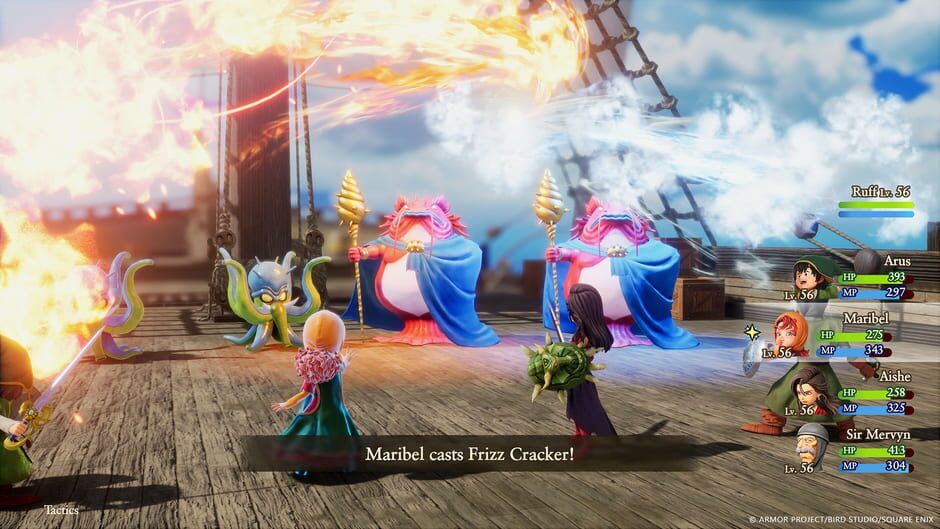
These are not just flavored stat presets. Starter vocations come with exclusive low‑tier skills that define how each character plays in the first stretch of the game. Screenshots of early battles show commands like Explorer’s Survey and Quickstep on the protagonist, alongside Kiefer’s heavy single‑target strikes and Maribel’s small but efficient spell list. You immediately get a sense of “this is my lane” before you ever see a job board.
The critical shift is timing. Ichikawa has openly acknowledged that the original’s three‑hour pre‑battle prologue is gone. Now you are fighting in under an hour, and you are already learning vocation‑tagged abilities from those starter roles. VII’s identity as the “job system entry” is present from the opening, but in a way that teaches through play instead of a big Alltrades info dump.
A Streamlined Ladder: Beginner, Intermediate, Advanced
Once the party reaches the vocation hub, the familiar tiered ladder from the original returns, but with far stricter curation.
Square Enix has confirmed there are 10 beginner vocations in Reimagined: classic Dragon Quest jobs like Warrior, Mage, Priest, Martial Artist, Thief and Sailor, as well as VII‑specific roles such as Jester and Shepherd. On PS1 these formed the base of a larger web where mastering certain pairs unlocked hybrid “advanced” classes. You could easily chart out dozens of paths with a wiki open on your lap.
Reimagined keeps that sense of growth but clips away redundancies. Hands‑on previews and system breakdowns repeatedly use the word “streamlined.” Beginner vocations are clearly marked as broad archetypes, with their stat modifiers and skill unlocks surfaced cleanly in the new UI. New screenshots of the vocation board show clean, radial layouts where each beginner job branches toward one or two obvious promotions instead of five opaque possibilities.
Intermediate and advanced vocations, including capstone roles like Hero and Druid, now unlock through explicit requirements that the game actually tracks for you. Instead of old VII’s hidden rank math and occasionally confusing class combinations, you see something closer to Dragon Quest XI’s skill panels in philosophy: clear goals, advertised payoffs.
Where PS1 VII trusted you to experiment and live with the consequences, Reimagined wants each promotion to feel like you are climbing a designed staircase. The result should be fewer “I wasted 10 hours in Monster Tamer and never used it” stories and more purposeful builds that feel distinct yet manageable.
Moonlighting: Dual Vocations And Hybrid Builds
The real wildcard is the new Moonlighting system. This is the mechanic that most clearly could not exist on PS1.
Moonlighting lets each character equip a secondary vocation alongside their main one. On the field and in battle, you can swap between the two, effectively giving everyone a dual‑class identity. The interface in recent screenshots shows a compact portrait stack on the bottom right, with each character’s main vocation icon large and a smaller badge denoting the moonlighting role.
This has huge implications for both balance and pacing:
In the original, creating a hybrid like a Gladiator required you to fully master multiple basic vocations, then commit to the advanced class. That often meant long stretches of dull grinding in easy fights, especially if you switched people into squishy jobs late. Here, a character can level a sturdy main vocation while moonlighting as something experimental. You might keep Kiefer as a Swordsman for survivability while moonlighting Mage to pick up elemental coverage, switching in battle when it is safe.
Previewers describe this as a way to “try before you fully commit,” and Ichikawa’s interviews back that up. The team wanted players to feel freedom without being punished by hours of inefficient leveling. Mechanically, it likely halves the friction of pursuing hybrids, which in turn encourages you to actually engage with the full breadth of the system instead of parking everyone in two or three comfortable roles.
Moonlighting also subtly replaces some of the old hybrid‑class fantasy. While there are still defined intermediate and advanced vocations, dual‑classing means you can build your own combos instead of chasing specific recipes. A Hero / Druid moonlight pairing could approximate an old Archmage‑style toolkit, while a Thief / Martial Artist can create a crit‑heavy striker without needing a dedicated “Bandit King” title.
It is a more flexible, modern reading of what VII’s vocation web was trying to do.
Monster Hearts, Vicious Monsters And The Future Of Monster Jobs
On PS1 and 3DS, monster vocations were one of VII’s coolest but most opaque systems. Monster Hearts dropped from specific enemies at low rates. Equip them at Alltrades and you could turn human characters into monster classes like Slime, Golem or Demon, inheriting monster skills and stat quirks. It was powerful, but drop rates and requirements were punishing without a guide.
Reimagined slices that system apart and rebuilds it.
The first pillar is the new “vicious monsters” roaming the world. These tougher optional enemies are accessed through stone tablets that act almost like mini hunts. Screens show them marked clearly on the map with red icons, and their models bathed in a distinct aura. Beat them and you earn monster Hearts that are immediately flagged as accessories.
Those Hearts no longer force a full monster vocation switch by default. Instead they can be slotted into a dedicated accessory slot, granting stat boosts, resistances and sometimes unique combat effects. One preview describes Hearts that add a chance to inflict status ailments, while another notes a Slime Heart that gently regenerates HP after each turn.
That alone fixes one of the old system’s biggest pain points: you get monster flavor without nuking your build. A Kiefer who has spent hours as a Warrior and Swordmaster no longer has to become a squishy Slime just to access a regen skill. He can stay in his lane and socket a Heart.
So what about full monster jobs? Square Enix’s wording and the Eurogamer interview hint that they still exist, but they are treated as more deliberate, late‑game pursuits. Earning enough proficiency with Hearts or fulfilling certain side objectives appears to unlock monster‑aligned vocations on the main ladder. Screens of the vocation board show monster silhouettes in their own branch, separated from the human job line.
This essentially elevates monster vocations from obscure side content to a capped bonus track: easier to preview through Hearts, harder to fully unlock, and less likely to accidentally break the difficulty curve for players who ignore them.
How The New System Rewrites Pacing
Ichikawa has been unusually candid about VII’s pacing problems.
He calls the original structure “legendary, but exhausting,” and describes Reimagined as taking a scalpel to that structure rather than a hammer. You can see that approach in how vocations and story progression now speak to each other.
The early game is the most explicit fix. On PS1 it could take several hours to reach Alltrades Abbey, and in that time you were effectively playing a classless Dragon Quest with no real sense of the game’s true identity. Reimagined pushes battles forward into the opening hour and uses starter vocations to drip‑feed the job system from the beginning.
Ichikawa has talked about wanting every “chapter” island to have a “hook,” and the vocation system seems to be one of the major hooks. Preview code already shows islands where specific beginner vocations gain rank faster or where intermediate promotions are temporarily discounted to encourage experimentation. Side dungeons written for Reimagined lean into this by featuring enemies and layouts that clearly favor certain class setups.
By building around Moonlighting and a more honest difficulty curve, the team can compress the time you spend grinding and expand the time you spend solving tactical puzzles. Instead of circling the field outside a town to hit the next rank threshold for a hybrid unlock, you are nudged toward a vicious monster hunt that both challenges your current build and rewards it with a new Heart.
Dungeons Cut, Folded And Reframed Around Roles
Eurogamer’s interview and multiple preview outlets all latch onto a key phrase from Ichikawa: they did not want to “add more to VII,” they wanted to “cut and shape” it.
That mentality is visible in Reimagined’s dungeon design. Many of VII’s original labyrinths were notorious for repetition and length. The team has not been shy about shortening or fusing these spaces.
Screenshots of familiar locales show fewer dead‑end corridors and more set‑piece rooms. A multi‑floor ruin that used to be a winding staircase of samey fights now highlights a single large puzzle arena, with visible environmental gimmicks tied to specific skills. One image shows cracked pillars and heavy blocks that clearly want a physical bruiser to move them, hinting that certain class skills or buffs will make traversal challenges snappier.
The battle UI in these dungeons backs up the theory. Skill lists are short and punchy, often showing four to six moves per character that all do distinct jobs. In the PS1 version it was common to carry 20+ skills, many redundant, simply because hybrid classes spat them out. The new vocation progression prunes this bloat and lets encounter designers assume a smaller but more defined toolkit.
You can imagine how this plays out in practice. A cave island tuned around beginner vocations might expect the hero’s Explorer tools for field scanning, Kiefer’s physical burst, and Maribel’s early healing, then lean on Moonlighting to give you an elemental toggle or emergency revive without forcing a full party respec.
In that sense, dungeons are no longer just “places where you fight until you level up.” They are pacing beats designed around what vocations you likely have at that point and what the Moonlighting system enables you to do.
Story Flow As A Job‑Driven Arc
Dragon Quest VII’s original narrative cadence was almost anthology‑like. You hopped from island to island in time, solving self‑contained tragedies, and your power spikes came in messy, job‑system clumps. You might arrive on a new island halfway through mastering a hybrid class, which made its balance feel all over the place.
Ichikawa’s “masterpiece cut” framing suggests a more deliberate pairing between story arcs and vocation milestones.
Interviews hint that some islands have shifted order or had their connective tissue reworked so that major emotional beats line up with clear role upgrades. A town’s salvation might now coincide with a character’s promotion into an intermediate vocation that reflects their growth in the story. The starter vocations help here: the hero as Explorer growing into a world‑saving Hero reads much more cleanly when the system tracks that ascent in a straight line.
The team has also talked about making the cast feel less interchangeable. In the PS1 and 3DS versions, late‑game VII often devolved into optimizing stat spreads and passive bonuses, with characters blurring together behind the same handful of top‑tier jobs. Reimagined’s starter vocations, curated ladder and Moonlighting dual roles give each party member a strong “primary identity” that the story can lean on.
If Maribel is introduced and written as a sharp‑tongued support mage whose starter vocation emphasizes buffing and debuffing, then her sidequests and dialogue can point you toward hybrid builds and Hearts that amplify that niche. Story and systems start reinforcing one another instead of existing in parallel.
The Shape Of A “Masterpiece Version”
It is tempting to read “masterpiece version” as marketing bluster, but in this case the design through‑line is visible.
Starter vocations root each character in a role from the first battle instead of after a three‑hour prologue. The beginner‑to‑advanced ladder is slimmer but more guided, giving you a sense that every promotion has weight. Moonlighting finally frees VII’s hybrid dream from the grind that originally constrained it, letting you play with overlapping identities instead of chasing a perfect job chart.
Monster Hearts and vicious monsters reclaim one of the PS1 game’s most fascinating side systems and turn it into a visible progression track rather than a secret for guide readers only. Dungeons are cut down and refocused so that your evolving toolkit matters in moment‑to‑moment play, and the story appears to bend around vocation milestones instead of fighting them.
The question, as always with a bold rework, is how much of that original messy charm survives the surgery. Some fans will miss wandering Alltrades with 20 jobs unlocked and no idea where to go. Others will welcome a version of VII that understands its own strengths and pushes you into them faster.
What is clear from the systems we have seen is that Dragon Quest VII Reimagined is not just polishing an old gem. It is cutting it into a new shape, with vocations at the center of every facet.