
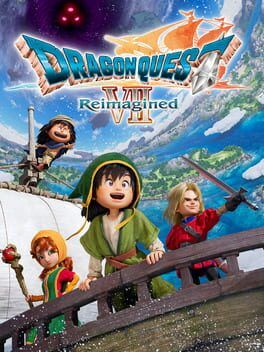

Breaking down the Hero, Kiefer, and Maribel character trailers for Dragon Quest VII Reimagined and how this lavish remake modernizes a famously sprawling PS1/3DS JRPG for today’s platforms and players.
Dragon Quest VII has always been the odd one out. On PS1 it was a dense, often glacial behemoth built on chunky polygons and walls of text. The 3DS version smoothed some edges, but it still felt like a throwback even in 2016. Dragon Quest VII Reimagined, arriving February 5, 2026 on Switch, Switch 2, PS5, Xbox Series X and PC, is Square Enix’s second attempt to bring this sprawling time-hopping story in line with modern expectations.
With a diorama-like visual overhaul, streamlined combat systems, and now a run of character trailers for the Hero, Kiefer, and Maribel, it is finally clear how far this remake goes beyond an upscale. It is closer to Dragon Quest III HD-2D in intent than the 3DS port in scope, rethinking presentation, pacing, and how each party member reads on screen.
A new visual identity built for modern hardware
The most striking change is the art direction. Rather than strict pixel art or glossy Unreal-style rendering, Reimagined leans into a handcrafted doll aesthetic that taps directly into Akira Toriyama’s clean lines and bold silhouettes. Square Enix and HexaDrive are literally scanning physical figure-like models of characters and monsters, then compositing them into a richly lit, tilt-shifted world.
The result, glimpsed in every character trailer, is a tabletop diorama look that scales gracefully from handheld to 4K. Towns like Fishbel feel like miniature sets with shallow depth of field and soft environmental lighting. Fields have the same toybox charm as Dragon Quest XI’s more painterly world, but the characters pop with their sculpted edges and distinct materials. Cloth, hair, and armor all catch the light differently, yet the overall style still reads as classic Dragon Quest at a glance.
For a game that always lived and died on atmosphere and the slow pleasure of watching restored islands come back to life, this shift matters. The remake’s presentation is deliberately cozy, built to make extended sessions of chatting to NPCs, combing through towns, and revisiting old locations feel inviting on modern displays.
Combat that sells identity as much as numbers
Reimagined keeps turn-based battles, but the camera work and animation give each action a stronger sense of character. UI cleanup and snappier transitions bring it closer to Dragon Quest XI’s pacing, while still respecting the deliberate rhythm fans expect.
In the character trailers, attacks are more expressive than in the 3DS version. The camera cuts in tighter for big skills, spins slightly to track movement, and exaggerates hit impact with sharper effects and concise hitstop. There is no attempt to turn Dragon Quest into an action RPG, but every swing, spell, and flourish sells who is doing it.
That focus on personality is key to why a slower RPG might land better in 2026. Modern players are used to turn-based games that lean hard on animation and staging to make repeated actions feel satisfying. Reimagined adopts those lessons without sacrificing the series’ clean readability.
The Hero: a quiet lead with more cinematic framing
The Hero’s trailer opens with scenes around Fishbel, the small fishing village that serves as both hometown and springboard for the entire story. On PS1 and 3DS, these early hours were infamous for being slow and visually plain. Here, the camera sits lower to the ground, following the Hero as he runs through curved streets, past layered props and busy NPC clusters.
The Hero’s model is faithful to the original design, but the doll-like rendering gives his big eyes and soft features more presence. In battle slices, he fights alongside Kiefer, Maribel, and Ruff with clean sword swings and basic skills that feel weightier thanks to tighter angles and subtle camera shake. Even default attacks look ready for repeated viewing.
What stands out most is tone. The Hero is still the quiet, grounded center of the cast, but the trailer’s framing leans on him as an observer of strange events rather than a blank slate. Shots linger on him watching Kiefer argue with his father, or reacting to Maribel’s teasing. It is a small shift, but it sets expectations that Reimagined wants the party dynamic and the story’s emotional beats to read more clearly, not just the mechanics.
Kiefer: physicality, bravado, and a bigger narrative footprint
Kiefer’s character trailer paints him as the energetic counterpoint to the Hero’s calm. It begins in Estard Castle just after a conversation with his father, the king, then cuts to him literally running off with the Hero. Where the Hero’s movement is measured, Kiefer’s idle stances and sprint animations are broad and loose, selling his restless personality.
There is a strong maritime focus too. We see Kiefer taking the role of boat captain as he, the Hero, and Maribel set off across the sea. The way he plants his feet, leans into the helm, and gestures while shouting to his companions gives these scenes a more cinematic feel than the static camera angles of older versions.
In battle, Kiefer is pure aggression. His attack animations push him forward with big arcs and lunges, often stepping past the front of the formation as if he is too eager to stay lined up. Skills emphasize heavy, two-handed motions and wide slashes that visually distinguish him from the Hero’s more disciplined strikes.
The remake is also adding a sizable new storyline centered on an older, battle-hardened Kiefer. Later trailers and hands-on previews show the party encountering an imprisoned man in the future who recognizes them, confirming that Kiefer’s sacrifice in the original now feeds into playable content and new dungeons. That decision is controversial among purists, but it makes Kiefer the emotional spine of Reimagined and gives the remake a tangible way to surprise returning players.
Maribel: sharper personality and flashier spellcraft
Maribel’s trailer is all about contrast. Visually, her model strikes a balance between cute and prickly, with expressive brows and hair that catches the light as she turns. Dialogue snippets show her trading barbs with both the Hero and Kiefer, delivering the kind of cutting lines fans remember, but now backed by full voice acting and more animated facial expressions.
Where Kiefer’s battle presence is about force, Maribel’s is about flair. Her trailer leans into magic-based attacks and support skills. Casting animations are longer than basic attacks but more theatrical, with snug camera framing, swirling particle effects, and brighter color palettes. Spells read almost like miniature set pieces in the diorama scenery, reinforcing the idea that she is the party’s specialist rather than another generic attacker.
The way Maribel moves between exploration and battle sells her as the third pillar of the core trio. In towns she folds her arms, leans into conversations, and visibly reacts to absurdities, making it feel like she is carrying half of the party’s banter. That pays off in a game built around visiting dozens of isolated time-lost islands, where your attachment to the party is what ties a fragmented narrative together.
A sprawling structure rethought for modern players
Dragon Quest VII was famous for how long it took to truly start, and for how its story splintered into dozens of vignette-like arcs across the past and present. Reimagined is not discarding that identity, but Square Enix has already talked about key modernizations.
Stone tablet fragment collection is streamlined, with clearer guidance and UI aids, cutting down on aimless wandering. The vocation system returns, but with tweaks to progression and skill distribution that reduce grinding and make experimentation less punishing. Early impressions from hands-on previews suggest encounter pacing is closer to Dragon Quest XI, with battles that resolve faster and ask less of the player’s time moment-to-moment.
Combined with the new visual style and a much stronger focus on character-specific content like the adult Kiefer arc, this could reshape how the game feels without changing its core premise. It is still a long, slow build, but now the path between big payoffs is paved with more immediate delights: punchy animations, elevated banter, and smarter progression.
Why a slow, long-form JRPG might click in 2026
The JRPG landscape in 2026 is markedly different from 2000 or even 2016. Turn-based series have reinvented themselves with bold aesthetics and snappier pacing. Games like Octopath Traveler, Persona 5 and Like a Dragon have taught a new generation of players that extended playtimes are fine when character writing, visual flair, and quality-of-life systems respect their time.
In that context, Dragon Quest VII’s strengths feel less like relics and more like a niche that has been waiting for the right packaging. Its island-by-island structure is perfect for portable play on Switch and Switch 2, breaking the adventure into satisfying session-sized stories. On PS5, Xbox Series X and PC, the diorama visuals and richer soundscape finally give the game the audiovisual weight its script has always deserved.
There is also a growing appetite for earnest, hopeful fantasy. Dragon Quest VII’s emphasis on restoring cursed worlds, healing broken communities, and seeing tangible change across time makes it uniquely uplifting compared to darker, twist-heavy RPGs. With better animation, voice work, and directed cutscenes, those emotional payoffs should be easier for new players to connect with.
A second chance at a misunderstood classic
The Hero, Kiefer, and Maribel character trailers are not just marketing snippets. They are proof that Dragon Quest VII Reimagined is taking a character-first approach to updating one of the series’ most divisive entries.
By tying a lush visual overhaul to smarter pacing, stronger characterization, and new story content that builds on one of the original’s most memorable twists, Square Enix is positioning Reimagined as more than a nostalgia exercise. If the full game can keep marrying that handcrafted charm with modern convenience, Dragon Quest VII may finally step out of its cult-classic shadow and stand alongside Dragon Quest XI as a modern favorite.
For players who bounced off the PS1 or 3DS versions, 2026 might be the moment to board Kiefer’s ship one more time and give Eden’s fragmented world a fresh chance.