
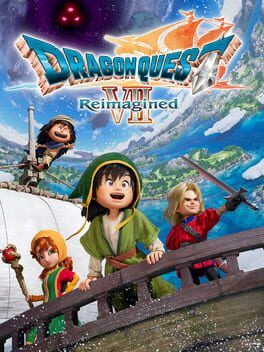

A launch-focused breakdown of Dragon Quest VII Reimagined, covering what’s been cut, reworked, and overhauled from the PS1 and 3DS versions, how the diorama art changes exploration, and why this is the most approachable way to experience one of the series’ biggest adventures.
Dragon Quest VII has always been the massive, slightly intimidating black sheep of the series. The PlayStation original was sprawling and slow to start. The 3DS remake fixed a lot, but it was still a dense, sometimes unwieldy RPG. Dragon Quest VII Reimagined goes further, refitting that gigantic adventure into something that respects your time without losing its soul.
This is not a simple visual upgrade. At launch, Reimagined arrives as a structural overhaul that touches everything from how you move through time, to how the job system ramps up, to how dungeons are laid out and surfaced to the player. It is still the same island-hopping time travel epic, but the way you reach its best moments is very different.
A Faster, Clearer Opening
The PS1 original was infamous for its hours-long prelude before a single real battle. Even the 3DS version, which reduced that slog, took its time before the adventure properly opened up. Reimagined finally treats the opening as a modern onboarding sequence instead of a test of patience.
The early-game exploration on Estard is now heavily streamlined. Critical path objectives are more clearly signposted, traversal routes are cleaner, and downtime between story beats is cut down. You still get that slow-burn sense of starting as a nobody in a sleepy fishing village, but the game now starts feeding you combat, dungeon exploration and time travel hooks far earlier.
NPC guidance is also smarter. Key dialogue is better highlighted, hints repeat more clearly if you get lost, and map markers nudge you toward the next story flag without handing you a GPS-style line to follow. It is still Dragon Quest, so you have to pay some attention, yet it no longer feels like you can lose an hour just because you missed one villager in a side room.
Tablets, Time Travel, And A Cleaner Loop
Dragon Quest VII’s core structure revolves around finding stone fragments, rebuilding tablets, and jumping to past versions of lost islands to fix their problems. That loop is intact, but it is much tighter and more focused.
Fragment hunting has been one of the most aggressively streamlined parts of Reimagined. In the PS1 and 3DS versions, tablet shards could feel like busywork scattered across dungeons, fields and towns, sometimes hidden in obscure corners. Now their placement tends to align with natural story and dungeon progression. When you clear a key area or complete an episode, you are much more likely to walk away with the fragments you need without being forced into a scavenger hunt.
The interface around tablets is also more transparent. The altar hub surfaces which tablets are close to completion, how many pieces are missing, and where your next most likely fragment is found. That does not turn the game into a checklist, but it does reduce backtracking and random guesswork. The time travel flow becomes a rhythm you can understand, not a puzzle you constantly fight.
Each island story still functions as its own miniature chapter, with its past and present versions forming a self-contained arc. Reimagined keeps that anthology-like structure, but cuts some of the repetition inside those arcs. Conversations are tighter, travel routes are more direct, and dungeons that once felt padded with extra rooms now resolve more quickly. The result is that hopping to a new island feels like starting a fresh, punchy side story rather than committing to several nights of slow burn.
Diorama Worlds And What They Change About Exploration
The new visual pitch for Dragon Quest VII Reimagined is its diorama-like presentation. Characters and monsters are based on real physical doll figures that have been scanned and lit inside miniature-style environments. That artistic choice does more than give the game charm. It changes how you read and explore spaces.
Areas are built like compact diorama stages where layers of depth are easy to parse at a glance. Instead of the flatter, tile-based impression of the PS1 game or the more traditional chibi 3D of the 3DS remake, Reimagined uses its toy-like sets to make navigation intuitive. Foreground elements, stairways and side paths pop visually, which subtly directs you toward interactive objects and side routes.
Camera angles are more deliberate too. Towns and dungeons often frame entrances, treasure paths and key NPCs in a theatrical way, as if you are looking into a physical play set. That staging makes it harder to walk straight past important doors or loot because the layout invites you to scan every layer of the miniature.
On the world map and in field areas, the diorama approach keeps zones relatively compact while still feeling detailed. Elevation changes, water edges and cliffs are all exaggerated just enough to serve as visual boundaries, which reduces moments where you wrestle with pathfinding. It is still an RPG built around wandering, but exploration friction is lower than ever.
The diorama art also helps with the game’s heavy use of revisiting locations across time. Seeing the same island staged as slightly different dioramas in past and present makes it easier to notice what has changed. When a town that was half-ruined in the past is shown as a cozy, completed set in the present, the contrast is immediate and readable without lengthy exposition.
Battles That Get To The Point
Combat in Dragon Quest VII Reimagined aims to preserve the classic turn-based feel while cutting down on grind and downtime. Both PS1 and 3DS versions were notorious for asking you to chew through a lot of battles to get jobs and skills where you wanted them. Reimagined addresses this from multiple angles.
Encounter pacing benefits from quicker animations and snappier transitions in and out of battle. The toy-figure models help here too, as attacks and spell effects are expressive without needing long, drawn-out sequences. The flow from field to battle and back again feels closer to modern RPG expectations.
Experience and job progression have been tuned to reach key class abilities faster. You still have to commit to vocations and grind to unlock their full move sets, but the number of fights needed to see meaningful growth is reduced compared to past releases. This makes experimentation with different party builds less punishing and encourages swapping jobs more freely.
Quality-of-life tools surround that system. The interface surfaces what new skills you are working toward, which vocations synergize with each character’s strengths, and how close you are to unlocking advanced jobs. That clarity was not present in the PS1 original and was only partially addressed on 3DS.
Cuts, Reworks, And Overhauls
Dragon Quest VII Reimagined is careful about what it trims. The core narrative arcs, cast, and overall length remain substantial, but the developers have targeted bloat and friction points rather than entire storylines.
Side content that boiled down to extra steps between points A and B has largely been compressed. Some multi-part errands now resolve across fewer trips back and forth between towns. Optional detours still exist, but they run parallel to the main route more often, so you are not forced to break pacing to chase them down.
Dungeon layouts have seen some of the most obvious rework. Mazes with multiple near-identical floors have been restructured into more distinct sequences where each level has a clearer gimmick or visual hook. Dead-end corridors exist less to waste your time and more to hide a treasure or secret. That change keeps the feeling of exploring real spaces without the fatigue of constant wrong turns.
Interface and system overhauls pull together features that were once scattered across submenus. Item management, skill selection and formation tweaks are presented in cleaner screens, cutting down on the button presses between thinking about a strategy and executing it. That alone makes longer play sessions easier, especially in the back half of the game.
One of the most significant invisible cuts is time spent not knowing where to go next. Improved hinting, better use of the world map, and clear surfacing of tablet progress all attack the original’s habit of leaving you directionless for long stretches. Veterans will still recognize the scenarios, but they will spend more time playing them and less time wandering around trying to trigger the next flag.
Making A Massive RPG Approachable
Despite all these changes, Dragon Quest VII Reimagined still embraces being one of the biggest entries in the series. The number of islands, characters and time-spanning vignettes has not been drastically reduced. What has changed is how the game respects your learning curve and your schedule.
The onboarding is gentler without flattening the challenge. Systems like vocations, tablets and party builds are introduced with clearer tutorials, in-game explanations and UI support so players who have only experienced modern, streamlined JRPGs are not overwhelmed. Optional help layers let you surface more explicit hints if you want them, or lean on traditional exploration if you prefer to figure things out alone.
The ability to carry demo progress into the full game further plays into that accessibility. You can test drive the early chapters, learn the rhythm of tablet-based progression, and settle into your preferred difficulty and pacing before committing to the full journey. Configurable options for text speed, combat flow and camera help fine-tune the experience to your comfort level.
Even seasoned fans who have cleared the PS1 or 3DS editions stand to gain from this new structure. Reimagined trims the parts that made replays feel like a slog and replaces them with faster access to favorite scenarios and class setups. Combined with the new audiovisual presentation, it makes returning to this world feel less like revisiting an old obligation and more like unpacking a carefully curated collector’s diorama.
The Definitive Way To Travel Through Time
Dragon Quest VII Reimagined launches as more than a visual facelift. Its diorama worlds reshape how you read and move through spaces. Its structural cuts and reworks remove much of the friction that once made this entry tough to recommend to newcomers. And its rebalanced systems make character building and time travel progression feel deliberate instead of drawn out.
For players who bounced off the original opening, who never finished the 3DS run, or who have always heard that VII is the "huge one" you need to set aside a month to tackle, Reimagined is positioned as the most approachable route in. It finally lets the richness of its time-hopping episodes and its heartfelt character arcs speak first, while the grind and guesswork fade into the background where they belong.