

How the doll-like art, reworked vocations, and structural cuts turn Dragon Quest VII Reimagined into a modern epic without losing its old soul.
Dragon Quest VII has always been the strange giant of the series, a slow-burn, 100-plus-hour epic that drops a tiny fishing village onto a broken world and asks you to patiently stitch history back together. With Dragon Quest VII Reimagined, Square Enix is not just bumping the resolution or layering on HD-2D. It is pulling the game apart at the seams and rebuilding it around a new visual thesis, a new take on vocations, and a radically tighter structure.
This is not a simple remaster of the PS1 original or a light-touch follow-up to the 3DS remake. It is a response to two and a half decades of feedback about a beloved but exhausting RPG, and it all starts with how the game looks.
The “doll-like” diorama: Toriyama through a toy box
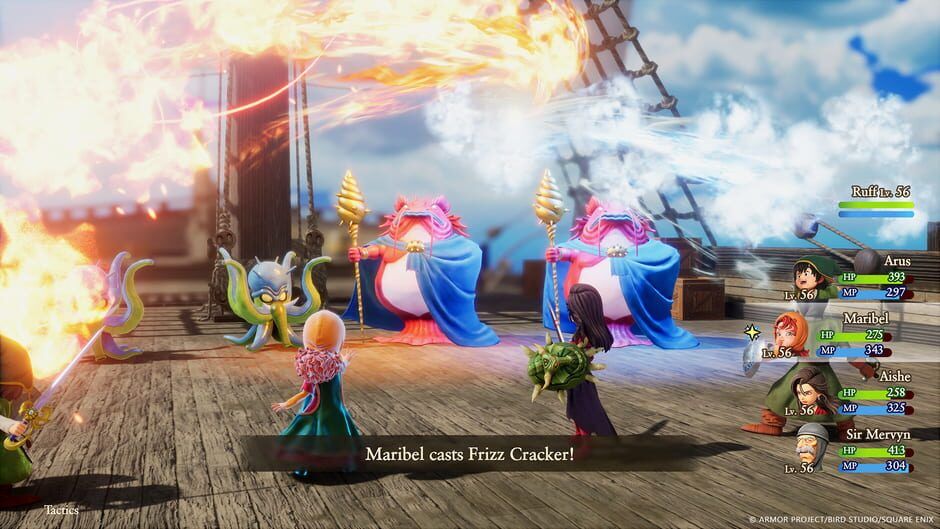
Instead of the now-familiar HD-2D look from Octopath Traveler and Dragon Quest III HD-2D, Reimagined’s team settled on what producer Takeshi Ichikawa calls a "doll-like" and "hand-crafted" style. Characters are built like miniatures, with soft proportions and painted detail, while towns and dungeons are arranged as if they were physical table-top sets.
The key creative choice was to align the visuals with Akira Toriyama’s original designs for Dragon Quest VII. Compared with other mainline entries, VII’s cast has more exaggerated silhouettes and storybook energy: the floppy hat and poncho of the hero, Maribel’s puffed sleeves and braids, Kiefer’s loose, princely swagger. In screenshots, the new models look less like typical JRPG mannequins and more like physically sculpted dolls, then scanned into the game.
That tactile quality is echoed in the environments. Villages stack crooked houses and tiny fences like a model train town. Cliffs and ruins have chunky, almost claylike edges. The team describes the world as a diorama, and that shows up in the camera work too. Rather than the free camera and relatively tight framing of the 3DS remake, Reimagined swings back toward a more readable, elevated view, closer to the PS1 original. From that vantage point, towns really do look like miniature sets on a table, with party members posed like figurines.
The result hits a specific sweet spot. It honors Toriyama’s line work, keeps the charm-forward identity that defines Dragon Quest, and importantly, reads clearly on a portable screen. But it also helps sell the tone of VII itself. This has always been one of the darkest Dragon Quest stories, all plagues, lost civilizations, and moral failure. By filtering that through a toy box aesthetic, Reimagined leans into contrast: you are moving dolls through dioramas to replay tragedies and try to fix them. That idea that history is something you can pick up, examine, and rearrange is now literally embedded in how the game looks.
Hand-crafted staging and fully voiced drama
The visual reset would not land as well without a parallel rethink of presentation. Where both PS1 and 3DS versions were completely text-only, Reimagined fully voices the main story in English and Japanese. The localization has been rewritten around spoken delivery, with stronger regional dialects and timing that make recurring NPCs feel more grounded.
That matters in Dragon Quest VII more than most. Its structure is a series of short stories, each focused on a single island’s past and future, so almost every few hours you are meeting an entirely new cast of townsfolk and villains. In the older versions many of those arcs blurred together. With voiced performances layered over the doll-like staging, characters like the doomed villagers of El Ciclo’s replacement scenario or the proud knights of new past-era episodes have sharper silhouettes in your memory.
Cameras lean into the diorama concept with deliberate framing. Conversations often play out with the party and key NPCs treated like figures posed in a box, the background slightly out of focus, the floor and walls arranged like set pieces. Battles keep a familiar Dragon Quest look, but enemy groups now pop against soft-focus backdrops that feel like painted boards behind a row of miniatures.
It is not aiming for realism. It is aiming for a specific kind of tactility, the feeling that if you reached into the screen you could physically pick up the hero and move him to another square on the board. For a game built around arranging stone fragments on a pedestal to unlock new lands, that matters.
Rebuilding a giant: structure and pacing
Where the PS1 original was notorious for taking three or four hours to let you fight anything, and the 3DS remake trimmed that to roughly an hour, Reimagined cuts again. The fishing village introduction is still there, and you still sneak around the castle and discover the ruins under Estard, but it moves briskly. Key tablet fragments arrive faster, and Kiefer now brings along an important fragment and early reward to keep momentum.
That sense of urgency carries into the broader structure. The core identity of Dragon Quest VII remains intact: you use stone fragments to visit islands in the past, resolve some local catastrophe, then return to the present to see how history has changed. Each island is still its own short story, with its own cast, theme, and boss. What has changed is how much connective tissue and repetition sits between those peaks.
Some of the most meandering or tonally redundant arcs from the PS1 and 3DS versions have been cut entirely. Regions like El Ciclo, Grondal, and Providence do not appear in Reimagined, along with side systems like the Immigrant Town, Monster Meadows, the casino, and the Excellence Grading Organization. That is the most controversial part of the remake, because for long-time fans those areas were part of what made VII feel expansive and strange.
Square Enix’s argument is simple: for many players that content made the game feel bloated rather than rich. Trimming it brings the main story in line with modern expectations, turning what used to stretch well beyond 100 hours into something closer to 40 to 60 for a reasonably thorough run, or longer if you linger.
In exchange, Reimagined adds a smaller set of more focused episodes. There are new vignettes that explore the hero and Maribel’s childhood and a crucial new scenario set in the past-era Rucker region built around Kiefer’s fate. The latter is the structural lynchpin of the remake. In the original, Kiefer leaves the party early and never returns except in a letter. Here you eventually meet a battle-scarred older Kiefer, see the consequences of his choice, and even fight alongside him as an AI-controlled party member. Under certain conditions he can rejoin for the final act.
The island-by-island rhythm is still there. You still feel like a traveling historical repair crew, hopping between times and places, slowly piecing together the world map. But you spend less time wandering without direction. Fragment hunts are supported by map markers and reminder text. Sub-objectives are tracked more aggressively. You are nudged along instead of left to circle dungeons looking for the one tile you missed.
The cost of this approach is clear. Some beloved side distractions are gone, and purists will absolutely miss the maximalist, almost MMO-like density of the old VII. The upside is a version that respects your time in a way the original simply did not.
Vocations reimagined: Moonlighting and deliberate builds
For many players the real star of Dragon Quest VII was its vocation system. Alltrades Abbey unlocked a dizzying mix of basic jobs, advanced hybrids, and monster classes, each learned by grinding battle after battle on specific fields. The 3DS remake smoothed some of that out, but it was still a system that rewarded spreadsheets and enormous time investment.
Reimagined keeps the spirit of that system but focuses it through a new concept called Moonlighting. Instead of permanently learning and stockpiling abilities from every job you have ever touched, each character now equips two vocations at once. Those two define your skill list and combat role at any given time. When you change vocations, you are swapping out available tools rather than just adding more entries to an ever-growing spell list.
Mechanically, this does three things. First, it cuts way down on menu clutter. You no longer scroll past pages of outdated skills you picked up thirty hours ago. Second, it makes each build more legible. A Warrior plus Priest combination reads immediately as a paladin-style tank-healer, not as a random grab-bag of buffs. Third, it makes grinding more efficient, because both equipped vocations gain experience simultaneously.
That efficiency is reinforced by the new Career Sphere. Instead of trekking back to Alltrades Abbey every time you want to respec, you can change vocations anywhere from the menu. Dragon Quest XI players will recognize the philosophy: the depth is still there, but the friction is deliberately sanded down.
There is also the Let Loose system that rides on top of vocations. As characters act in battle they build toward a heightened state that unlocks a powerful vocation-specific move, from giant damage spikes to group-saving buffs. It introduces a layer of resource timing that VII never truly had before, encouraging you to line up Let Loose bursts for boss phases rather than simply spamming your best spell every turn.
One of the biggest cuts is the removal of full monster vocations. In the PS1 and 3DS games, Monster Hearts could turn characters into dedicated monster jobs, opening up dozens of additional classes. Reimagined zeroes in on human vocations instead. Monster Hearts now function as equippable accessories dropped by special "Vicious Monsters," granting passive bonuses and occasionally unique skills but not entire class trees. Monster Master still exists, leaning more toward commanding monsters rather than transforming into them.
It is a clear trade. There are fewer total paths on paper, but each path is faster to realize and better communicated. In practice you spend more time experimenting with interesting pairings and less time wondering whether you have to grind out yet another obscure monster class to be viable.
Combat and exploration: modern tools in a classic frame
Combat in Dragon Quest VII Reimagined is still classic turn-based Dragon Quest. You pick commands from menus, enemies line up opposite your party, and numbers fly. The modernization is mostly around pacing and control.
Encounters are now entirely visible on the field, as in the 3DS version, with a key twist: the hero can swing his sword in the overworld to instantly dispatch very weak enemies for reduced experience and gold. That keeps old areas from becoming a slog when you backtrack for fragments or side quests. When you do choose to fight, battle speed can be adjusted, and a more capable auto-battle system can handle routine fights with sensible tactics.
Difficulty settings let you tune enemy strength, gold and experience gain, and even enable auto-healing between battles. Those options are aimed squarely at modern players who might be curious about Dragon Quest’s roots but wary of grind. At the same time, mid-to-late-game bosses expect you to actually engage with Moonlighting synergies, buffs, and debuffs. You cannot coast on auto-battle through the entire story.
Exploration also benefits from small but crucial quality-of-life changes. Quest logs more clearly point you to the next island or key location without spoiling the story. Fragment pedestals are easier to parse visually, and the game is more generous about nudging you toward the missing piece you need. The diorama camera is not just aesthetic; it improves spatial clarity, making it easier to see which path actually leads somewhere important.
Taken together, these changes push the experience closer to Dragon Quest XI in feel, even though the underlying structure and mechanics are much closer to a late-90s JRPG.
Cutting and adding without losing the soul
All of this invites a blunt question: at what point does a reimagining stop being the same game? Dragon Quest VII Reimagined trims entire regions, compresses the runtime, removes whole subsystems, changes how vocations work, adds voice acting, and rebuilds the presentation around a new art style. Yet when you step back, the core loop and themes that defined VII are still there.
You still start as a nobody in a remote village. You still discover that your world is broken, most continents wiped from the map. You still travel into the past to fix some disaster, then return to a changed present. Each island is still its own fable about fear, greed, faith, and the way single choices echo across centuries. You still feel that gentle but persistent melancholy that made VII stand apart from its more straightforward siblings.
The doll-like visuals and voiced scenes emphasize that melancholy instead of undercutting it. Chibi villagers crying over a cursed relative are more affecting when you can hear their voices crack. A tiny knight figure vowing to defend a doomed kingdom lands harder when the diorama framing zooms in just enough that it looks like the whole world.
Square Enix seems comfortable that for a portion of the audience, the PS1 or 3DS versions will remain definitive. Reimagined is not an attempt to overwrite those games. It is an attempt to make Dragon Quest VII legible and inviting in 2026, on modern hardware, for players who do not have 120 spare hours and a tolerance for old-school cruft. That is why the changes are so aggressive. The developers are less curator and more dramatist, reshaping an existing script for a new stage and new actors.
A new entry point into a once-intimidating classic
Seen from a distance, Dragon Quest VII Reimagined looks like a contradiction. It takes a famously long, slow, maximalist RPG and packages it in a tiny, toy-like aesthetic. It cuts content but deepens certain character arcs. It simplifies vocations while teasing out more tactical nuance.
The bet Square Enix is making is that the heart of Dragon Quest VII is not its sheer volume of regions or the number of vocations on a wiki page. It is the feeling of pulling forgotten islands back onto the map, of standing in the ruins of a tragedy and trying to rewrite it, of seeing how people across time react to disaster and hope. That experience survives the cuts because the structure of island restoration survives, and the diorama staging arguably makes it clearer than ever.
For veterans, this is a chance to see a familiar story staged like a new play, with new actors and tighter direction. For newcomers who bounced off the PS1 original or never saw the 3DS cartridge in stores, it is finally a version of Dragon Quest VII that asks for commitment but not total surrender.
Dragon Quest VII has always been the odd one out, the series’ slow, strange epic. Dragon Quest VII Reimagined does not try to fix that. It just sculpts it into something you can hold in your hands, like a tiny, painted island in a glass case, and invites you to step inside.