
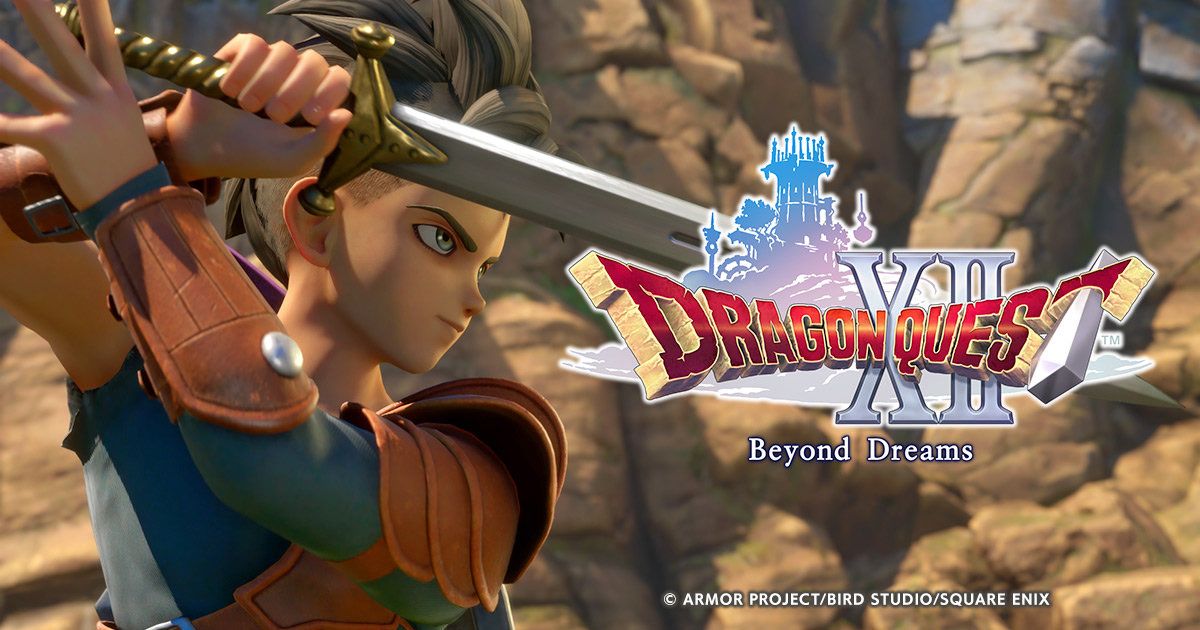

Square Enix has restarted Dragon Quest XII from scratch, rebranding it as Beyond Dreams. Here is what the troubled development, title change and tonal shift could mean for the future of the Dragon Quest franchise.
Dragon Quest XII was supposed to be the game that pulled the series into a darker, more mature future. What fans actually got at the Dragon Quest 40th anniversary stream was something far stranger: confirmation that Square Enix scrapped that original vision, rebooted the project under a new development structure, and is now building it again as Dragon Quest XII: Beyond Dreams.
In an industry where long delays and quiet retools are often hidden behind PR silence, Square Enix chose to say the quiet part out loud. The result is one of the most fascinating and uncertain chapters in Dragon Quest history.
From The Flames of Fate to Beyond Dreams
When Dragon Quest XII: The Flames of Fate was revealed in 2021, it came with a stark, minimalist logo and creator Yuji Horii openly talking about a darker game that would force players to make choices about their own lives. It felt like Dragon Quest’s answer to the modern prestige RPG, signaling a break from the bright optimism that has defined the series since the NES.
Fast forward to 2026 and that game, at least in its original form, no longer exists. Executive producer Yosuke Saito confirmed that Dragon Quest XII was restarted from scratch. The structure of the project changed, the subtitle was dropped, and the team effectively began again under the new name Beyond Dreams.
The new subtitle is not cosmetic. It reflects a complete tonal reorientation. Instead of fate, fire and moral crossroads, Beyond Dreams centers on a hero haunted by strange visions that bleed into reality, with Horii now describing the story as focused on a bright and exciting future. The language coming out of Square Enix suggests that the bleakness teased in 2021 has been dialed back in favor of something more hopeful and adventurous, even if the dream concept allows for surreal or unsettling imagery.
That pivot raises an obvious question: what went so wrong that a mainline Dragon Quest had to be rebooted mid‑development?
Why you restart a numbered Dragon Quest
A full restart on a flagship RPG is not a small move. Saito has framed the decision as a necessary correction so the game can appeal to a broader range of Dragon Quest fans. Read between the lines and several likely factors emerge.
First, the darker Flames of Fate pitch may have proven too difficult to reconcile with Dragon Quest’s identity. This is a series that leans on warmth, earnest heroes and a sense of cozy adventure even when the stakes go cosmic. Pushing too far into grim moral choice territory risks alienating the exact multi‑generational audience that keeps Dragon Quest thriving in Japan.
Second, structural and technical ambitions may have outgrown the team’s first attempt. Dragon Quest XI successfully modernized the series without discarding turn‑based combat, but XII was repeatedly teased as a bigger evolution. Square Enix has not given specifics, beyond promising things you have never seen in a DQ game before, yet that line alone hints at new systems that might have demanded fresh tech, new pipelines or even new leadership.
Finally, the reality of losing two pillars of the franchise cannot be ignored. Composer Koichi Sugiyama passed away in 2021 and character designer Akira Toriyama died in 2024, with Square Enix confirming that both had already completed their contributions to XII. That puts enormous pressure on the game to feel like a worthy sendoff to their work. If the original Flames of Fate build was not living up to that standard, a reboot becomes easier to justify internally.
Whatever combination of factors pushed the reset button, Square Enix is now being unusually transparent about how drastic the change really is.
What the reboot actually changes
The public details on Beyond Dreams are still thin, but aligning reports and official statements paints a clearer picture of what survived the reset and what did not.
On the story side, the focus has shifted from deterministic, heavy themes about fate toward the ambiguity of dreams and the promise of the future. The new protagonist is framed as a more universal stand‑in for the player, plagued by dreams that hint at a greater mystery. Dreams give Horii room to introduce unsettling scenarios without locking the entire game into a relentlessly dark tone.
Visually, Beyond Dreams keeps Toriyama’s unmistakable style, but early footage and promotional materials present a softer, more ethereal palette than the stark black logo of Flames of Fate. Where the old teaser leaned on stark typography and fire imagery, the new branding leans into clouds, sky and light. It is still recognizably Dragon Quest yet avoids the harshness some fans associated with the original reveal.
Mechanically, Saito and Horii continue to talk about evolution, not revolution. Dragon Quest XII is still pitched as a game that will feel like Dragon Quest, while also layering in systems that have never appeared in the series before. That likely means changes to how battles flow, how exploration is structured or how choices express themselves, without discarding core turn‑based DNA entirely. The reboot gives the team the chance to recalibrate those experiments in a way that fits the new tone.
Crucially, though, the reset also means time. There is no release window, no firm platform lineup beyond modern consoles and PC, and a clear warning from Saito that players will be waiting a bit longer. In practice, that likely pushes XII further into the late generation for current hardware and possibly into cross‑generation territory with whatever succeeds today’s systems.
A Dragon Quest caught between eras
Dragon Quest has always moved at its own pace. While Final Fantasy darts between genres and battle systems, Dragon Quest advances slowly and deliberately, layering new ideas over a consistent core. That consistency is part of why the series is so beloved in Japan and why a mainline entry can still feel like an event.
The troubled path of XII shows what happens when that careful approach collides with a rapidly changing market. Square Enix is under pressure to grow Dragon Quest globally, not just maintain its domestic dominance. That requires a bigger visual spectacle, more complex systems and narratives that can stand next to Western prestige RPGs on streaming clips and social media.
Flames of Fate looked like an attempt to leap into that space in one bold move. Beyond Dreams reads more like a compromise: ambitious enough to justify a new generation of hardware, but grounded enough in classic Dragon Quest texture that long‑time fans will not feel abandoned.
In that sense, the reboot is as much about brand management as it is about game design. Square Enix appears to have decided that a flawed or divisive Dragon Quest XII would hurt the franchise more than a delayed one.
What this means for the future of the series
The shift to Beyond Dreams has several implications for Dragon Quest going forward.
First, it demonstrates that even Dragon Quest is no longer immune to the big reset that has affected so many large‑scale RPGs. Final Fantasy XV, Metroid Prime 4 and countless other projects have gone through similar restructures, but Dragon Quest historically presented itself as a rock of stability. Admitting that XII had to be rebuilt signals that expectations for scope and polish have risen even for this conservative series.
Second, it suggests that future Dragon Quest games may be planned with more flexibility in mind. If the dream motif and the brighter tone are well received, you can easily imagine spin‑offs, cross‑media adaptations and mechanical follow‑ups that build on whatever XII introduces. If they are not, the series can more safely pivot again since Beyond Dreams, by its very concept, is about uncertainty and possibility rather than locked‑in destiny.
Third, there is the legacy question. With Toriyama and Sugiyama gone, Dragon Quest XII will shape how fans accept future artistic and musical directions for the series. If Beyond Dreams feels like a thoughtful culmination of their final work, it will give Square Enix more latitude to experiment with new composers and artists in Dragon Quest XIII and beyond. If it feels compromised, fans may cling harder to tradition and scrutinize every stylistic change.
Finally, the reboot underscores how central Dragon Quest remains to Square Enix’s identity, even as the publisher restructures and chases new business models. You do not restart a numbered Dragon Quest lightly. By choosing to do so, the company is implicitly stating that a merely okay Dragon Quest XII is not acceptable.
A risky bet wrapped in comforting slimes
For players on the outside, Beyond Dreams is going to look, at least on the surface, like more Dragon Quest. There will be smiling slimes, boisterous party banter, Toriyama silhouettes and a world that beckons you to chase optional quests for dozens of hours.
Underneath that familiarity, though, sits one of the riskiest bets the series has ever made. Rewriting a game mid‑development and asking fans to wait even longer is a gamble at the best of times. Doing it on the first mainline Dragon Quest to ship without its original core creative trio actively guiding it is something else entirely.
If Square Enix can thread the needle, Dragon Quest XII: Beyond Dreams could become the bridge that carries the series into its next era, fulfilling the promise of a brighter future while honoring the past. If not, the story of this reboot might end up being remembered as the moment Dragon Quest’s once unshakeable trajectory finally cracked.
For now, all we really know is that Dragon Quest XII as we first saw it is gone, and in its place is something both more familiar and more mysterious. The flames have gone out. What lies beyond the dreams will decide what Dragon Quest becomes next.