
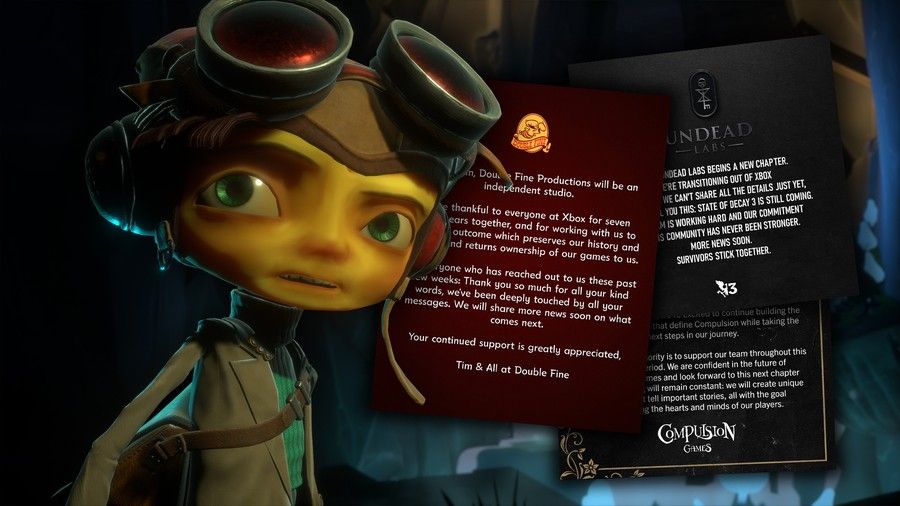

Double Fine has confirmed 23 layoffs shortly after leaving Xbox, with Tim Schafer saying survival drove the cuts as the Psychonauts studio adjusts to independence.
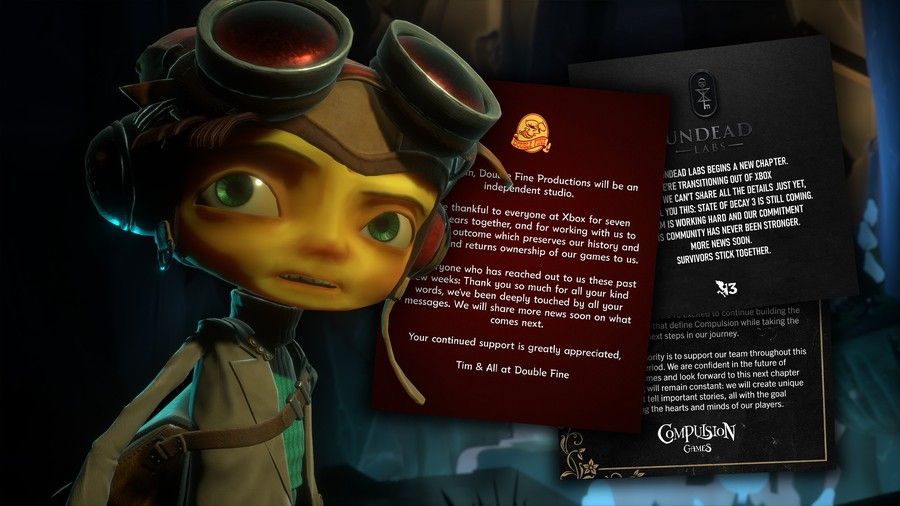
Image: purexbox.com
Double Fine confirms 23 layoffs as independence begins with cuts
Double Fine Productions has laid off 23 employees, a move studio head Tim Schafer directly tied to the Psychonauts studio’s return to independence after its separation from Xbox. In a statement posted by Double Fine on Bluesky and quoted by multiple outlets including Rock Paper Shotgun, Kotaku, Polygon, and Game Informer, Schafer said the studio had let go of 23 members of staff and framed the decision as a survival measure rather than a routine restructuring.
“As a small, tightly-knit team, these actions are not taken lightly,” Schafer said in the statement. “Only the survival of our studio would ever make us consider such a painful action. Our transition to becoming an independent company also means becoming a size that we can sustain.” He added that the affected employees “all made an impact on our games and culture” and said Double Fine is “committed to supporting each affected person as best we can.”
That is the confirmed center of the story: 23 jobs are gone, Double Fine says the cuts were necessary for sustainability, and the layoffs arrive almost immediately after Xbox divested the studio. The timing gives the news its harder edge. Double Fine avoided closure during Xbox’s broader shakeup, but its first public step back into independence is a significant reduction in staff.
The scale of the cuts depends on which headcount estimate you use
The 23 confirmed layoffs represent a major contraction for a studio of Double Fine’s size, though the exact percentage varies because public reporting differs slightly on the pre-layoff headcount. Rock Paper Shotgun cited Bloomberg’s Jason Schreier saying Double Fine had around 90 staffers before the cuts, which would make the layoffs roughly a quarter of the studio. Polygon also cited Schreier reporting around 90 employees. Neowin, citing a social post from Schreier, described the team as about 80 strong before the layoffs, which would put the impact closer to almost 30 percent.
The confirmed number is 23 affected employees. The percentage should be treated as an estimate, because Double Fine’s own statement did not provide a total headcount. In practical terms, either estimate describes a sharp downsizing for a studio that has long worked around creative experimentation, smaller teams, and unusual project shapes.
Some reporting also points to the personal cost behind the number. Rock Paper Shotgun noted that social media posts suggested some of the affected employees had been at Double Fine for double-digit years. That detail has not been itemized by the studio, but it matches the tone of Schafer’s statement, which emphasized lost cultural and creative contributions rather than presenting the layoffs as an abstract budget line.
Xbox says Double Fine now manages its own operations
The separation from Xbox is central to how Double Fine is explaining the cuts. Kotaku reported that an Xbox spokesperson said Double Fine “fully returned to independent management earlier this week, with their IP, catalog, and runway for their next games.” The spokesperson added that Xbox looks forward to seeing what the studio creates next. Rock Paper Shotgun quoted a similar Xbox statement and included the line that Double Fine “is now fully independent and manages its own operations.”
Kotaku also reported that Xbox declined to comment on how much runway Double Fine has. That unanswered detail matters because “runway” is the word doing heavy lifting here. Xbox says Double Fine left with runway for its next games, while Double Fine says its new independent status requires a team size it can sustain. Those statements do not directly conflict, but they leave a large gap for readers: runway may exist, yet the studio still says survival required immediate layoffs.
The known timeline adds to that tension. Game Informer reported that Double Fine was among five studios spun off from Xbox as part of ongoing restructuring and that the studio was granted independence earlier in July. PC Gamer framed the layoffs as arriving three weeks after Xbox cut Double Fine loose. Kotaku’s Xbox statement says the studio fully returned to independent management earlier in the same week as the layoffs. In other words, the separation was announced earlier in the month, but the operational handoff appears to have been very recent. The cuts landed right as the studio moved from being protected by a platform holder’s balance sheet to carrying its own operating weight.
A wider Xbox shakeup put several studios in motion at once
Double Fine’s layoffs are one part of a larger Xbox restructuring that has affected thousands of workers and multiple studios. Kotaku reported that the Xbox shakeup followed concerns over profitability inside Microsoft’s gaming division and years of expansion through studio acquisitions. Neowin described the reset as involving 3,200 layoffs across game development studios, major internal IP changes, and five first-party Xbox Game Studios being spun off as independent companies or sold. Game Informer described Xbox as parting ways with five studios amid more than 3,000 layoffs.
Across those reports, the studio map is clearer than the corporate math. Double Fine and South of Midnight developer Compulsion Games became independent, with both reported to have retained their intellectual property and game catalogs. Game Informer and ixbt.games reported that Ninja Theory and Undead Labs were sold to unspecified buyers. Arkane Studios’ future was described as uncertain, with Game Informer and ixbt.games noting a mandatory consultation process in France.
Polygon reported that Xbox’s new CEO, Asha Sharma, said of the broader move, “It is neither possible nor desirable to own every great independent studio.” That line reads differently now that Double Fine has announced layoffs so quickly after leaving Xbox. The platform-holder logic is that some studios may operate better outside Microsoft’s ownership. The studio-level reality, at least in Double Fine’s case, is that independence also means immediate exposure to payroll, project financing, and the cadence of finding or funding the next release.
Double Fine’s creative history makes the business pressure sharper
Double Fine was founded in 2000 by Tim Schafer and other former LucasArts developers, with Polygon and Kotaku both pointing to Psychonauts in 2005 as the release that established its identity. The studio’s reputation came from offbeat action-adventure design, oddball worlds, and projects that often felt built around a central creative dare. Brutal Legend, Stacking, Broken Age, Psychonauts 2, Keeper, and Kiln all sit in that lineage of games that do not behave like standard franchise machinery.
That history is also a history of funding pressure. Kotaku noted that Double Fine remained independent for years but frequently struggled to fund projects before Xbox acquired it in 2019. Under Xbox, the studio shipped Psychonauts 2 in 2021, Keeper in 2025, and Kiln earlier in 2026, according to Kotaku, Game Informer, ixbt.games, and Neowin. Polygon also noted that Psychonauts 2 received strong reviews and a Game of the Year nomination at The Game Awards.
From a player’s point of view, Double Fine’s games often work because they move with a different rhythm than big-budget action-adventure production. Psychonauts 2 uses platforming and psychic combat as a way into character psychology. Keeper, as described in the source coverage, continued the studio’s taste for atmospheric adventure. Kiln, reported by Game Informer as a pottery-themed multiplayer party game and by ixbt.games as a clay-shaping action game, is another eccentric swing. Those creative swings are part of the studio’s value, but they can be difficult to square with the cash-flow demands of independence, especially if a recent release fails to become a major commercial event.
Recent releases and unanswered questions around the next project
The sources do not establish a single commercial performance picture for Double Fine’s recent games, but they do show why sustainability is now the central question. Kotaku wrote that Keeper was “great but seemingly not very lucrative” and that Kiln was “very fun and clever” but “seemingly not very popular.” Polygon similarly wrote that Kiln “failed to make much of a splash.” Those are outlet assessments, not formal sales disclosures from Double Fine or Xbox. No source material provided unit sales, revenue, Game Pass performance, or budget figures.
Neowin reported that Double Fine has not revealed any future projects yet. Xbox’s statement to Kotaku says the studio left with runway for its next games, but Xbox declined to say how much runway. That leaves the biggest production question unanswered: whether Double Fine’s next phase is built around one main project, smaller experimental releases, external publishing deals, work-for-hire support, or some combination of those paths.
There is also no announcement in the provided sources of game cancellations, platform changes, delistings, pricing changes, or altered availability for Double Fine’s existing catalog. The practical read for players is narrow but important: the studio has retained its IP and catalog according to Xbox’s statement and multiple reports, but its staffing level and independent status have changed. Anyone waiting for the studio’s next game should expect the next public update to carry new significance, because it will show what Double Fine can build after losing both Xbox ownership and 23 colleagues.
The layoffs turn independence into a survival test
Double Fine’s split from Xbox could have been framed as a return to the studio’s old identity: independent, idiosyncratic, and free to define its own creative path. The confirmed layoffs complicate that picture. Independence is still real, according to Xbox and the studio’s own transition language, but it begins with a smaller team and an explicit warning from Schafer that survival drove the decision.
For a studio known for strange worlds and handcrafted set pieces, that is a brutal opening beat. Double Fine is not closing, and the source material says it retains its IP, catalog, and runway. At the same time, 23 people are gone from a team that public reporting places somewhere around 80 to 90 employees before the cuts. That is the cost Double Fine says it had to pay to become a size it can sustain.
The broader gaming industry layoffs 2026 story is still moving, and Double Fine now sits at one of its most visible pressure points: a beloved creative studio separated from a corporate parent during a sweeping Xbox reset, trying to preserve its future by cutting into the team that built its past. The next chapter will be judged by what the studio can actually make at its new scale, but the immediate story belongs to the people who will not be there to make it.