
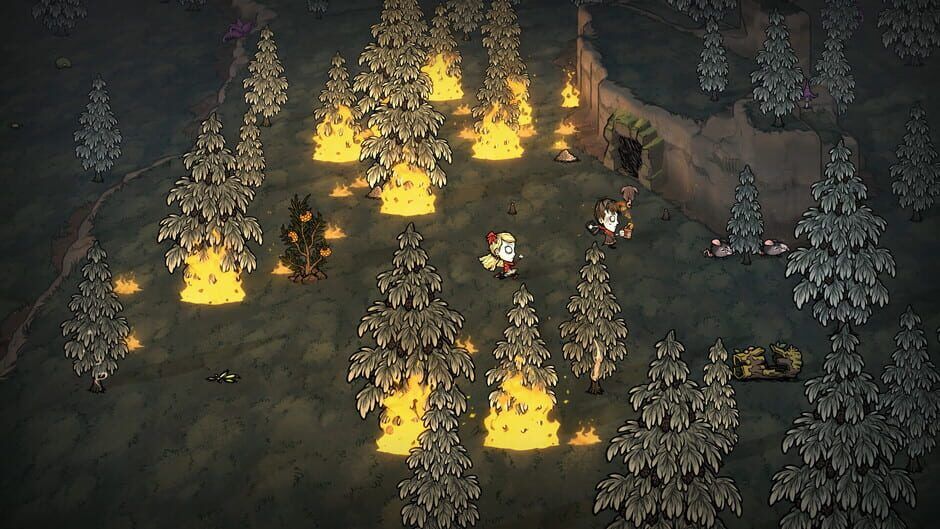

Klei’s next Don’t Starve game leans into co-op, magic, and a stranger new world. Here’s why it looks less like a side-step and more like a real evolution for the series.
Klei Entertainment is taking another crack at starving us to death, this time with a lot more company. Don’t Starve Elsewhere, revealed during the Triple-i Initiative showcase, is the studio’s next entry in its long-running survival series. On paper it sounds familiar: gather resources, build a base, keep the darkness at bay. But Elsewhere layers in full online co-op, a heavier focus on magic, and a brand new world that suggests this is not just another spin on the same loop, but a deliberate push toward a new phase for the franchise.
A new world beyond the Constant
Don’t Starve Elsewhere shifts the action to a fresh realm accessed through a portal, separating it from the Constant that has framed the series so far. The reveal trailer shows rolling hills, towering mushrooms, strange stone formations, and architecture that feels more overtly fantastical than the haunted wilderness of the original games. Eurogamer notes this new location comes with actual elevation and hills, something the series has never really toyed with before.
That shift matters because the geography of Don’t Starve has always dictated its tension. The original world was flat, fragmented, and hostile in a very utilitarian way. By contrast, Elsewhere’s world looks more like a bespoke fantasy setting, closer to a hand-crafted action RPG map than a purely systemic survival grid. If Klei leans into that, exploration could feel less like checking off biome boxes and more like peeling back layers of a strange, curated realm.
This change also gives Klei an excuse to redefine the rules. The Steam page and early coverage highlight dynamic environmental hazards and a mysterious fog that creeps across the landscape. Pushing into that fog can chip away at your sanity, a returning mechanic from earlier games, but now tied more visibly to an actual spatial threat. Instead of sanity being a mostly internal meter that responds to your actions, Elsewhere turns it into an external pressure you push against with each step into the unknown.
Co-op at the core, not an add-on
Don’t Starve Together proved that the formula works brilliantly in multiplayer, but it was still fundamentally the original game refitted for co-op. Elsewhere, by contrast, is built around playing with others from the start. The trailer shows up to four classic characters traveling together, fighting creatures in formation, and sharing space in a more compact, visually dense world.
That distinction is important. In Together, co-op often felt like parallel play. You shared resources and revived each other, but the world and its challenges were mostly tuned for a single survivor, with difficulty scaled outward. Elsewhere has the chance to treat the group as a single, multi-bodied entity. Enemies can have attacks that assume multiple targets. Environmental puzzles can expect several players to coordinate. Even base design could shift from personal camps stitched together across a map to communal hubs that feel necessary rather than convenient.
The official description frames the game as an uncompromising survival experience where you band together to craft, farm, build, and explore. That phrasing underlines the idea that co-op is not just a checkbox, but the default mindset. If Klei follows through, you can imagine encounter design that demands role separation within the group, such as dedicated frontliners, support-focused characters, or builders who stay at camp while others delve into the fog. It nudges Don’t Starve closer to a survival-tinged action RPG party dynamic without losing its systemic backbone.
Magic moves from flavor to foundation
Magic has always lurked in Don’t Starve, but largely as an exotic endgame tech line. You labored through primitive tools and alchemy engines before dabbling in the occult. Elsewhere appears to pull that thread to the surface. The announcement coverage consistently describes it as a roguelike survival RPG with a stronger fantasy and magic focus, and the trailer is thick with glowing sigils, enchanted structures, and spell-like abilities popping off in the midst of combat.
That tonal pivot is more than cosmetic. If magic becomes a core pillar of progression, it could reshape how early, mid, and late game feel. Instead of slowly trudging through stone and science before earning a few strange artifacts, players might be flirting with risky, sanity-draining powers much earlier. Tying that to the new fog mechanic raises the stakes. Venturing deeper into the unknown could grant access to new magical resources or spell tiers while constantly threatening to unravel your mind.
Mechanically, this is also where the roguelike RPG label starts to sound less like marketing and more like a meaningful signal. Magic is ripe for procedural variety, randomized modifiers, and build experimentation. One run might see your group leaning into fire-based area control while another leans on crowd control or defensive wards. If the survival loop is the skeleton, magic could be the new musculature that keeps each attempt feeling distinct beyond the usual resource and season shuffles.
Familiar faces, shifting roles
Fans will recognize returning survivors like Wilson, Wendy, Willow, and WX-78 in the Elsewhere footage. At a glance they look like they always have, sketched in that signature scratchy gothic style, but there are hints that their function might be more sharply defined in co-op.
In previous games, character choice mostly affected solo playstyles and a bit of group synergy in Together. Here, with magic and a heavier RPG tilt, there is room for more explicit roles. Imagine Wendy’s ghostly Abigail becoming a more support-focused tool for crowd control while Willow leans harder into fire-based offense. Wilson’s experiments could feed into crafting magical gadgets that keep the group intact in hostile zones. WX-78’s mechanical quirks might make them uniquely suited to environments or enemies that punish the living.
This is speculative for now, but it is exactly the kind of evolution that would justify the “Elsewhere” subtitle. Returning characters ground the game in the established universe, but tying them into a more structured co-op ecosystem would make them feel fresh, not just ported over.
Survival, reinterpreted rather than replaced
For all this talk of co-op and magic, Don’t Starve Elsewhere still looks like a Don’t Starve game at heart. The core loop remains about managing limited resources, building something that barely qualifies as safety, and accepting that death is an eventuality rather than a failure state. The Steam description emphasizes crafting, farming, base building, and braving the night against lurking horrors. Monsters still prowl just beyond your campfire’s reach, and sanity still whittles down as the world’s logic breaks around you.
The difference is where the emphasis lies. Previous entries treated survival as a mostly solitary battle against the environment, with other players slotted into that fight later. Elsewhere reframes survival as a shared burden. Instead of one player building a fortress for themselves, a small crew cobbles together a fragile village. Instead of one mind slowly unraveling, a group has to triage whose sanity and health get prioritized before the next push into the fog.
The new world and the stronger narrative framing of entering it through a portal also suggest a more directed sense of progression. Rather than simply lasting as many days as possible, you might be chasing deeper incursions, unlocking new regions of Elsewhere, or turning the act of survival into a series of structured expeditions that sit halfway between open-ended sandbox and roguelike run.
Does Elsewhere feel like a true next step?
So far, Don’t Starve Elsewhere reads less like a minor remix and more like a focused attempt to pull three big threads together: co-op as a design foundation, magic as a primary system, and a more characterful world. That combination pushes the series away from being purely about raw endurance and closer to something that resembles a survival-flavored fantasy RPG.
Where Don’t Starve Together cast a wide net by simply making the existing game social, Elsewhere looks poised to be narrower but deeper. Its new world gives Klei permission to bend the rules of the Constant without rewriting lore. The pivot to fog-bound exploration and overt magic builds on sanity and horror staples instead of discarding them. And its focus on party play hints at a structure where the fun is as much about what your group attempts as how long it technically survives.
Of course, the proof will be in the details we have not seen yet. How often do runs reset? How punishing is death in a four-player context? Will magic and progression lead to power creep that erodes the series’ cherished harshness? Klei’s track record suggests a willingness to iterate and support their games for years, which bodes well for Elsewhere’s long-term health.
Right now, though, this looks less like another side branch such as Shipwrecked or Hamlet and more like a deliberate fork in the main line of Don’t Starve. It preserves the anxious nights and brittle safety fans expect while daring to imagine what happens when the Constant’s quiet madness finally spills into a new, louder, more enchanted frontier.