
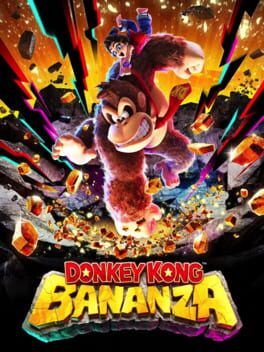
Donkey Kong Bananza turns Nintendo’s original mascot into the star of a Super Mario Odyssey‑style 3D epic. We break down its open zones, terrain tech, traversal, and why it’s quietly becoming the Switch 2’s most enduring platformer.
Donkey Kong has spent decades as Nintendo’s perennial side act. He anchored the arcade era, reinvented himself in the Donkey Kong Country trilogy, then mostly played supporting roles while Mario and Link fronted Nintendo’s biggest experiments.
Donkey Kong Bananza on Switch 2 finally changes that. It is a confident, fully modern 3D platformer built to sit beside Super Mario Odyssey rather than under it. The result is a game that feels immediately familiar to Odyssey fans, yet leans into Donkey Kong’s brute strength and earthy slapstick in ways that make it distinct, strange, and surprisingly enduring.
Bananza did not launch as the most hyped Switch 2 exclusive, but it is steadily becoming one of the system’s defining long-tail hits. Its open zones and terrain tech invite obsessives to keep coming back months later, long after the credits roll.
An underground Odyssey for Nintendo’s first star
Structurally, Donkey Kong Bananza borrows from Super Mario Odyssey’s playbook. Instead of linear worlds or short, objective-based levels, Bananza gives players big, semi-open sandboxes. Each one is a slice of the planet’s crust, stacked as you descend with DK and his unlikely partner, teenage Pauline, on a quest for a wish-granting power at the world’s core.
Where Odyssey framed its kingdoms as wide plazas of playful movement challenges, Bananza’s layers feel like excavations waiting to happen. Forest canopies sit atop fragile caverns. Rusted mine rails loop through volcanic pockets. Every surface invites you to hit it, uproot it, burrow under it, or otherwise ruin its day.
Collectibles follow the familiar Nintendo loop, but they are woven into exploration rather than dangled at the end of strict obstacle courses. Bananas, relics, and special crystals are everywhere, often hidden behind a bit of creative destruction or a traversal route you did not notice at first glance. The structure supports short sessions perfectly, yet rewards long stretches where you keep saying “just one more find” for hours.
Open zones that feel like toys, not just stages
Each major area in Bananza is closer to a toy box than a traditional stage. You are not just running from the start to the goal. You are prying at every seam of the world.
One moment you are sprinting across a jungle canopy, swinging between colossal vines that double as physics-driven bridges. The next, you punch the ground, shatter a cracked plateau, and tumble into an underground lake that was invisible from the surface. From there, a mine-cart rail emerges, spiraling you up and out into a cliffside village that becomes the new hub for that layer.
Nintendo EPD clearly internalized what made Odyssey’s kingdoms so sticky. There is always a nearby point of interest, a curious silhouette in the distance, or a suspiciously placed enemy formation suggesting there is something more if you veer off the obvious path. Bananza adds another twist though: most of those distractions ask you to reshape the world, not just parkour through it.
Traversal built around power instead of finesse
If Mario is about momentum and precise jumps, Donkey Kong is about impact. Bananza’s moveset sells that difference immediately.
DK can still roll, jump, and hand-slap, but the Switch 2 sequel builds a traversal system that turns those basics into a destructive toolkit. The roll is now a controllable charge that chews through weak rock, knocks down trees, and punts enemies into one another. The classic ground pound sends a shockwave through the floor, briefly highlighting breakable terrain, hidden tunnels, and secret caches in a way that doubles as an exploration “radar.”
Wall-climbing, swinging, and rail-riding layer on top of this core. Vines and ropes are less about delicate timing and more about leveraging DK’s weight to swing huge distances or rip fixtures out of the environment. Rails are no longer just straight rollercoaster tracks. Some dive into the earth like drills, letting DK corkscrew into new zones as chunks of the environment crumble around him.
All of it is tuned to feel immediate. Multiple previews and reviews have called out how quickly the new moveset clicks. You hop into a zone and, within minutes, you are chaining roll-charges, ground-slap radars, vine swings, and wall bounces as if this were the way Donkey Kong always moved.
Terrain tech that makes the world feel punchable
The real star of Bananza might be its terrain technology. Siliconera singled the game out as a showpiece for what Switch 2 can do beyond simple resolution bumps, and that praise is deserved.
Nearly every layer of the world reacts to DK. Soft earth deforms with each roll, leaving furrows that eventually collapse into trenches. Rock faces crumble in layered chunks, revealing tunnels or rare minerals inside. Trees splinter, topple, and become temporary platforms or barricades. Lakes can be drained or flooded depending on what you smash or unblock.
Importantly, this is not just cosmetic. Bananza continually ties terrain changes to secrets and traversal. Punch out the supports under an old mine tower and it does not just fall; it falls in a direction you can plan around, bridging a gap or cracking open an otherwise unreachable cliff. Roll through mud enough times and you might carve a new slope that funnels rolling boulders into a hidden wall, freeing an optional challenge room.
On older hardware, this sort of systemic destruction would likely be tightly gated. On Switch 2, Bananza throws it at you from the opening zone and rarely lets up. It is one of the first platformers on a Nintendo system where literally hitting the ground running reveals as many secrets as careful platforming.
Rethinking the Donkey Kong formula
Nintendo has tried 3D Donkey Kong before, but Bananza feels like the first time the series has fully reconciled its arcade and Donkey Kong Country identities in three dimensions.
From the arcade days comes the idea that levels are machines. Structures are made of ladders, girders, and movable parts that change state as you interact with them. Bananza borrows that spirit at a far grander scale. Whole zones are interlocking devices you can reroute and dismantle.
From the Country trilogy and Retro’s Returns and Tropical Freeze, Bananza takes the focus on secrets, side paths, and kinetic setpieces. Those famous barrel cannons show up as more than just scripted launchers; now they are tools that can be aimed into weak walls or fired through destructible layers of the environment. Classic mine-cart sequences return, but many are now embedded in the open zones as optional routes that reveal shortcuts, throw you into hidden sub-levels, or even change the layout of the overworld.
Even the partnership with Pauline rethinks series tradition. Instead of a damsel, she is a companion whose voice-based powers act as a secondary verb for co-op and puzzle-solving. In a light two-player mode, one person drives DK while another controls Pauline’s off-screen targeting, using her “thrown” words to detonate objects, trigger switches, or absorb properties from nearby materials. It is more active and engaged than Odyssey’s Cappy mode, and it quietly cements Pauline as a modern co-star instead of a nostalgic cameo.
Open-ended challenges that invite experimentation
Bananza keeps clear goals in every zone, but it rarely dictates an exact route. Objectives, mini-bosses, and puzzle shrines sit at the center of flexible networks of paths and shortcuts. Because you can alter terrain, no two players carve precisely the same course.
A simple example sees you trying to reach a relic locked inside a spiky geode suspended over a lava pool. One player might pound distant pillars until a buried rail rises, then ride a mine cart that jumps through the geode. Another might tunnel under a nearby cliff, find a cluster of explosive barrels, and chain them together to blast the geode sideways into a safer platform. A more advanced player might improvise a ramp out of debris by selectively smashing supports and using DK’s extended roll to vault up to the relic directly.
These scenarios are not fully systemic like an immersive sim, but they feel broader than classic “find the one intended trick” platforming. When Bananza is at its best, you are playing with ideas more than hunting for the one correct answer.
Why it is built for the long haul
So why is Donkey Kong Bananza becoming such a long-tail favorite instead of a one-and-done launch novelty?
Part of it is the obvious appeal of the exploration loop. The open zones are dense enough that you can revisit earlier layers later in the game with new knowledge and a more confident grasp of DK’s abilities, only to discover whole tunnels and challenges you missed. Players who like methodically combing worlds for collectibles have a lot to chew on, but the act of traversal is so enjoyable that it rarely feels like checklist drudgery.
Post-launch support is another factor. Nintendo has already bolstered Bananza with updates and DLC, most notably the DK Island & Emerald Rush expansion. That add-on reimagines Donkey Kong’s home turf as a modern, explorable hub that folds in iconic sights like DK’s Treehouse and the Gangplank Galleon, along with a time-attack style mode that encourages skilled players to master traversal routes. It gives veterans fresh reasons to play with terrain shortcuts and movement tech long after they have seen the ending.
Socially, Bananza also benefits from being the kind of game people love to show off. Clips of improbable saves, ridiculous environmental chain reactions, or co-op chaos with Pauline’s voice powers spread easily. Word-of-mouth from reviews and communities that position it as a spiritual follow-up to Odyssey has slowly reframed it from a curiosity to a must-play for platformer fans buying a Switch 2.
Finally, Bananza fills a vital gap in the Switch 2 library. Early in a console’s life there is often a hunger for big, expressive platformers that really lean on the hardware. While fans wait for Nintendo’s next mainline 3D Mario, Donkey Kong Bananza steps into that role with unexpected confidence.
A new benchmark for 3D Donkey Kong
Donkey Kong Bananza will not replace Super Mario Odyssey in the platformer canon, but it does something arguably more important for Nintendo’s original mascot. It proves that DK can headline a modern, ambitious 3D adventure that stands shoulder to shoulder with Mario and Link.
By grounding its Super Mario Odyssey style open zones in a world that is meant to be smashed apart, Bananza builds a unique identity out of Donkey Kong’s physical comedy and raw power. Its traversal feels joyful, its terrain tech makes exploration tactile, and its structure is tuned for players who love to keep picking at a game long after its story wraps.
In the Switch 2 era, Donkey Kong is no longer just the second banana. Bananza finally gives him the sprawling, inventive playground he has always deserved, and it is the kind of 3D platformer that only seems to grow richer the more time you spend swinging through its underground world.