
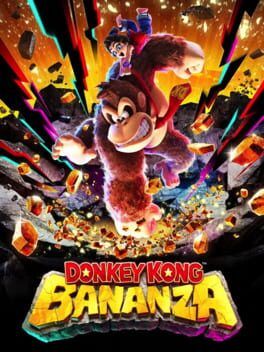
A design deep dive into how Donkey Kong Bananza’s chaos‑first sandbox exploration rewires Nintendo’s classic Mario platforming philosophy, from Super Mario 64 to the Switch 2 era.
Nintendo has spent nearly three decades teaching players that its 3D platformers are about control. From the moment you nudge the analog stick in Super Mario 64’s Peach’s Castle and feel Mario’s arc-perfect triple jump, the message is clear: this is a game about precision first and exploration second. Donkey Kong Bananza doesn’t reject that heritage, but it inverts the priorities. Instead of sculpted routes and exacting jumps, Bananza asks a different question: what if the world crumbles before your movement, and the joy comes from the mess you leave behind?
In Bananza, the Switch 2’s new DK outing, Nintendo turns its sandbox instincts toward chaos. The result is a game where the movement feel, level structure and even the camera are tuned to celebrate volatility. To understand how bold that shift is, you have to track Nintendo’s design philosophy from Super Mario 64 through Sunshine and Galaxy, into Odyssey, and then down into Bananza’s noisy underground.
From empty courtyard to analog playground: Mario sets the template
Shigeru Miyamoto has often described Super Mario 64’s Peach’s Castle as a space where it should be fun just to move around, even if there is nothing to do. The castle interior is a safe, mostly flat arena meant to showcase the feel of the new analog stick: gentle runs, tiptoeing, wide arcs into wall jumps and that iconic triple jump. The world is a stage for moves you execute with surgical intention.
The level design bends around that idea. Bob-omb Battlefield and Whomp’s Fortress are essentially courses: slopes, ledges and enemy placement are tuned to test your ability to start and end a jump exactly where you intend. Sunshine’s Delfino Plaza refines this further, using fluid roofs and awnings as a network of lines that reward players who can chain FLUDD-assisted jumps on a tight rhythm. Even when the games flirt with openness, they are still about knowing precisely where your character’s feet will land.
Later Mario sandboxes like Super Mario Odyssey keep the freedom but preserve the discipline. New Donk City is dense and non-linear, yet beneath the exploration lies an invisible graph of optimal routes and skill checks: cap bounces that barely clear gaps, wall jumps that line up with fire escapes and lampposts you can vault off for extra height. Nintendo’s rulebook through all of this is clear: exploration is meaningful because the space is authored around precision.
Donkey Kong Bananza flips the axis: movement as controlled chaos
Donkey Kong Bananza starts from that same Mario 64 foundation that movement should feel satisfying in an empty space. The key difference is how it defines “satisfying.” Where Mario aims for tight responses and clean arcs, Bananza leans into weight, momentum and impact.
Donkey Kong’s basic run in Bananza has heft. He accelerates with a small but perceptible delay, and his stop has a skid that feels closer to drifting a shopping cart full of bricks than piloting a cartoon acrobat. His jump is high enough to matter, but the landing is the real punch. A ground pound doesn’t just stun enemies, it leaves a crater, kicks chunks of debris outward and slightly shuffles the camera so you feel the shock.
The designers push that sensation through every core action. A running shoulder charge chews through dirt walls and shatters stone arches into cascading fragments. Throws are less about finely tuned aim and more about hurling barrels or rocks into crowds to see what breaks. The transformations follow the same philosophy. Zebra-DK stretches your top speed and turning radius until you are careening across slopes, clipping corners and generating a path of gouged earth without ever losing readability. Ostrich-DK turns aerial control into a wobbly balancing act where flapping too hard or banking too late can send you smashing through ceilings or crashing into scaffolding.
It sounds wild, but there is discipline behind the noise. Inputs still map cleanly to actions and animation priority is high, which means DK never feels slippery in the way some physics-driven characters can. Instead, Bananza widens the window of “acceptable outcomes.” Rolling slightly off your intended path is not a failure if it caves in a wall and reveals a secret shaft. Falling short of a clean landing can drop you into a nest of breakable fossils that lead to a shortcut. Nintendo’s core joy-of-movement rule remains, but it now measures satisfaction by how interesting the result is, not how exact.
Level structure: from courses to caverns that collapse
The strongest contrast with Mario is in how levels are assembled. Traditional 3D Mario stages are layered obstacle courses. Even in their most open forms, like Odyssey’s Sand Kingdom, you can sketch clean lines from point A to point B that reveal tightly spaced jumps and handcrafted enemy encounters.
Donkey Kong Bananza builds its world like a cross-section of a planet-sized ant farm. Each major zone is a vertical slice of the underground, stacked with strata of rock, ruins and industrial leftovers. At first glance you see platforms, ramps and ledges in familiar Mario fashion. But nearly everything that looks like scenery is also material. Dirt, brittle stone, old mine supports and technicolor crystal are all destructible in different ways and with different resistances.
That single decision unhooks level structure from “course design” and reorients it around affordances. A tall pillar in a Mario stage is a fixed traversal challenge. In Bananza, that same pillar might be a ladder if you climb it, a ramp if you knock it over, or a tunnel entrance if you smash straight through its core. Designers still plant key routes and set-piece moments, but they accept that players will constantly redraw those routes by breaking things.
Mission objectives reinforce this philosophy. Many goals are placed high above the ground or deep inside rock faces with deliberately ambiguous approach vectors. Reaching a banana temple perched on a cliff can involve carefully hopping up via a subtly marked series of ledges, or you can simply tunnel upward from below, punching through hollow-sounding rock until the floor of the temple gives way. Where Mario tends to say “here is the way, can you execute it,” Bananza asks “what can you do with the tools and materials in arm’s reach?”
This turns even simple tasks into mini sandboxes. Digging for Banandium Gems might start as following a glowing indicator, but quickly becomes a negotiation between curiosity and restraint. You can burrow too deep and create a problem for your return route. You can over-smash supports and transform a neat cavern into a Swiss cheese of improvised ledges. Every crater you leave behind is persistent, a physical diary of your experiments.
Chaos-first exploration: curiosity over mastery
Mario’s sandboxes reward mastery. Once you learn a technical move like the cap bounce into wall jump into dive, entire new paths open; the world is a puzzle box designed for your growing precision. Donkey Kong Bananza shifts the reward structure toward curiosity.
The most lucrative discoveries often hide not at the end of a tricky jump sequence but behind a hunch. A slightly discolored wall, a suspiciously hollow echo when you ground pound or a column of dust leaking from a ceiling can all signal secrets. The destruction mechanics are not just spectacle. They are your primary exploratory verbs, joined to the same input set as movement and combat.
Because so many surfaces can be carved, the game constantly tempts you to deviate from clear routes. You might be on your way to chase Void Kong deeper into the world’s core, only to spot a fragile-looking stalactite and detour to see what happens if you drop it. Twenty minutes later you are in a hidden music club nestled in a cavern, having reached it by punching open a wall that was never part of the “main” plan.
Nintendo mitigates potential aimlessness by tightly curating each zone’s footprint. This is not a true open world, but a network of large sandboxes with concise boundaries. The space inside those boundaries, however, is pliable. Where Mario’s rooms feel like stages, Bananza’s feel like toy boxes that you can upend and rearrange. Exploration is less about learning the one right route and more about stress testing the environment to see what surprising shapes it can take.
Camera and readability: managing the mess
Letting players shatter the playspace raises immediate readability problems. Mario’s camera, especially in Odyssey, is tuned for clarity above all else. It floats out to show you upcoming jumps, snaps into tight tracking for linear sequences and rarely allows the environment to occlude hazards.
Bananza’s camera has to do something trickier: frame usable information in a space that is constantly changing shape. It tends to sit further back, embracing a slightly wider field of view to give you context for the pits and tunnels you are creating. During intense destruction, there is a modest dip and zoom out that provides a clearer picture of flying debris without obscuring DK’s position.
UI support fills in the gaps. A clever map system layers a scan of the world over your current location, showing the tunnels you have carved and the rooms you have opened. This is not just a fast-travel utility but a design crutch to keep chaos legible. It lets Nintendo safely encourage extreme experimentation, knowing that players can always reorient themselves.
In movement design terms, it is an elegant compromise. Mario removes friction by making spaces perfectly readable so your only challenge is execution. Bananza accepts visual noise as part of the fantasy and instead gives you tools to zoom out, literally and figuratively, on the complexity you have created.
Character identity as design driver
Underneath all of these systems is a simple observation: Mario and Donkey Kong are different characters, and Nintendo finally treats their games as different species of platformer instead of cousins.
Mario is nimble, polite and expressive. His jumps are balletic, his spin moves project control and his games celebrate meticulous problem solving. Donkey Kong, especially in Bananza, is rude to architecture. The entire design premise is “what would it feel like to give this gorilla a whole planet of stuff he is allowed to break?”
That character-first thinking is present in older Nintendo work, but here it becomes the organizing principle. In Super Mario 64, movement was tuned in a vacuum first, then levels were built as obstacle courses around the resulting move set. In Bananza, DK’s destructive power is the starting constraint. The team accepts that any wall that can be broken will be broken and then asks how to turn that inevitability into a source of playful discovery rather than sequence breaking.
It leads to moments that would be unthinkable in Mario. A puzzle intended to be solved by redirecting minecarts along rails might be trivialized if you simply punch through the blockage. Instead of closing that loophole, Bananza quietly rewards you with a different collectible or shortcut, acknowledging your lateral thinking. The game’s design respects cleverness in the same way Mario respects technical mastery.
Evolution of Nintendo’s control philosophy
Taken in the long view, Donkey Kong Bananza feels like a pivot point in Nintendo’s philosophy on character control.
Super Mario 64 established the creed that analog movement must feel good in an empty room. Sunshine and Galaxy layered scenario design and movement gimmicks on top of that creed, but never questioned precision as the ideal. Odyssey broadened exploration and loosened structure, yet still treated the environment as a mostly static testing ground for your growing skill.
Bananza keeps the creed and changes the metric. The design concern is no longer “does this move let you land exactly on that ledge,” but “does this move create interesting outcomes even when you miss?” Careful tuning ensures DK is responsive enough to avoid frustration, yet his interactions are noisy enough that every action can generate an unexpected angle, a new passage or an emergent problem to solve.
Technically, this is made possible by the Switch 2 hardware’s ability to track much more persistent environmental state: destroyed chunks, altered terrain, debris piles. Philosophically, it shows a Nintendo newly comfortable with giving up some directorial control in exchange for player-authored play. The studio that once feared players “breaking” a level now ships a flagship platformer whose central loop is breaking levels as often and as joyfully as possible.
Mario’s precision, DK’s chaos and what comes next
Donkey Kong Bananza does not replace Mario’s precision-driven 3D platformers. Instead, it complements them by staking out a different corner of the design space. Mario remains the yardstick for clean, authored challenge that celebrates mastery of a tight move set. Bananza is the cousin who hands you a shovel and asks what happens if we dig until we cannot dig anymore.
For Nintendo, the lesson is powerful. Movement feel and character control no longer have to serve only one fantasy. In Bananza’s case, the fantasy is being an unstoppable force reshaping a brittle world, and every stick tilt, button press and leap is calibrated to support that fantasy, even when it leads to chaotic, imperfect outcomes.
Tracing the arc from Peach’s Castle to the caverns of Bananza, you can see a studio evolving from total authorship of space to a kind of shared custody. Nintendo still builds the toys, but now it lets Donkey Kong, and by extension the player, smash them into new configurations. If Super Mario 64 taught us that it is fun just to move, Donkey Kong Bananza argues that sometimes it is even more fun to move in a world that refuses to stay tidy.